
Digital Twin Verification, Validation and Uncertainty Quantification (VVUQ) for Rail Infrastructure: A Methodology Guide for UAE Rail PhD Research
- Why this is a research problem, not a modelling task
- Verification and validation are different questions
- The validation hierarchy, and what it fixes
- Choosing the validation metric before you look
- Model-form uncertainty: the term most twins set to zero
- Sensitivity analysis: what the twin is actually sensitive to
- Bayesian data assimilation: updating without overwriting
- What the UAE rail context actually constrains
- Data access and instrumentation
- Study design checklist
- Research questions
- Contribution, and what a reviewer will ask

Recent Post
Building a digital twin is now the easy part. Proving it is accurate is what ends badly at viva — because “the model agrees well with the sensor data” answers only one question, while an examiner may ask three.
Who is this for: PhD scholars in civil, structural, mechanical and systems engineering, and supervisors scoping digital-twin projects on rail infrastructure in the UAE and GCC.
Scope. This article separates published evidence, cited to source, from research hypotheses, labelled as such, and design guidance. It is not an engineering assessment, a safety case, an inspection or maintenance regime, or advice on operating any rail asset.
1. Why this is a research problem, not a modelling task
The field’s own review literature says the gap is real. A 2026 systematic review of digital twins for railway infrastructure maintenance concludes that most studies remain “conceptual or pilot-scale, with limited validation under real operating conditions”, reports that over 70% of the IoT railway implementations reviewed were tested only on restricted testbeds or single routes, and cautions that the benefits circulating in the literature are “indicative trends from pilot studies rather than universal performance guarantees” [7].
That figure concerns IoT railway implementations specifically, not railway digital twins as a whole, and should not be restated more broadly than that.
That is the opening a thesis can occupy. The contribution is not another twin; it is a validation methodology that states in advance what evidence would make the twin credible and within what scope.
Scope the VVUQ to a component, not to “the twin”. A digital twin may contain several models, data pipelines, state-estimation components and interfaces. VVUQ should therefore be scoped to a specific model or component and its intended use, rather than treating “the digital twin” as one homogeneous computational object. Most of what follows is model-level VVUQ; whole-twin credibility is the sum of those scoped assessments plus the interfaces between them.
2. Verification and validation are different questions
Conflating them is the commonest defect. The established formulation separates them:
- Verification asks whether the equations are solved correctly. Two parts: code verification, that the implementation does what the mathematics specifies, and solution verification, that discretisation in space and time has converged [2].
- Validation asks whether the right equations are being solved, by comparison against the physical system. Two parts: conceptual validation of the model’s design, and empirical validation against the real asset or an acceptable alternative, with the source data itself assessed for relevance and accuracy [2].
Both sit inside VVUQ, the framing used by the ASME standard for computational solid mechanics [1]. NASA-STD-7009B requires the credibility assessment to address uncertainty and to record the verification and validation domains [2]; its implementation guide, NASA-HDBK-7009B, sets out how that is done in practice [10]. For a thesis, reporting the uncertainty attached to each substantive prediction or validation result — quantitatively, qualitatively, or as an explicit statement that none is available — is a defensible implementation of that principle, and is what the checklist in §12 asks for.
3. The validation hierarchy, and what it fixes
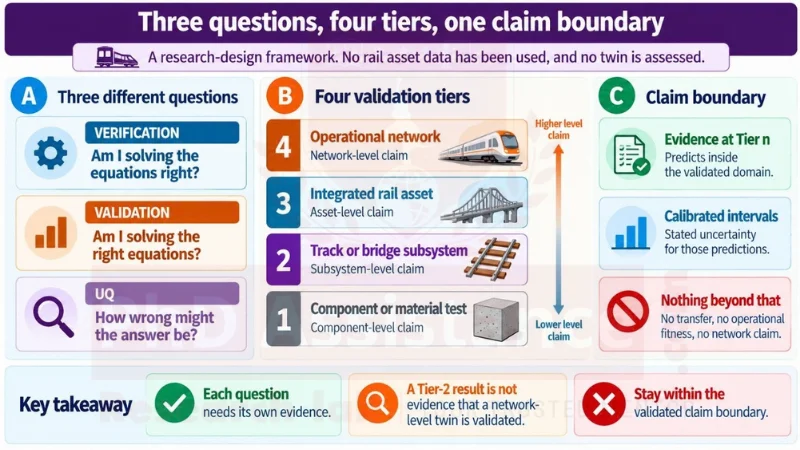
Figure 1. Three questions, four tiers, one claim boundary. Panel A separates verification, validation and uncertainty quantification; Panel B gives the four validation tiers and the claim each supports; Panel C states the resulting claim boundary. The figure is a design framework and contains no rail asset data.
Validation is not a single event. The canonical treatment organises it as a validation experiment hierarchy, from unit problems up to the complete system [3]. The trade-off is structural: data is abundant and clean at the bottom tier, scarce and confounded at the top, while relevance to the asset runs the other way.
The methodological consequence is straightforward. A twin validated at component level is validated at component level. Claiming more requires evidence at that tier, or a defended argument that lower-tier evidence transfers.
|
Tier |
UAE rail example |
Evidence |
Legitimate claim |
|
1 |
Rail component or material specimen |
Controlled laboratory experiment |
Component response |
|
2 |
Track section or bridge subsystem |
Instrumented test section |
Subsystem behaviour |
|
3 |
Integrated rail asset |
Operational monitoring of that asset |
Asset-level prediction |
|
4 |
Operational rail network |
Multi-condition field data across the network |
Network-level claim, within the validated domain |
A Tier-2 result cannot be presented as evidence that a network-level digital twin is validated. Stating which tier was reached is the cheapest defence available at examination.
4. Choosing the validation metric before you look
A validation comparison needs three things fixed in advance: the quantity of interest, the validation metric measuring agreement between model and measurement, and the acceptance criterion deciding whether that agreement is adequate for the intended use. Choosing the metric or acceptance criterion after inspecting the validation results risks post-hoc decision-making and can weaken the credibility of the validation. The metric should account for measurement uncertainty in the referent data, not only the model’s spread.
Predeclaring a metric is not the same as knowing how to choose one, so choose it from the validation objective:
|
Validation objective |
Candidate metric |
When useful |
Limitation |
|
Systematic offset |
Mean error |
Detecting bias |
Hides variability |
|
General accuracy |
RMSE |
Overall prediction error |
Sensitive to outliers |
|
Agreement across scales |
Normalised error |
Quantities of differing magnitude |
Depends on the denominator |
|
Probabilistic prediction |
Interval coverage |
Predictive intervals |
Needs sufficient observations |
|
Dynamic behaviour |
Phase or correlation metrics |
Time-varying response |
Can hide amplitude error |
And define the validation domain, not just the metric. The validation domain is the set of conditions under which agreement has actually been demonstrated. For a UAE rail twin it should name the temperature range, the loading condition, the asset condition, the operating regime, the sensor configuration, the time period and the geographic section. Predictions outside that domain need further validation evidence or a justified transfer argument.
5. Model-form uncertainty: the term most twins set to zero
Parameter uncertainty is easy to acknowledge and to propagate. Model-form uncertainty — the discrepancy between model and reality that no choice of parameters can remove — is the term most often assumed away. The standard statistical treatment makes it explicit, writing the observation as the model output at the calibrated parameters, plus a discrepancy function, plus observation error [4]. Giving discrepancy its own term, rather than letting it hide inside the calibrated parameters, is what stops a twin looking accurate for the wrong reasons.
One warning belongs in any thesis using it: discrepancy and parameters can be confounded, so a flexible discrepancy term can absorb genuine parameter error and yield physically implausible calibrated values that still fit well. Constrain the discrepancy with physical reasoning, and report the calibrated parameters so their credibility can be judged.
6. Sensitivity analysis: what the twin is actually sensitive to
Before calibration, establish which inputs matter. Variance-based global sensitivity analysis apportions output variance across inputs and their interactions, with estimators and designs available for the total-effect index [5]. One-at-a-time perturbation is no substitute for a model that may contain important interactions, as an infrastructure twin typically does.
Two uses. Screening: inputs with negligible total effect can be fixed. Diagnosis: an input engineering judgement says should matter, but the indices say does not, signals that the model structure or parameter ranges are wrong — a finding, not a nuisance.
7. Bayesian data assimilation: updating without overwriting
A model that lacks the data connection and state-update mechanism expected of a digital twin may be better characterised as a static or offline model. Data assimilation can turn a static or periodically updated model into a dynamically state-updated digital-twin implementation; the methodology should therefore test whether assimilation improves the twin’s predictive performance rather than assuming that updating alone establishes twin status. The practical question is how to update without letting the newest reading overwrite what the physics knows.
Sequential Bayesian methods carry an explicit state uncertainty that sets how much weight a new observation receives. The ensemble Kalman filter is a widely used sequential state-estimation method for high-dimensional systems, propagating an ensemble of states and updating it against observations with their own error covariance [6]. Three decisions belong in the methodology: what is state and what is parameter; how observation error is specified, including correlated sensor error; and how often assimilation runs relative to the dynamics.
And a hypothesis worth testing rather than asserting: that assimilation improves accuracy at the tier the thesis cares about. Assimilation can improve nowcast agreement while degrading forecast skill, and a design reporting only the former has not tested the claim.
8. What the UAE rail context actually constrains
The national network is recent, and that is a methodological fact rather than background colour. The UAE Government portal states that Etihad Rail’s network extends 900 km, that the 2023 expansion links all seven emirates from Ghuwaifat to Fujairah, and that an earlier 264 km line from Shah and Habshan to Ruwais has operated since 2016 [8]. Freight operations began across the UAE in 2023, while national passenger services entered operation on 30 June 2026, on the Abu Dhabi to Fujairah route [9].
Three consequences. Monitoring histories are short, so a design cannot assume years of in-service data at Tier 4 and should say what it does assume. Environmental loading differs from the temperate networks the literature is mostly built on — high ambient temperature, large diurnal swing, and sand and dust ingress are contextual factors requiring empirical parameterisation rather than assumption. Treating imported parameter ranges and degradation models as hypotheses rather than defaults is research-design guidance here, not an empirical UAE finding. And the network now carries both freight and passenger traffic [8,9], so the loading spectrum is itself something the design must characterise rather than inherit.
9. Data access and instrumentation
This is the feasibility gate, settled before the proposal. A credible study needs sensor records with known provenance and calibration state, a maintenance log, and enough channels to observe what the model predicts. Access to operational rail infrastructure data is a major feasibility risk, and no established research-access route was identified in the sources reviewed for it. Work down this order: a collaboration agreement with the infrastructure manager, with a named contact and written terms; an instrumented test section or rig, accepting the tier limit that imposes; and a simulation study with synthetic observations, declared as such. Infrastructure data is security-sensitive as well as commercially sensitive — settle disclosure terms and publication rights before collection.
10. Study design checklist
|
Dimension |
Evidence to hold before submission |
Risk if unresolved |
|
Verification |
Code and solution verification recorded, with the domain [2] |
Numerical error read as physical behaviour |
|
Validation tier |
The hierarchy level reached, stated [3] |
A component result claimed for a network |
|
Validation domain |
Conditions under which agreement was demonstrated |
Predictions made outside what was tested |
|
VVUQ scope |
The specific model or component assessed, not “the twin” |
Whole-twin credibility assumed from one part |
|
Metric and criterion |
Both declared beforehand |
Validation becomes curve-fitting |
|
Model-form uncertainty |
A discrepancy term estimated, not assumed zero [4] |
Accuracy for the wrong reasons |
|
Sensitivity |
Variance-based indices, computed before calibration [5] |
Calibrating what does not matter |
|
Assimilation |
State/parameter split, observation error, cadence [6] |
Sensor noise absorbed as physical change |
|
Uncertainty reporting |
An interval with every result, or an explicit statement [2] |
A credibility gap the examiner will name |
|
Data access |
A named contact and a signed agreement |
A major feasibility risk |
11. Research questions
RQ1 (primary): at which hierarchy tier can a digital twin of a UAE rail asset be validated with the monitoring data realistically obtainable, and what validation domain results? Design and estimation, not hypothesis testing. RQ2: how large is the model-form discrepancy once represented explicitly, and does including it change the calibrated parameters materially [4]? RQ3: which inputs dominate output variance, and does that ranking match engineering expectation [5]? RQ4: does assimilation improve predictive accuracy outside the assimilation window, not only within it [6]? RQ5 (exploratory): do parameter ranges imported from temperate networks remain credible under UAE environmental loading?
12. Contribution, and what a reviewer will ask
A completed thesis would deliver a verified model with its verification domain recorded; a validation result at a named tier with a pre-declared metric and criterion; an explicit discrepancy term; sensitivity indices justifying what was calibrated; an assimilation scheme with stated assumptions; and predictions with intervals. The scope limit is the contribution’s frame, not its weakness.
Common weaknesses that require revision: verification skipped; “good agreement” offered as validation; the metric chosen after the comparison; discrepancy assumed zero; local sensitivity on an interacting model; assimilation reported only inside its own window; and a component-tier result presented as a validated network twin.
Need to validate your digital twin research design before you build it?
The problem: a twin that cannot be defensibly validated at the tier its claim requires. The intervention: a VVUQ and research-design review. The deliverable: written methodological recommendations. The outcome: a validation scope and methodology you can put in front of a supervisor.
PhD Assistance can review the proposed VVUQ framework, the validation tier and domain, the uncertainty treatment and the assimilation design, to identify methodological weaknesses while they are still cheap to fix.
Request a Digital Twin Research Design Review with PhD Assistance’s research-methodology team. You receive a written recommendations summary for a supervisor meeting, covering whether the proposed validation evidence supports the claim you intend to make, which quantities are identifiable from the sensors you will have, and what must be recorded before modelling begins. The consultation advises on methodology; you carry out the research.
Related support: PhD research proposal development · PhD data analysis and statistics · PhD literature review support
Frequently asked questions
asks whether the equations are solved correctly — code correctness and numerical convergence. Validation asks whether the right equations were chosen, by comparison against the asset. A twin can be perfectly verified and still wrong, and reporting only agreement with data leaves verification undemonstrated [1,2].
Not on its own. An examiner can ask at which tier the comparison was made, what metric and criterion were set beforehand, whether convergence was demonstrated, and what uncertainty the prediction carries. Close agreement answers none of the four.
Reporting only parameter uncertainty implies the model structure is correct — the assumption most likely to be challenged. Representing discrepancy explicitly is the standard route [4], though it can be confounded with parameters, so calibrated values need a plausibility check.
A validation domain defines the operating conditions under which a model has been demonstrated to reproduce the behaviour of the referent system with acceptable agreement. It can include load, temperature, asset condition, operating regime, sensor configuration and geographic scope. Predictions outside that domain require additional validation evidence or a justified transfer argument.
Not automatically. Transfer is a claim needing its own evidence — validation on the second section, or a defended argument that loading, environment and condition are equivalent. State scope limits in the thesis rather than discovering them in the viva.
Reference
- American Society of Mechanical Engineers. V&V 10-2019 (R2025), Standard for Verification and Validation in Computational Solid Mechanics. New York: ASME; 2019, reaffirmed 2025.
- National Aeronautics and Space Administration. NASA-STD-7009B, Standard for Models and Simulations. Revision B, approved 5 March 2024. NASA Office of the Chief Engineer. https://standards.nasa.gov
- Oberkampf WL, Roy CJ. Verification and Validation in Scientific Computing. Cambridge: Cambridge University Press; 2010. ISBN 978-0-521-11360-1
- Kennedy MC, O’Hagan A. Bayesian calibration of computer models. J R Stat Soc Series B Stat Methodol. 2001;63(3):425–464. doi:10.1111/1467-9868.00294
- Saltelli A, Annoni P, Azzini I, Campolongo F, Ratto M, Tarantola S. Variance based sensitivity analysis of model output. Design and estimator for the total sensitivity index. Comput Phys Commun. 2010;181(2):259–270. doi:10.1016/j.cpc.2009.09.018
- Evensen G. The ensemble Kalman filter: theoretical formulation and practical implementation. Ocean Dyn. 2003;53(4):343–367. doi:10.1007/s10236-003-0036-9
- Kazemi MJ, Rashidi M, Kang W-H, Siahkouhi M. Toward smart railway infrastructure predictive and optimised maintenance through digital twin (DT) system. Sensors. 2026;26(8):2333. doi:10.3390/s26082333. Correction published 28 May 2026: Sensors. 2026;26(11):3430.
- Government of the United Arab Emirates. Railways. Official UAE Government portal. https://u.ae/en/information-and-services/transportation/railways
- Passenger train service launched in the UAE. Railway Gazette International. 2 July 2026. https://www.railwaygazette.com/passenger/2026/07/02/passenger-train-service-launched-in-the-uae/
- National Aeronautics and Space Administration. NASA-HDBK-7009B, NASA Handbook for Models and Simulations: An Implementation Guide for NASA-STD-7009B. Version B, Change 0; document date 3 February 2026. NASA Office of the Chief Engineer. https://standards.nasa.gov