
Ancestry-Specific Recalibration of Polygenic Risk Scores for Early-Onset Type 2 Diabetes in Emirati Nationals Using Whole-Genome Sequencing Data
Sustainable Practices in Environmental Science
- Why early-onset type 2 diabetes is a high-value PhD target in the UAE
- What a polygenic risk score measures — and what it does not
- Why risk scores built on European cohorts lose accuracy in Emirati populations
- Separating early-onset type 2 diabetes from MODY: phenotype definition is a design decision
- Data access, ethics approval and genomic governance for UAE-based research
- How to turn this blueprint into an approvable PhD proposal
- Request a genomics topic feasibility and proposal review

Recent Post
A PhD on ancestry-specific polygenic risk score (PRS) recalibration for early-onset type 2 diabetes (T2D) in Emiratis is approvable only when five decisions are fixed early: phenotype, data source, recalibration method, validation metrics and clinical-utility claim. This blueprint shows how.
Who this is for: PhD applicants, early-stage scholars and supervisors in medical genetics, bioinformatics, endocrinology and public-health genomics at UAE institutions; GCC scholars can adapt it.
Scope: this is research-design guidance for a doctoral project. It is not clinical, diagnostic or genetic-counselling advice, and it must not be used to interpret an individual’s genetic result. Regulatory and data-access requirements change; confirm them with your research ethics committee and the relevant health regulator before submission.
The research-design pipeline at a glance
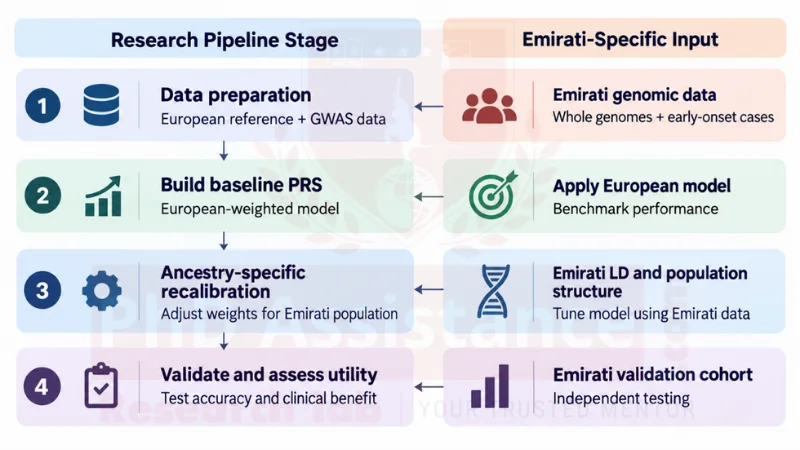
Research-design pipeline from GWAS summary statistics to baseline PRS, ancestry-specific recalibration, validation and clinical utility, with the Emirati-specific input for each stage
Each stage can form a major methodological component of the thesis, subject to the final study design and supervisor approval. Each right-hand box is the Emirati-specific input that makes the work a recalibration rather than application of a European score.
1. Why early-onset type 2 diabetes is a high-value PhD target in the UAE
The topic combines a large disease burden, a new national genomic resource and a documented gap in ancestry-matched prediction.
2. What a polygenic risk score measures — and what it does not
A PRS ranks people by inherited common-variant liability within one population. It is not a diagnosis or an absolute risk.
PRSi = Σj β̂j × Gij, summed over the M variants in the score (j = 1 … M)
Here G is the allele dosage (0, 1 or 2) for person i at variant j, and β̂ is that variant’s weight. A proposal must name four inputs:
- GWAS summary statistics: for T2D, the multi-ancestry meta-analysis of 2,535,601 individuals reporting 1,289 signals at 611 loci [8]. Check how many Arab or Gulf cohorts contributed.
- An LD reference panel: European panels are the usual default and a major source of error when the target population differs [9].
- Variant selection and weighting: thresholds or Bayesian shrinkage (Section 5).
- A target cohort: Emirati genomes, split so that tuning and testing never overlap.
A standard PRS does not capture rare monogenic (MODY) variants, non-additive effects or age at onset unless these are modelled explicitly.
3. Why risk scores built on European cohorts lose accuracy in Emirati populations
In the Saudi Arab cohort above, the standard European T2D score gave an OR per SD of 1.41, against 1.82 in a matched UK Biobank European sample [3]. Across 17 traits, Martin et al. reported European-derived prediction accuracy 1.7-fold lower in South Asians, 2.5-fold lower in East Asians and 4.9-fold lower in Africans [9]. Accuracy also falls continuously with genetic distance from the training data, even within one labelled ancestry group [10]. Because the EGP population spans African, Asian and European ancestry components [5], accuracy may vary between Emirati individuals as well.
Mechanism | Effect | Thesis response |
LD differences | European tag SNPs mark causal variants less well | Build an Emirati LD panel from EGP |
Allele-frequency differences | Emirati-common risk variants may be missing from European GWAS | Report divergence; test EGP-specific variants |
Effect-size heterogeneity | Per-allele effects may differ by background or environment | Allow ancestry-specific effects |
Qatar evidence stated precisely. In a Qatar Biobank whole-genome study of 2,765 T2D cases and 8,671 controls (with prediabetes participants added to the control group for the score evaluation), the European-derived PGS000036 gave an AUC of 0.56 and the multi-ancestry PGS000804 an AUC of 0.66 in score-only models. In an age- and sex-matched subset, the AUCs were 0.61 and 0.65, both below published European performance [11]. A second Qatar Biobank study benchmarked 140 published T2D scores; the best, PGS004838, predicted progression to T2D with a hazard ratio per SD of 1.79 [12].
4. Consanguinity, runs of homozygosity and population structure: analytic implications
A 1997 UAE study reported consanguinity rising from 39% to 50.5% within one generation [13]; current rates should be taken from recent sources. In the 43,608-genome EGP preprint, the median inbreeding coefficient and cumulative runs-of-homozygosity (ROH) length were elevated, largest in groups with Arabian main ancestry, and higher than values reported for Qatar [5]. If this is not handled, validation results will be inflated.
- Relatives leak across splits: estimate kinship (e.g. KING [14]) and split by family.
- Cryptic relatedness inflates GWAS: use mixed models such as REGENIE [15] or SAIGE [16].
- Tribal and regional structure: adjust for Emirati-specific principal components and report results by stratum.
- Recessive effects: test ROH burden as an exploratory covariate.
- Uneven accuracy: report performance by genetic-distance bin [10].
5. Recalibration methods compared: clumping and thresholding, LDpred2 and PRS-CSx
PRS-CSx is proposed as the primary multi-ancestry method, with clumping and thresholding (C+T) and LDpred2 retained as prespecified comparators on identical Emirati splits. No method is assumed superior: in the Saudi Arab study, no single scoring method outperformed the others across all traits [3].
| Method | How it works | Strength | Emirati limitation |
|---|---|---|---|
| C+T (PLINK, PRSice-2) [19] | Keeps the lead SNP per LD clump below a p-value threshold | Transparent, fast | Discards signal; European clumping may mis-tag Emirati LD |
| LDpred2 [18] | Bayesian shrinkage given an LD matrix; the auto mode needs no tuning set | Often improves on C+T | Single-ancestry; needs a matched LD matrix |
| PRS-CSx [17] | Shared shrinkage prior across ancestries; ancestry-specific weights combined on a tuning set | Borrows power from large GWAS; used in recent multi-ancestry T2D work [20] | Needs an Emirati LD panel and ideally an Emirati GWAS |
| Fine-mapping or local-ancestry methods | Upweight likely causal variants or adjust by ancestry segment | Potentially better transfer | Compute-heavy and still maturing; exploratory only |
Proposed design: give PRS-CSx non-overlapping, ancestry-stratified T2D summary statistics (for example, the separate European, East Asian, South Asian, African and admixed American strata of the multi-ancestry meta-analysis, where released [8]) plus an Emirati GWAS run on the EGP discovery partition. Pair each with its matching LD reference panel, including an EGP-derived panel for the Emirati input. Do not also supply the combined multi-ancestry meta-analysis: it already contains the European cohorts, so those samples would be counted twice. Confirm that no individual in the external GWAS or the Emirati discovery set appears in the tuning or test sets.
Sensitivity analyses: European versus Emirati LD panel; with versus without the Emirati GWAS; early-onset versus all-onset outcome.
6. Separating early-onset type 2 diabetes from MODY: phenotype definition is a design decision
If monogenic diabetes, type 1 diabetes or LADA contaminate the cases, the score is trained on a mixed outcome [2]. MODY has been estimated to account for approximately 1–5% of diabetes in some populations; a population-based Qatar study estimated 2.2–3.4% [21]. These figures justify phenotype purification but should not be assumed to represent Emiratis. A registered Tawam Hospital study notes that no UAE MODY prevalence data exist to date [22].
Case definition to adapt with the supervisor:
- Diabetes by repeated HbA1c or glucose results, a coded diagnosis or glucose-lowering medication (phenoEGP).
- First qualifying record before age 40.
- Exclude type 1 diabetes and LADA (insulin from diagnosis, autoantibodies, coded type 1).
- Exclude individuals carrying pathogenic or likely pathogenic variants in prespecified MODY-associated genes, classified with an appropriate clinical variant-classification framework (e.g. ACMG/AMP [23]) and reviewed in phenotype context.
- Exclude secondary and gestational-only diabetes.
Controls need normal HbA1c and ideally follow-up past age 40. Validate the algorithm against chart review and report its positive predictive value.
7. Validation metrics examiners expect: discrimination, calibration and reclassification
Report the measures below on a held-out Emirati test set, with 95% confidence intervals and against a clinical-only baseline, following TRIPOD+AI [24] and the Polygenic Risk Score Reporting Standards [25]. AUC alone is insufficient.
| Domain | Measures | Reporting requirement |
|---|---|---|
| Discrimination | AUC/C-statistic; OR per SD; sensitivity and specificity if a clinical threshold is relevant | Prespecify how the PRS is standardised and apply it consistently across training, tuning and testing, without information leakage |
| Calibration | Calibration-in-the-large, calibration slope, calibration plot; Brier score where appropriate | Applies only to models that output absolute risk (Models A–C in Section 10). A raw standardised PRS is a ranking, not a probability, so it cannot be calibrated on its own |
| Incremental value | ΔAUC; likelihood-ratio test for nested models; categorical NRI [26] | Use NRI only with risk categories that are prespecified and clinically justified before analysis |
| Clinical usefulness | Decision-curve analysis (net benefit) [27] | Prespecify the threshold-probability range and the clinical decision it represents (e.g. referral for earlier screening) |
| Validation design | Family-aware split; bootstrap optimism correction; external validation if available | State which results are internal and which are external |
Report onset before 40 and at 40 or later separately, with a time-to-event model as a secondary analysis.
8. Data access, ethics approval and genomic governance for UAE-based research
Data access, not analysis, is usually the critical path. Federal Decree-Law No. 49 of 2023 Regulating the Use of the Human Genome applies to all human-genome uses in the UAE, including free zones (Art. 2), and entered into force on 1 December 2023 (Art. 48) [28]. The provisions most relevant to this PhD are summarised below; this is a research-planning summary, not legal advice.
| Provision | Article [28] | Implication for the PhD |
|---|---|---|
| Written, explicit informed consent on the Health Authority’s approved form | Art. 6 | Confirm the original EGP consent covers PRS research |
| New consent needed to use collected samples for additional purposes | Art. 7(7) | Check whether secondary use of samples needs re-consent |
| Samples may not be transferred or stored outside the UAE except as the Health Authority determines or approves | Art. 7(9) | Plan all sample handling inside the UAE |
| Genome research must meet the legislation on scientific and clinical research; results kept confidential | Art. 18 | University and regulator ethics approvals are required |
| Genomic and genetic data kept confidential; no use leading to discrimination | Art. 25(1)–(2) | Aggregate outputs only; no individual-level release |
| Research containing UAE Genome Programme data may be published only with approval of the Minister or Head of the Health Authority | Art. 25(3) | Build publication approval into the timeline |
| Employers and insurers may not require or use genetic screening results, with defined exceptions | Arts 19–20 | Frame the thesis away from these uses |
| National Genomic Database; licensing of genome research facilities | Arts 26, 28 | Work through licensed, authorised custodians |
The two EGP preprints report approval from the Department of Health – Abu Dhabi and a university or regulator research ethics committee, with data accessed under a Data Access Agreement in a secure environment [5, 6].
Approval checklist:
9. Sample size, power and computational feasibility
The binding constraint is the number of confirmed early-onset cases in the test set, not the total number of genomes.
Compute: WGS quality control, the Emirati LD panel and mixed-model GWAS need cluster resources, parallelised by chromosome. Restricting PRS work to well-characterised common SNPs keeps matrices tractable. Confirm cores, storage and software rules in the secure environment.
Indicative timeline (3–4 years): months 0–6, protocol and approvals; 6–12, onboarding, quality control and phenotype validation; 12–20, LD panel and GWAS; 20–30, PRS builds and internal validation; 30–40, clinical models and external validation; 40–48, writing and publication approvals.
10. From risk score to clinical utility: integrating PRS with clinical predictors
The question is whether the PRS adds information beyond routine clinical predictors. In the 5,399-person Saudi Arab cardiovascular-care cohort, T2D prevalence was 31.9% in the bottom PRS decile and 74.9% in the top, and scores were associated with disease independently of conventional risk factors [3]. That cohort is high-risk and hospital-based, not a representative Emirati population.
- Model A: age, sex, BMI, family history and HbA1c.
- Model B: Model A plus the recalibrated PRS.
- Model C: Model B plus PRS × BMI and PRS × age interactions.
- Model D: the PRS alone at a young age, before clinical markers change. This is a ranking model; it needs refitting as a probability model before any calibration claim.
Plausible uses include earlier screening of genetically high-risk young adults and targeting of prevention programmes. Frame results as evidence toward implementation, not a recommendation for individual testing.
11. PhD Assistance PRS Research Feasibility Matrix
The matrix compares data sources by methodological scope and access dependency. Identify one primary design and one lower-risk fallback.
| Data source | Methods supported | Metrics achievable | Approval risk | Feasibility assessment |
|---|---|---|---|---|
| EGP whole genomes + phenoEGP [5, 6] | C+T, LDpred2, PRS-CSx with Emirati LD and GWAS; ROH aims | Full set, including calibration of Models A–C, NRI and time-to-event | Medium–high | Highest methodological scope if access is confirmed within the proposed timeframe |
| Hospital case–control with new sequencing | All three, with an external LD panel | AUC, OR per SD, R²; calibration limited by case–control sampling | Medium | Suited to clinician-researchers with site access; limited for NRI |
| Population cohort with genotypes (e.g. UAE Healthy Future Study [30], if genotype data exist) | All three, with a proxy LD panel | Full set; incident outcomes possible | Medium | Potential external-validation option; availability must be confirmed |
| Public summary statistics only | Benchmarking and simulation | Simulated accuracy only | Low | Fallback design with limited clinical-validation scope |
| Regional cohort (e.g. Qatar Biobank [11]) | Transfer testing | AUC, OR per SD, calibration | Medium–high | Potential secondary or stretch objective |
A proposal is more defensible when it demonstrates data-access contingency planning rather than assuming access. If you are unsure which row fits your situation, the feasibility review described at the end of this article maps your data access against this matrix.
12. How to turn this blueprint into an approvable PhD proposal
State the research questions, one primary aim with a measurable endpoint, the evidence gap, the expected limitations and the contribution, and pair every data dependency with a fallback.
Evidence gap map
| Study | Population and design | PRS evaluated? | Gap left |
|---|---|---|---|
| Elashi et al. 2024 [11] | Qatar Biobank WGS GWAS; 2,765 cases, 8,671 controls | Yes: European vs multi-ancestry | Not Emirati; no early-onset focus or MODY exclusion |
| Aliyu et al. 2025 [12] | Qatar Biobank; prediabetes and progression | 140 published scores benchmarked | No recalibration; not Emirati |
| Shim et al. 2023 [3] | 5,399 Saudi Arab cardiovascular-care patients | Yes: Arab-optimised score | Hospital cohort; not Emirati or early-onset |
| Mousa et al. 2025, preprint [5] | 43,608 Emirati genomes; population genetics | No | Structure and ROH data; no disease PRS |
| Al-Safar et al. 2015 [7] | 272 Emirati T2D cases, 216 controls; candidate genes | No | Single variants only |
Research questions:
- RQ1: How much discrimination does a published European-derived T2D PRS lose for early-onset T2D in Emiratis, compared with its reported performance in Europeans?
- RQ2: Does recalibration with PRS-CSx, using an Emirati LD panel and an Emirati GWAS, improve discrimination over C+T and LDpred2 on the same family-aware, held-out test set?
- RQ3: Does the best-performing score add discrimination, calibration within an absolute-risk model and net benefit over a clinical model of age, sex, BMI, family history and HbA1c?
- RQ4 (exploratory): Does score performance vary by genetic distance, ancestry stratum or ROH burden?
Aims: (1) validate an early-onset T2D phenotype algorithm that excludes monogenic diabetes; (2) build an Emirati LD panel and discovery GWAS; (3) compare C+T, LDpred2 and PRS-CSx; (4) evaluate incremental clinical value. Stretch aim: external validation. Primary endpoint: prespecified (e.g. ΔAUC or liability-scale R² against the best European score), justified by the power analysis.
Expected limitations to state in the proposal:
Contribution statement: the thesis would contribute (1) an early-onset T2D phenotype algorithm for Emirati health-record data, validated against chart review and purified of monogenic diabetes; (2) an Emirati LD reference panel and discovery GWAS summary statistics, released within the limits of Art. 25(3); (3) a head-to-head comparison of three PRS methods in a consanguineous Gulf population; and (4) evidence on whether an Emirati-recalibrated PRS adds value to clinical prediction of early-onset T2D.
Design weaknesses to address before submission: data access assumed without evidence; outcome not defined by type, onset age and exclusions; a single method with no comparator; overlapping GWAS inputs; AUC-only validation; calibration claimed for a raw score; relatedness ignored; compute and approval timelines not costed; clinical claims beyond the research design.
Request a genomics topic feasibility and proposal review
PhD Assistance’s bioinformatics and biostatistics team reviews your topic against this blueprint. You receive:
To start, share: your draft topic or research questions, your target university and programme, and what you currently know about data access. The review supports your own proposal writing; it does not replace it.
Frequently asked questions
1. Is ancestry-specific PRS recalibration original enough for a PhD?
It can be, if the thesis produces new population-specific resources rather than only applying an existing score. Typical original contributions are an Emirati LD reference panel, an Emirati discovery GWAS feeding a multi-ancestry method, a validated early-onset T2D phenotype algorithm that excludes monogenic diabetes, and a prespecified evaluation of added clinical value. Confirm originality with a documented literature search.
2. Why not use a published European type 2 diabetes polygenic risk score?
European-derived scores lose accuracy in populations genetically distant from their training data. In a Saudi Arab cohort, a European T2D score gave an odds ratio per SD of 1.41, against 1.82 in matched Europeans, while an optimised score reached 1.83 [3]. The PhD tests whether a similar gap exists in Emiratis and whether recalibration closes it.
3. Do I need whole-genome sequencing data?
Imputed array data can support PRS construction. Whole-genome sequencing adds three capabilities this topic benefits from: screening cases for pathogenic variants in MODY-associated genes, building an Emirati LD panel without imputation bias, and testing Emirati-specific variants. Whether WGS is available depends on the dataset and access route confirmed with the data custodian.
4. Which PRS method should be the primary method?
PRS-CSx is a reasonable proposed primary method because it combines ancestry-stratified GWAS with ancestry-specific LD. It should not be presented as superior in advance, because method performance varies by trait and population [3]. Prespecify C+T and LDpred2 as comparators, run all three on identical family-aware splits, and let the held-out test set decide.
5. How many early-onset cases are needed?
There is no fixed number. The required test-set size depends on the anticipated AUC, case/control ratio, desired confidence-interval width and validation design. Because the number of confirmed early-onset Emirati cases is not published, request a feasibility count from the data custodian first, then run a formal precision or power calculation before fixing the aims.
6. What if data access is delayed?
Plan for it. Start with chapters that need no individual-level Emirati data, such as method benchmarking with public summary statistics, simulation of LD-panel effects and the systematic review. Keep a documented fallback design from the Feasibility Matrix, and build regulator, custodian and publication approvals under Federal Decree-Law No. 49 of 2023 into the timeline.
7. Can the thesis recommend clinical use of the score?
It can report whether the score adds predictive value and net benefit over clinical predictors in a research setting. Decisions about individual genetic testing, risk disclosure or screening policy belong to clinicians, genetic-counselling services and health regulators, and would need prospective evaluation beyond a doctoral research-design study.
References
- International Diabetes Federation. IDF Diabetes Atlas. 11th ed. Brussels: IDF; 2025. United Arab Emirates country profile. org
- Strati M, Moustaki M, Psaltopoulou T, Vryonidou A, Paschou SA. Early onset type 2 diabetes mellitus: an update. Endocrine. 2024;85:965–978. doi:10.1007/s12020-024-03772-w
- Shim I, Kuwahara H, Chen N, et al. Clinical utility of polygenic scores for cardiometabolic disease in Arabs. Nat Commun. 2023;14:6535. doi:10.1038/s41467-023-41985-1
- Emirates Genome Council. Khaled bin Mohamed bin Zayed chairs Emirates Genome Council meeting. News release; March 2025. gov.ae
- Mousa M, Olbrich RM, Wohlers I, et al. The UAE Genome Program: unique genetic insights from 43,608 individuals. medRxiv [preprint, not peer-reviewed]. 2025. doi:10.1101/2025.09.12.25334546
- Alkaf B, Abdulrahman WM, Al Marzooqi S, et al. The Emirati Genome Program enables population-wide penetrance estimation and novel discovery for inherited retinal disease. medRxiv [preprint, not peer-reviewed]. 2025. doi:10.1101/2025.10.14.25337784
- Al-Safar H, Hassoun A, Almazrouei S, Kamal W, Afandi B, Rais N. Association of the genetic polymorphisms in transcription factor 7-like 2 and peroxisome proliferator-activated receptors-γ2 with type 2 diabetes mellitus and its interaction with obesity status in Emirati population. J Diabetes Res. 2015;2015:129695. doi:10.1155/2015/129695
- Suzuki K, Hatzikotoulas K, Southam L, et al. Genetic drivers of heterogeneity in type 2 diabetes pathophysiology. Nature. 2024;627:347–357. doi:10.1038/s41586-024-07019-6
- Martin AR, Kanai M, Kamatani Y, Okada Y, Neale BM, Daly MJ. Clinical use of current polygenic risk scores may exacerbate health disparities. Nat Genet. 2019;51:584–591. doi:10.1038/s41588-019-0379-x
- Ding Y, Hou K, Xu Z, et al. Polygenic scoring accuracy varies across the genetic ancestry continuum. Nature. 2023;618:774–781. doi:10.1038/s41586-023-06079-4
- Elashi AA, Toor SM, Umlai UKI, et al. Genome-wide association study and trans-ethnic meta-analysis identify novel susceptibility loci for type 2 diabetes mellitus. BMC Med Genomics. 2024;17:115. doi:10.1186/s12920-024-01855-1
- Aliyu U, Umlai UKI, Al-Thani NM, Toor SM, Abou-Samra AB, Albagha OME. Genetic risk and polygenic risk score assessment of prediabetes and progression to type 2 diabetes. Diabetes Obes Metab. 2025;27(8):4469–4479. doi:10.1111/dom.16490
- Al-Gazali LI, Bener A, Abdulrazzaq YM, Micallef R, Al-Khayat AI, Gaber T. Consanguineous marriages in the United Arab Emirates. J Biosoc Sci. 1997;29(4):491–497. doi:10.1017/S0021932097004914
- Manichaikul A, Mychaleckyj JC, Rich SS, Daly K, Sale M, Chen WM. Robust relationship inference in genome-wide association studies. Bioinformatics. 2010;26(22):2867–2873. doi:10.1093/bioinformatics/btq559
- Mbatchou J, Barnard L, Backman J, et al. Computationally efficient whole-genome regression for quantitative and binary traits. Nat Genet. 2021;53:1097–1103. doi:10.1038/s41588-021-00870-7
- Zhou W, Nielsen JB, Fritsche LG, et al. Efficiently controlling for case-control imbalance and sample relatedness in large-scale genetic association studies. Nat Genet. 2018;50(9):1335–1341. doi:10.1038/s41588-018-0184-y
- Ruan Y, Lin YF, Feng YCA, et al. Improving polygenic prediction in ancestrally diverse populations. Nat Genet. 2022;54:573–580. doi:10.1038/s41588-022-01054-7
- Privé F, Arbel J, Vilhjálmsson BJ. LDpred2: better, faster, stronger. Bioinformatics. 2020;36:5424–5431. doi:10.1093/bioinformatics/btaa1029
- Choi SW, O’Reilly PF. PRSice-2: polygenic risk score software for biobank-scale data. GigaScience. 2019;8:giz082. doi:10.1093/gigascience/giz082
- Huerta-Chagoya A, Kim J, Mandla R, et al. Multi-ancestry polygenic risk scores for the prediction of type 2 diabetes and complications in diverse ancestries. Lancet Diabetes Endocrinol. 2026;14(7):558–569. doi:10.1016/S2213-8587(25)00405-X
- Elashi AA, Toor SM, Diboun I, et al. The genetic spectrum of maturity-onset diabetes of the young (MODY) in Qatar, a population-based study. Int J Mol Sci. 2022;24(1):130. doi:10.3390/ijms24010130
- gov. Identifying maturity-onset diabetes of the young in Emirati patients. NCT05586594. clinicaltrials.gov
- Richards S, Aziz N, Bale S, et al. Standards and guidelines for the interpretation of sequence variants: a joint consensus recommendation of the American College of Medical Genetics and Genomics and the Association for Molecular Pathology. Genet Med. 2015;17(5):405–424. doi:10.1038/gim.2015.30
- Collins GS, Moons KGM, Dhiman P, et al. TRIPOD+AI statement: updated guidance for reporting clinical prediction models that use regression or machine learning methods. BMJ. 2024;385:e078378. doi:10.1136/bmj-2023-078378
- Wand H, Lambert SA, Tamburro C, et al. Improving reporting standards for polygenic scores in risk prediction studies. Nature. 2021;591:211–219. doi:10.1038/s41586-021-03243-6
- Pencina MJ, D’Agostino RB Sr, D’Agostino RB Jr, Vasan RS. Evaluating the added predictive ability of a new marker: from area under the ROC curve to reclassification and beyond. Stat Med. 2008;27:157–172. doi:10.1002/sim.2929
- Vickers AJ, Elkin EB. Decision curve analysis: a novel method for evaluating prediction models. Med Decis Making. 2006;26(6):565–574. doi:10.1177/0272989X06295361
- United Arab Emirates. Federal Decree-Law No. 49 of 2023 Regulating the Use of the Human Genome. Issued 2 October 2023; in force 1 December 2023. gov.ae
- Hanley JA, McNeil BJ. The meaning and use of the area under a receiver operating characteristic (ROC) curve. Radiology. 1982;143(1):29–36. doi:10.1148/radiology.143.1.7063747
- Taimah M, Ahmad A, Al-Houqani M, et al. Association between obstructive sleep apnea risk and type 2 diabetes among Emirati adults: results from the UAE Healthy Future Study. Front Endocrinol. 2024;15:1395886. doi:10.3389/fendo.2024.1395886