
Critical Review of Jamshed et al.’s non-terrestrial networks for 6G: Integrated, intelligent, and ubiquitous connectivity
Introduction
Development of 6G wireless communications technology would require networks that can deliver ubiquitous and intelligent network connectivity. Non-Terrestrial Networks (NTN) such as satellites, Unmanned Aerial Vehicles (UAVs) and High-Altitude Platforms (HAPs) offer an interesting solution for extending network coverage in areas where implementation of conventional terrestrial technologies is difficult or not economically feasible. Nevertheless, the integration of NTN and TN faces certain issues in terms of latency, path loss, Doppler effect, interference, mobility, spectrum efficiency, and network management.
This critical review focuses specifically on Jamshed et al. (2025), Non-Terrestrial Networks for 6G: Integrated, Intelligent and Ubiquitous Connectivity. The article examines the integration of NTN and TN through 3GPP standardisation activities, advanced beamforming techniques, and Artificial Intelligence (AI). It also presents two numerical use-case demonstrations: an airborne NTN scenario examining UE energy efficiency and a LEO satellite scenario examining system capacity.
This article is a focused critical review of Jamshed et al. (2025), rather than a systematic review of the wider NTN literature. The selected article is treated as the primary study, while its proposed technologies, assumptions, technical challenges, and research opportunities are critically examined to identify directions for future research.
Summary of the article
Jamshed et al. (2025) examine the possible ways NTN can be used with terrestrial infrastructure to realise the vision of ubiquity in 6G. The paper analyses the work done by 3GPP and considers ways in which satellite NTN, UAVs, and HAPs can be used to enable connectivity in areas where terrestrial networks are not available or are hard to set up.
The study identifies transmission delay, path loss, Doppler shift, and interference management as important technical challenges. It reviews developments from 3GPP Release 17 onwards and considers how future releases can support increasingly native integration between terrestrial and non-terrestrial components.
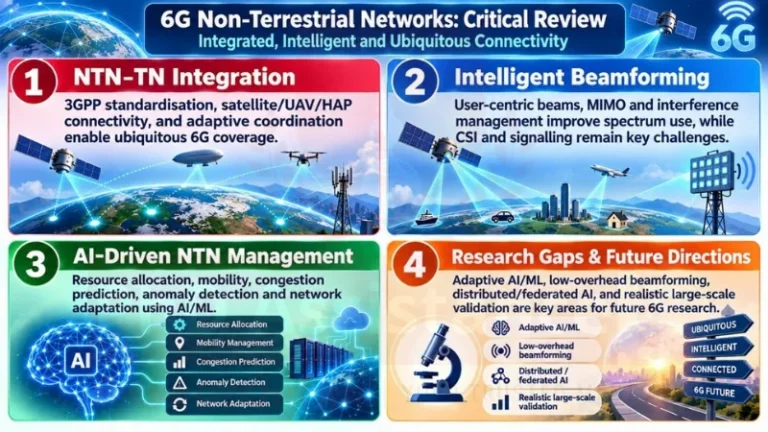
The article also examines user-centric beamforming as a means of improving interference management. In addition, AI is considered for network optimisation, resource management, mobility, congestion prediction, anomaly detection, beam management, and other complex network-control tasks.
Significance and contribution of the field
A major contribution of the article is its integrated examination of NTN-TN coexistence from standardisation, communication, beamforming, and AI perspectives. Rather than treating satellite connectivity as an independent communication system, the study considers NTN as an increasingly integrated component of future mobile networks.
The discussion of 3GPP standardisation provides useful context for understanding how NTN integration is evolving. Release 17 introduced important NTN capabilities, while subsequent releases continue to address mobility, satellite access, backhaul, regenerative payloads, and other requirements.
Another important contribution is the examination of user-centric beamforming. The article argues that dynamically generating beams towards users could improve the use of MIMO capabilities and help address interference, although such approaches still face challenges involving channel-state information, signalling overhead, and standardisation.
For research in 6G Non-Terrestrial Networks, the article provides a useful foundation for examining these technologies while also revealing important areas that require further investigation. Despite its numerical use-case demonstrations, several aspects of practical large-scale deployment remain open, particularly realistic wireless conditions, distributed coordination, AI reliability, and the standardisation of advanced beamforming techniques.
Critical Analysis of NTN Integration for 6G
1. NTN-TN Integration and Standardisation:
The article demonstrates that NTN-TN integration is progressing through successive 3GPP releases. This provides a strong foundation for future networks because standardised integration can improve interoperability and reduce dependence on proprietary systems. The authors identify satellite access, backhaul, mobility, and coverage as important areas of development.
Interpretation:
The standardisation-based approach is valuable because successful 6G NTN deployment will require terrestrial and non-terrestrial components to operate as a coordinated network rather than as isolated systems.
Critical assessment:
The integration remains technically challenging because NTN links have different propagation characteristics, delays, mobility patterns, and capacity constraints compared with terrestrial networks. The article itself notes that it is still too early to establish exactly how NTN will be integrated with future 6G public mobile networks.
Research implication:
Future research should investigate adaptive architectures capable of dynamically coordinating terrestrial and non-terrestrial resources under changing network conditions.
2. Beamforming and Interference Management
The article highlights advanced beamforming as an important mechanism for managing interference in integrated NTN-TN systems. Full frequency reuse can increase spectral efficiency but also produces substantial co-channel interference, requiring techniques such as precoding and MIMO processing.
Interpretation:
User-centric beamforming provides a promising direction because beams can be dynamically generated towards users instead of relying entirely on fixed geographic beam patterns.
Limitation:
The implementation of advanced user-centric approaches requires accurate channel information and can introduce significant computational and signalling overhead. For example, CSI-based approaches may require information from large numbers of antenna elements, creating substantial practical challenges.
Research implication:
Future research could develop AI-assisted beamforming methods that reduce CSI requirements while maintaining interference suppression and system capacity.
3. Artificial Intelligence for Intelligent NTN Management
The article identifies AI as an important technology for managing the complexity of integrated 6G NTN systems. The combination of terrestrial base stations, multiple satellites, heterogeneous quality-of-service requirements, and dynamic user mobility creates network-management problems that can be computationally expensive for conventional model-based approaches.
Interpretation:
Deep learning can provide faster inference for complex optimisation tasks, while reinforcement learning can be used to explore network configurations through interaction with the environment. AI can also support congestion prediction, anomaly detection, interference detection, and network adaptation.
Critical assessment:
Although AI offers significant potential, the article also recognises that AI-enabled NTN systems face limitations. Models depend on appropriate training data and must adapt to changing network environments. The dynamic nature of NTN therefore creates challenges for model reliability and continuous learning.
Research implication:
A significant research opportunity exists in developing adaptive and distributed AI models that can operate reliably across changing satellite and terrestrial network conditions.
Comparison with the Literature
The article provides a broad overview of NTN integration, while related studies address specific aspects such as multi-connectivity, generative models, beamforming, and satellite communication. The reviewed study is particularly valuable because it brings these areas together within the broader 6G integration problem.
| Study | Main Approach | Key Findings | How This Extends/Challenges Jamshed et al. |
|---|---|---|---|
| Jamshed et al. (2025) | NTN–TN integration | Examines beamforming, AI, delay, Doppler, interference, CSI and standardisation. | Provides a broad framework, but individual technologies and deployment assumptions need deeper validation. |
| Guidotti et al. (2024) | Federated cell-free MIMO | Explores distributed and federated beamforming for NTN. | Provides deeper evidence on distributed MIMO and approaches to reduce CSI dependence. |
| Machumilane et al. (2023) | Generative models | Applies generative models to decision-making and traffic scheduling in 6G NTN. | Extends Jamshed et al.’s broad AI discussion into specific network-control applications. |
| Majamaa (2024) | Multi-connectivity | Examines multi-connectivity for NTN reliability and mobility. | Provides an alternative coordination approach beyond beamforming-focused solutions. |
| Toka et al. (2024) | LEO satellite networks | Examines RIS-enabled LEO satellite networks for connectivity and interference management. | Extends the technical options for addressing LEO link and interference challenges. |
| Nguyen et al. (2024) | Network slicing, AI/ML and O-RAN | Examines technologies for flexible and intelligent 6G NTN architectures. | Broadens the integration perspective toward network programmability and operational integration. |
Methodology and Research Design
Jamshed et al. (2025) combine standards and literature analysis with numerical demonstrations to examine integrated 6G NTN–TN connectivity, with emphasis on beamforming, AI and standardisation. The methodological scope can be critically assessed across the network scenarios, modelling assumptions, beamforming approach, AI applications, evaluation measures and external validity.
| Methodological dimension | What Jamshed et al. do | Critical question |
|---|---|---|
| Network scenario | NTN + TN scenarios | Are the scenarios representative of heterogeneous deployments? |
| Channel assumptions | Numerical modelling | How realistic are the propagation and mobility assumptions? |
| Beamforming | User-centric approach | How sensitive are the results to imperfect or outdated CSI? |
| AI | Proposed across management tasks | Are training-data availability and distribution shift adequately addressed? |
| Evaluation | Energy-efficiency and capacity demonstrations | Are these sufficient to support broader deployment claims? |
| External validity | Primarily simulation/numerical | How well do the findings generalise beyond the simulated scenarios? |
System Design: The study considers LEO satellites, UAVs, HAPs, and terrestrial networks, focusing on user-centric beamforming, cell-free MIMO, and multi-connectivity.
Standards Framework: The analysis follows 3GPP NTN developments, particularly issues related to interoperability, beam management, spectrum, mobility, and signalling.
AI and Beamforming: AI is examined for network management, CSI processing, beam management, positioning, and network adaptation, while user-centric beamforming is assessed for improving interference management and network performance.
Evaluation: Numerical demonstrations examine UE energy efficiency in an airborne NTN scenario and system capacity using LEO satellite user-centric beamforming.
Critical Assessment: The methodology provides a useful broad assessment of 6G NTN technologies. However, its reliance on numerical demonstrations limits real-world validation across different mobility, channel, traffic, and deployment conditions.
Theoretical and Interdisciplinary Analysis
The article connects several research areas:
This interdisciplinary perspective is a major strength because successful NTN deployment cannot be addressed through a single communication-layer solution. Network architecture, radio access, spectrum management, AI, mobility, and standardisation must operate together.
The article’s AI discussion is particularly important because future NTN systems will involve dynamic satellite coverage, heterogeneous users, changing traffic demand, and complex network configurations. AI can potentially provide adaptive optimisation under these conditions.
Practical Implementation and Engineering Considerations
Implementation of NTN technology in 6G entails dealing with various technical problems. There are variations in propagation delay, path loss, mobility, and interference between satellites and terrestrial networks. These problems have been identified as some of the major hurdles to the integration of NTN and TN.
Advanced beamforming also introduces implementation challenges. CSI-based beamforming may require substantial signalling and computational resources, particularly when large antenna arrays are involved. Distributed cell-free MIMO additionally requires tight time and frequency synchronisation between NTN nodes.
AI introduces additional engineering challenges related to training-data availability, model updating and adaptation to changing operational conditions. Distributed AI on satellite networks is a good prospect, but inter-satellite as well as ground-to-space communication is an added coordination challenge.
Limitations of the Study
| Limitation | Critical Significance | Required Improvement |
|---|---|---|
| Broad review-oriented approach | Individual technologies receive limited depth | Conduct focused simulation and, where feasible, experimental validation |
| Advanced beamforming remains challenging | CSI and signalling requirements may limit deployment | Develop low-overhead adaptive beamforming |
| AI depends on suitable training data | Changing NTN environments may reduce model reliability | Develop adaptive and continual-learning models |
| Distributed NTN coordination | Satellite cooperation requires synchronisation | Develop robust distributed coordination mechanisms |
| Standardisation is still evolving | Future 6G architecture remains uncertain | Validate solutions against emerging standards |
| Real-world deployment complexity | Simulation may not capture all operational conditions | Conduct realistic large-scale network and deployment-oriented validation |
Table 1. Critical Limitations of the Reviewed Study
Research Gaps from the Study
Research Gap 1: AI-Based Adaptive NTN Resource Management
Jamshed et al. identify AI for resource management, mobility, congestion prediction, and network optimisation, but its reliability under changing NTN conditions remains insufficiently validated. This is consistent with Aygul et al. (2024), whose review highlights the dynamic nature of integrated TN–NTN networks and the need for scalable and adaptive ML-based resource management. Wang et al. (2025) further identify resource management, mobility, and AI-based adaptation as open NTN challenges.
Existing research establishes AI as a potential tool for resource allocation, mobility management and congestion prediction, but its reliability under changing NTN conditions remains insufficiently validated.
Research direction: A doctoral study could investigate adaptive AI/ML resource management under changing satellite visibility, traffic demand and TN–NTN mobility. Performance could be evaluated using resource-allocation efficiency, latency, throughput and QoS metrics.
Research Gap 2: Low-Overhead Intelligent Beamforming
Jamshed et al. identify user-centric beamforming as promising but constrained by CSI, signalling, and computational overhead. This limitation is strongly supported by Wang et al. (2025), who identify outdated CSI, beamforming complexity, and interference management as continuing NTN challenges. The recent Generative AI for NTN review also identifies CSI estimation and beamforming as important areas requiring further development (Adam et al., 2026).
User-centric beamforming can improve interference management, but CSI requirements, signalling overhead and computational complexity remain barriers to practical deployment.
Research direction: A doctoral study could investigate AI-assisted beamforming that reduces CSI and signalling requirements while maintaining spectral efficiency and reliable connectivity. Evaluation could consider interference suppression, spectral efficiency, CSI overhead and computational complexity.
Research Gap 3: Distributed and Federated AI Across Satellite Networks
Jamshed et al. propose distributed AI across satellites and terrestrial infrastructure, but practical validation remains limited. This gap is supported by Zhang et al. (2025), whose review identifies distributed satellite architectures and cooperative intelligence as important emerging technologies. In addition, the 2025 survey on ML for Satellite IoT identifies Federated Learning as an important approach while highlighting limited onboard computing resources and the gap between theoretical and practical deployment (Choquenaira-Florez et al., 2025).
Distributed and federated AI could support cooperative NTN intelligence, but limited onboard computing, bandwidth constraints and dynamic satellite connectivity create unresolved deployment challenges.
Research direction: A doctoral study could develop communication-efficient federated AI for satellite networks and evaluate model accuracy, communication overhead, convergence and computational requirements
Overall Critical Appraisal
| Dimension | Finding | Critical Judgement |
|---|---|---|
| NTN–TN integration | Provides a strong overview of integrated NTN–TN architectures and relevant standardisation developments. | Well supported |
| Beamforming | User-centric and distributed beamforming show considerable potential, but CSI, interference, synchronisation, and computational complexity remain challenging. | Well supported, but validation is limited |
| AI integration | AI can support network management, beam management, CSI processing, and network adaptation. | Broadly supported |
| Scalability | The proposed technologies appear scalable conceptually, but large-scale and heterogeneous deployments require further practical validation. | Requires further validation |
| Standardisation | 3GPP activities provide an important foundation, although several aspects of NTN–TN integration are still evolving. | Partially established |
| Real-world deployment | Delay, Doppler, interference, mobility, signalling overhead, and synchronisation create significant implementation barriers. | Limited validation |
| Research opportunities | The study identifies numerous open problems involving AI, beamforming, interoperability, resource management, and large-scale NTN deployment. | Clearly identified |
Table 2. Critical appraisal of the Reviewed Study
Conclusion
Jamshed et al.’s contribution to the 6G NTN research is significant because they combine NTN-TN integration, 3GPP standards, advanced beamforming, and AI-driven network management. In addition, the paper shows how NTN technology could contribute to extending connectivity toward the goal of ubiquitous 6G connectivity.
The main strength of this research is its comprehensive perspective, which considers not satellite communications, beamforming, or AI in isolation but rather how these technologies may help complement each other in the development of 6G. Yet, most solutions proposed by this paper are either at a research or simulation level or at the level of standardisation.
The strongest future direction is therefore the development of intelligent, adaptive, and distributed NTN architectures capable of dynamically coordinating satellites, airborne platforms, and terrestrial infrastructure. These directions also provide a basis for developing focused doctoral research questions around adaptive NTN coordination, intelligent beamforming and distributed AI.
Developing a PhD Research Gap in 6G NTN?
Identifying a research gap is only the first step. Researchers also need to refine the research problem, develop research questions, justify the methodology and establish appropriate evaluation criteria.
PhD Assistance Research Lab can support researchers with research-gap identification, literature-review strategy, research design, methodology consultation, theoretical framework development and academic editing.
Discuss Your PhD Research Problem with our experts!
Frequently Asked Question
The major challenges include propagation delay, Doppler shift, path loss, interference, mobility, spectrum management, signalling, and coordination between heterogeneous terrestrial and non-terrestrial nodes.
AI can support dynamic resource allocation, mobility management, congestion prediction, anomaly detection, beam management, and network optimisation. However, adaptive AI models still require validation under changing network conditions.
User-centric and AI-assisted beamforming can dynamically direct resources towards users and improve interference management. A key research challenge is reducing the CSI, signalling, and computational overhead associated with these approaches.
Large-scale NTN deployments involve numerous satellites, terrestrial nodes, heterogeneous users, and dynamic network conditions. Scalability is therefore constrained by computational resources, signalling overhead, synchronisation, communication capacity, and the ability of AI models to adapt reliably.
Important gaps include adaptive AI-based resource management, low-overhead intelligent beamforming, distributed and federated AI, robust NTN–TN coordination, and realistic large-scale experimental validation.
Reference
- Jamshed, M. A., Kaushik, A., Dajer, M., Guidotti, A., Parzysz, F., Lagunas, E., Di Renzo, M., Chatzinotas, S., & Dobre, O. A. (2025). Non-terrestrial networks for 6G: Integrated, intelligent and ubiquitous connectivity. IEEE Communications Standards Magazine, 9(3), 86–93. https://doi.org/10.1109/MCOMSTD.2025.3572
- Guidotti, A., Vanelli-Coralli, A., & Amatetti, C. (2024). Federated cell-free MIMO in non-terrestrial networks: Architectures and performance. IEEE Transactions on Aerospace and Electronic Systems, 60(3), 3319–3347. https://doi.org/10.1109/TAES.2024.3362769
- Machumilane, A., Cassarà, P., & Gotta, A. (2023). Towards a fully-observable Markov decision process with generative models for integrated 6G-non-terrestrial networks. IEEE Open Journal of the Communications Society, 4, 1913–1930. https://doi.org/10.1109/OJCOMS.2023.33072
- Majamaa, M. (2024). Toward multi-connectivity in beyond 5G non-terrestrial networks: Challenges and possible solutions. IEEE Communications Magazine. https://doi.org/10.1109/MCOM.001.2300581
- Toka, M., Lee, B., Seong, J., Kaushik, A., Lee, J., Lee, J., Lee, N., Shin, W., & Poor, H. V. (2024). RIS-empowered LEO satellite networks for 6G: Promising usage scenarios and future directions. IEEE Communications Magazine, 62(11), 128–135. https://doi.org/10.1109/MCOM.002.2300554
- Nguyen, C. T., Saputra, Y. M., Huynh, N. V., Nguyen, T. N., Hoang, D. T., Nguyen, D. N., Pham, V.-Q., Voznak, M., Chatzinotas, S., & Tran, D.-H. (2024). Emerging technologies for 6G non-terrestrial-networks: From academia to industrial applications. IEEE Open Journal of the Communications Society, 5, 3852–3885. https://doi.org/10.1109/OJCOMS.2024.34185
- Aygul, M. A., Turkmen, H., Cirpan, H. A., & Arslan, H. (2024). Machine learning-driven integration of terrestrial and non-terrestrial networks for enhanced 6G connectivity. Computer Networks, 110875. https://doi.org/10.1016/j.comnet.2024.110875
- Wang, F., Zhang, S., Yang, H., & Quek, T. Q. S. (2025). Non-terrestrial networking for 6G: Evolution, opportunities, and future directions. Engineering. https://doi.org/10.1016/j.eng.2025.05.013
- Adam, A.B.M., Lagunas, E., Samy, M. et al.Generative AI for non-terrestrial networks: design, applications, and challenges. Journal of Wireless Communications and Networking. 2026, 12 (2026). https://doi.org/10.1186/s13638-025-02549-7
- Zhang, Q., Xu, L., Huang, J. et al.Distributed satellite information networks: architecture, enabling technologies, and trends. China Inf. Sci. 68, 190301 (2025). https://doi.org/10.1007/s11432-024-4408-1
- Choquenaira-Florez, A. Y., Fraire, J. A., Pasandi, H. B., & Rivano, H. (2025). On the role of machine learning in satellite internet of things: A survey of techniques, challenges, and future directions. Computer Networks, 266, 111063. https://doi.org/10.1016/j.comnet.2025.111063