- / Title
PhD Research Directions in ML-Guided Biologic Design for Solid Tumour
Info: PhD Research Directions in ML-Guided Biologic Design for Solid Tumour | phdassistance.com
Published: 10th September 2026 inPhD Research Directions in ML-Guided Biologic Design for Solid Tumour | phdassistance.com
Share this:
Related Services
Introduction
Cancer biology’s increasing complexity and the need for more selective drugs have driven the development of sophisticated methods for solid tumour treatment. Tumour heterogeneity, variability in target expression, and the complexity of the tumour microenvironment make it difficult to develop biologics that can specifically target cancer cells while avoiding harm to normal tissue. In this regard, there is an interest in ML-guided biologic drug design that eases the identification and optimisation of targets and drugs.
Proposed PhD Title 1: Single-Cell Transcriptomics–Guided ML Optimisation of Bispecific Antibody Target Pairs for Selective Solid-Tumour Therapy
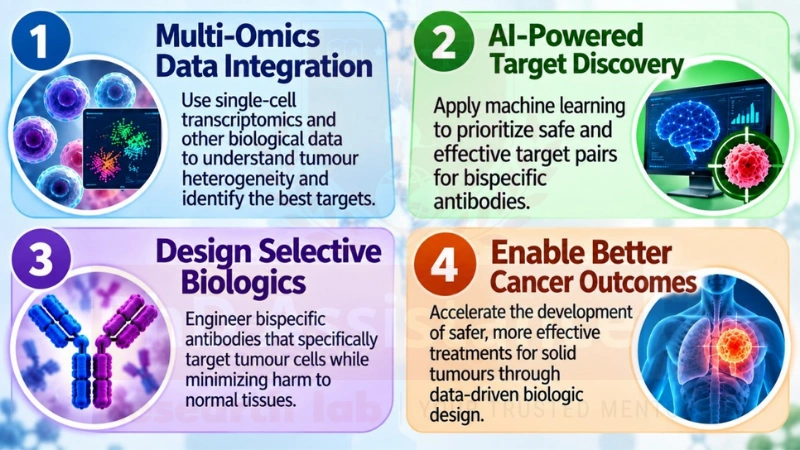
Machine learning can enhance the determination of potentially effective pairs of BsAbs through integration of various biological characteristics, as illustrated by Zhang et al. (2024). BsAbs can bind to two different antigens or epitopes, but their selective targeting relies on such aspects as target expression and localisation, antibody format, target binding and the mode of action. In the BiSpec Pairwise AI study, the scientists have included target safety, biological pathways, gene-gene interactions and single-cell gene expression data in a machine-learning model. The physical properties of antibodies like size, charge and affinity can also play a role in pharmacokinetics and ADME. Computational strategies for BsAb discovery are not fully developed, especially for target pair identification. Bispecific antibodies simultaneously recognize two distinct antigens or epitopes, with their tumour selectivity influenced by target expression, antibody format, and mechanism of action.
Problem Statement:
Current machine learning methods for designing bispecific antibodies cannot sufficiently take into consideration the heterogeneous nature of solid tumours. Expression of targets may differ between tumour and healthy cells, which makes tumour-specific target selection difficult. It is necessary, therefore, to incorporate single-cell tumour microenvironment profiling with target safety, biology and target interactions for better biologic target selection.
Literature Comparison:
| Existing method/study | Demonstrated capability | Remaining limitation | Potential doctoral research direction |
|---|---|---|---|
| Sun et al. (2023) – BsAb target selection | Reviews biological factors in BsAb target-pair selection. | Target selection remains context-dependent. | Incorporate tumour-contextual features into target-pair evaluation. |
| Zhang et al. (2024) – BSPAI | Integrates single-cell, safety, mechanism, and gene-relationship features via pairwise ML. | Limited evaluation of tumour-versus-normal selectivity and external transferability. | Evaluates target-pair robustness and selectivity across independent datasets. |
| Chekalin et al. (2024)-Co-expressed antigen study | Combines bulk, single-cell, and spatial data for target-pair discovery. | Generalisability across tumour contexts unverified. | Assess ML-based target-pair selection across independent tumour contexts. |
Research Gap:
Existing studies show that machine learning can support BsAb target-pair prediction, while single-cell expression provides information on target distribution. BSPAI already studied single-cell expression with target safety, mechanism and gene-relationship features using pairwise learning. The remaining question is whether these predicted target pairs are robust across independent datasets. External transferability and tumour-versus-normal tissue selectivity require further investigation. A potential doctoral research direction is to develop an independently validated framework for assessing the robustness and safety of ML-prioritised BsAb target pairs across heterogeneous solid tumours.
Research Question:
To what extent can machine-learning-prioritised bispecific antibody target pairs demonstrate robust tumour selectivity and transferability across independent single-cell tumour and normal-tissue datasets?
Proposed Methodology and Feasibility:
- Data access: Publicly available single-cell tumour and normal-tissue datasets will be obtained from the Gene Expression Omnibus (GEO) and relevant cancer databases. Datasets will be selected based on adequate sample size and available cell-type information.
- Model and baseline: A BSPAI-style pairwise XGBoost model will be used as the main baseline, with logistic regression and random forest included for comparison. This will allow assessment of predictive performance across different modelling approaches.
- Data validation: Data will be divided at the cohort level to minimise data leakage and improve generalisability. Independent cohorts will be reserved for validation.
- Outcome measures: Model performance will be assessed using AUROC, AUPRC and other relevant classification measures. Biological performance will also consider tumour enrichment and normal-tissue expression.
- External validation: Promising target pairs will be evaluated using independent datasets not used during model development. Spatial transcriptomic data will be considered where available to provide additional biological validation.
- Resource requirements: The study will require standard computational resources and bioinformatics tools for single-cell analysis and machine learning. Experimental validation may be pursued through appropriate research collaboration where feasible.
Outcome:
This research aims to evaluate and extend machine-learning approaches for BsAb target-pair prioritisation across independent single-cell tumour and normal-tissue datasets. An interpretable scoring framework will compare candidate pairs based on predictive robustness, tumour enrichment and normal-tissue expression. The framework will prioritise target pairs with consistent performance for subsequent experimental validation..
Reference:
Zhang, X., Wang, H., & Sun, C. (2024). BiSpec Pairwise AI: guiding the selection of bispecific antibody target combinations with pairwise learning and GPT augmentation. Journal of Cancer Research and Clinical Oncology, 150, 237.
Sun, Y., Yu, X., Wang, X., Yuan, K., Wang, G., Hu, L., Zhang, G., Pei, W., Wang, L., Sun, C., & Yang, P. (2023). Bispecific antibodies in cancer therapy: Target selection and regulatory requirements. Acta pharmaceutica Sinica. B, 13(9), 3583–3597. https://doi.org/10.1016/j.apsb.2023.05
Chekalin, E., Paithankar, S., Shankar, R., Xing, J., Xu, W., & Chen, B. (2024). Computational discovery of co-expressed antigens as dual targeting candidates for cancer therapy through bulk, single-cell, and spatial transcriptomics. Bioinformatics advances, 4(1), vbae096. https://doi.org/10.1093/bioadv/vbae0
Proposed PhD Title 2. A Standardised Machine Learning Drug Design Framework for Solid-Tumour Biologics: Harmonising Data Curation, Model Evaluation and Reproducibility in AI-Based Candidate Discovery
Machine learning has substantial potential to speed up the discovery of therapeutic antibodies. Wossnig et al. (2024) noted that variations in datasets, data processing, evaluation, and performance metrics may make ML-driven antibody research incomparable and non-reproducible. These challenges are particularly relevant to solid-tumour biologics, where datasets may contain diverse molecular, structural, functional and pharmacological information. Rather than developing a general standardisation pipeline, a potential doctoral research direction is to systematically investigate how specific data-curation and validation choices, including duplicate removal, sequence-aware splitting and cross-dataset testing, influence model performance, generalisability and candidate ranking in a defined solid-tumour biologic prediction task.
Problem Statement:
Machine-learning-based biologics discovery is gaining momentum, yet disparities in the datasets used, data processing procedures, criteria of evaluation, and validation methods render the results hard to compare and replicate. This lack of uniformity could lower the reliability of ML-based candidate selections, especially when applied to the challenging area of solid tumour therapy.
Literature Comparison:
| Existing method/study | Demonstrated capability | Remaining limitation | Potential doctoral research direction |
|---|---|---|---|
| Wossnig et al. (2024) – ML best practices | Identifies key issues in data quality, splitting, evaluation and reproducibility. | Provides recommendations rather than testing their effects on model performance. | Systematically test selected curation and validation strategies. |
| Mason et al. (2021) – Antibody sequence-based deep learning | Uses antibody sequences to predict antigen specificity and identify candidate variants. | Model performance may depend on the characteristics and relatedness of training and test sequences. | Compare random and sequence-aware splitting strategies. |
| Wossnig et al. (2024) – Evaluation and reproducibility | Highlights differences in datasets and evaluation methods as barriers to comparing antibody ML models. | The impact of these differences on model and candidate rankings remains to be quantified. | Compare model rankings under harmonised curation and evaluation protocols. |
Research Gap:
Current literature supports the importance of rigorous data curation and evaluation in antibody machine learning, but studies often differ in their treatment of duplicate sequences, data splitting and external validation. It remains unclear how these choices affect reported performance and the ranking of candidate models for a defined solid-tumour biologic prediction task. A potential doctoral research direction is therefore to quantify the impact of these methodological choices using a common dataset, multiple baseline models and independent validation datasets.
Research question:
How do data curation, sequence-aware splitting and cross-dataset validation affect the performance and ranking of machine-learning models for a defined solid-tumour biologic prediction task?
Proposed Methodology and Feasibility:
Outcome:
This research will develop an ML pipeline that is standardised based on data preparation, adherence to FAIR criteria, data splitting, metric measurement, and reproducibility. This will help in comparative analysis of the ML techniques and will allow choosing the right computational models for discovery of solid tumour biology
Reference:
Wossnig, L., Furtmann, N., Buchanan, A., Kumar, S., & Greiff, V. (2024). Best practices for machine learning in antibody discovery and development. Drug Discovery Today, 29(7), 104025.
Mason, D. M., Friedensohn, S., Weber, C. R., et al. (2021). Optimization of therapeutic antibodies by predicting antigen specificity from antibody sequence via deep learning. Nature Biomedical Engineering, 5, 600–612.Optimisation
Proposed PhD Title 3. Mechanism-Informed ML-Guided Biologic Drug Design for Solid Tumours: Integrating Antibody Properties, Target Pharmacology and Target-Occupancy Prediction
Patidar, Pillai, Dhakal, Avery, and Mavroudis (2025) have illustrated the potential of integrating mPBPK modelling with machine learning for evaluating the pharmacology of therapeutic antibodies as candidates. Properties of antibodies like molecular size, charge, affinity, and other physicochemical properties play a role in their pharmacokinetics, ADME and target interaction. In this regard, the authors explored virtual antibody candidates and their targets through high-throughput analysis to identify combinations of properties that would lead to good target occupancy. During this research, the researchers found that antibody dose, dosing regimen, charge, form of target, site of action and target properties could have a significant impact on target occupancy. Nevertheless, optimal values of antibody and target properties might not be clear during early stages of drug development, whereas experimental investigation is costly. Based on the method applied by Patidar et al., an ML-guided, mechanism-informed approach could aid in early selection of candidates and estimation of target occupancy with identification of biologically relevant ranges of properties.
Literature Comparison:
| Existing method/study | Demonstrated capability | Remaining limitation | Potential doctoral research direction |
|---|---|---|---|
| Patidar et al. (2025) – mPBPK–ML framework | Combines antibody/target properties with mPBPK modelling to predict target occupancy. | Mainly uses simulated drug–target combinations without detailed tumour-specific factors. | Extend the framework with tumour-specific target expression, distribution and turnover, with independent validation where feasible. |
| Chen et al. (2021) – mTPA framework | Combines PBPK/PD modelling, sensitivity analysis and ML for early target pharmacology assessment. | Focuses on general early drug discovery rather than tumour-specific occupancy. | Investigate tumour-contextual parameters in target-occupancy prediction. |
| Tang et al. (2021) – Therapeutic antibody PK/PD review | Reviews mechanistic PK/PD, TMDD and PBPK approaches for therapeutic antibodies. | Highlights challenges in tissue distribution and target engagement. | Evaluate whether tumour-specific factors improve occupancy prediction across tumour contexts. |
Research Gap:
Existing mechanistic and ML approaches can predict antibody target occupancy from drug and target properties. Patidar et al. (2025), for example, demonstrated an mPBPK–ML framework using simulated drug–target combinations. However, the influence of tumour-specific factors such as target expression, tissue distribution and target turnover, and the transferability of occupancy predictions to independent experimental data remain to be established. A potential doctoral research direction is therefore to evaluate whether incorporating these factors improves target-occupancy prediction in solid-tumour contexts.
Research Question:
Can tumour-specific target expression, tissue distribution and turnover parameters improve machine-learning-assisted prediction of antibody target occupancy in solid tumours?
Proposed Methodology and Feasibility:
Outcome:
The study will develop and evaluate a tumour-contextual ML framework linking antibody properties, target pharmacology and tumour-specific parameters to target occupancy. The framework will identify influential parameters and assess whether tumour-specific information improves occupancy prediction compared with an existing mPBPK–ML baseline.
Reference:
Patidar, K., Pillai, N., Dhakal, S., Avery, L. B., & Mavroudis, P. D. (2025). Development of an mPBPK machine learning framework for early target pharmacology assessment of biotherapeutics. Scientific Reports, 15, 4198.
Emile P. Chen, Robert W. Bondi, Paul J. Michalski; Model-based Target Pharmacology Assessment (mTPA): An Approach Using PBPK/PD Modeling and Machine Learning to Design Medicinal Chemistry and DMPK Strategies in Early Drug Discovery. J. Med. Chem. 25 March 2021; 64 (6): 3185–3196. https://doi.org/10.1021/acs.jmedchem.0c02033
Tang, Y., & Cao, Y. (2021). Modeling Pharmacokinetics and Pharmacodynamics of Therapeutic Antibodies: Progress, Challenges, and Future Directions. Pharmaceutics, 13(3), 422. https://doi.org/10.3390/pharmaceutics13030422
Proposed PhD Title 4. Multimodal AI-Guided Design of Antibody–Drug Conjugates for Solid Tumours: Joint Optimisation of Antibody–Antigen Binding, Linker–Payload Properties and Tumour Selectivity
Noriega and Wang (2025) discussed the increased use of AI in biologic drug development. Antibody-drug conjugates are composed of monoclonal antibodies and cytotoxic agents that allow their selective delivery to antigen-positive cancer cells. This makes ADCs especially useful in the treatment of solid tumours. Noriega and Wang mentioned that traditional ADC design was limited by empirical screening, lack of complete information on the structures, ineffective selection of linker-payload pairs, and limited experimental throughput. Current applications of AI/ML include antibody structure prediction, identification of conjugation sites, drug-to-antibody ratio prediction, pharmacokinetic models, toxicity prediction, and antibody affinity optimisation. Still, some limitations of AI/ML in ADC discovery and optimisation include data scarcity, model interpretability, validation, and incorporation of multiple components of ADCs into models. This suggests a requirement of multimodal methods of ADC component modelling.
Literature Comparison:
| Existing method/study |
Demonstrated capability |
Remaining limitation |
Potential doctoral research direction |
|---|---|---|---|
| Chen et al. (2025) – ADCNet |
Integrates antigen, antibody, linker, payload and DAR features to predict ADC activity. |
Tumour-contextual features are not a main focus. |
Test whether tumour-related features improve activity/selectivity prediction. |
| Noriega & Wang (2025) – AI-driven ADC design review |
Reviews AI approaches for ADC target, antibody, linker and payload design. |
Highlights data sparsity, validation and biological integration challenges. |
Evaluate selected tumour-contextual features within multimodal models. |
| Nagpal (2026) – ADC activity prediction |
Shows that relatively simple features can provide strong predictive signals for ADC anticancer activity. |
The value of complex features and biological context requires further evaluation. |
Compare multimodal and simpler feature sets with tumour-contextual information. |
Research Gap:
Existing AI-based ADC models, including ADCNet, integrate multiple ADC components to predict activity. However, the value of adding tumour-contextual biological features remains insufficiently established. A potential doctoral research direction is to compare multimodal models with and without these features using a defined endpoint and independent validation datasets.
Research Question:
Does incorporating tumour-contextual biological features improve multimodal AI prediction of ADC activity and tumour selectivity in a defined solid-tumour setting?
Proposed Methodology and Feasibility:
Outcome:
This research will evaluate multimodal AI models for ADC activity prediction and determine whether adding tumour-contextual features improves predictive performance and generalisability. The study will identify the features most strongly associated with ADC activity and tumour selectivity for subsequent experimental evaluation.
Reference:
Noriega, H. A., & Wang, X. S. (2025). AI-driven innovation in antibody-drug conjugate design. Frontiers in Drug Discovery, 5, 1628789.
Chen, L., Li, B., Chen, Y., Lin, M., Zhang, S., Li, C., Pang, Y., & Wang, L. (2025). ADCNet: a unified framework for predicting the activity of antibody-drug conjugates. Briefings in bioinformatics, 26(3), bbaf228. https://doi.org/10.1093/bib/bbaf228
Nagpal S. (2026). Supervisory signals are intriguingly high in even simple features for predicting anticancer effect of antibody drug conjugates. Briefings in bioinformatics, 27(2), bbag108. https://doi.org/10.1093/bib/bbag108
Proposed PhD Title 5. Closed-Loop AI-Guided Biologic Design for Solid-Tumour Therapy: Integrating In-Vitro Experimental Feedback, Tumour-Contextual Modelling and In-Vivo Translational Prediction
Tang et al. (2026) highlight the growing use of AI in biologic drug discovery, including predictive and generative approaches, while emphasising the challenge of translating computational predictions into reliable experimental outcomes. They propose linking computational design with experimental feedback through iterative development cycles. Building on this concept, the proposed research will focus on one defined biologic class and one solid-tumour model, using a limited number of design–test cycles supported by available experimental collaboration. Candidate selection will be compared with a static ML-selection approach to determine whether iterative in-vitro feedback improves prioritisation. Independent in vivo data will be used only if available and will not be a core requirement of the study.
Problem Statement:
AI can support biologic candidate design and optimisation, but computational predictions do not always correspond to experimental activity or tumour response. A key challenge is incorporating experimental feedback into subsequent candidate selection. A potential doctoral research direction is therefore to develop a focused closed-loop ML workflow for one biologic class and tumour model, linking computational design with iterative in-vitro testing and, where suitable data are available, translational modelling.
Literature Comparison:
| Existing method/study |
Demonstrated capability |
Remaining limitation |
Potential doctoral research direction |
|---|---|---|---|
| Tang et al. (2026) – AI in biologic drug discovery review |
Reviews predictive, generative and AI-assisted biologic design. |
Integration of AI prediction with repeated experimental feedback remains challenging. |
Develop a focused ML–experimental feedback workflow. |
| Mason et al. (2021) – Deep learning for antibody optimisation |
Uses deep learning to predict antibody specificity and experimentally validates selected variants. |
Does not implement repeated design–test–learning cycles. |
Tests whether iterative experimental feedback improves candidate prioritisation. |
| Wossnig et al. (2024) – ML in antibody discovery |
Identifies data, validation and reproducibility requirements for ML-based antibody discovery. |
Focuses on evaluation rather than closed-loop experimental optimisation. |
Establishes reproducible evaluation of an iterative ML–experimental workflow. |
Research Gap:
Existing studies demonstrate AI-assisted biologic design and the potential value of integrating computational and experimental data. However, the effect of repeated design–test cycles on candidate prioritisation remains less established for defined biologic and tumour contexts. A potential doctoral research direction is to evaluate whether iterative experimental feedback improves candidate selection compared with a static computational-selection approach.
Research Question:
Can iterative in-vitro experimental feedback improve ML-based biologic candidate prioritisation within a defined biologic class and solid-tumour model?
Proposed Methodology and Feasibility:
Outcome:
The research will develop and evaluate a closed-loop ML workflow linking biologic candidate design with iterative in-vitro experimental feedback. Performance will be compared with a static-selection approach to determine whether repeated design–test cycles improve candidate prioritisation and predictive accuracy. Where independent in-vivo data are available, they will be used for additional translational evaluation.
Reference:
Tang, J., Gong, D., Li, H., & Li, S. (2026). Artificial intelligence in biologic drug discovery: A review of methodological evolution and therapeutic applications. Acta Pharmaceutica Sinica B, 16(7), 3996–4023.
Mason, D.M., Friedensohn, S., Weber, C.R. et al. Optimization of therapeutic antibodies by predicting antigen specificity from antibody sequence via deep learning. Nat Biomed Eng 5, 600–612 (2021). https://doi.org/10.1038/s41551-021-00699-9
Wossnig L, Furtmann N, Buchanan A, Kumar S, Greiff V. (2024). Best practices for machine learning in antibody discovery and development. Drug Discovery Today, 29(7), 104025. DOI: 10.1016/j.drudis.2024.104025
Interested in pursuing research on ML-guided biologic drug design for solid tumours? Explore our PhD research support services for help with research topic selection, proposal development, methodology, and dissertation planning.
Our research methodology consultants can help refine your ideas, identify literature gaps, and guide you toward a topic that aligns with current academic trends and your programme requirements.
Contact us to begin one-on-one topic development and refinement with Phd Assistance Research Lab.
FAQs:
- How is AI used to design biologics for solid tumour targeting?
AI analyses biological data to identify therapeutic targets and prioritise biologic candidates. ML can integrate target expression, biological mechanisms, molecular relationships, and tumour-microenvironment information. It can also support antibody design, target-pair selection, ADC optimisation, pharmacokinetic prediction, and candidate prioritisation.
- How does machine learning improve antibody design for cancer treatment?
ML can predict antibody characteristics such as binding affinity, physicochemical properties, pharmacokinetics, and target engagement. For bispecific antibodies, it can evaluate target combinations and prioritise promising pairs. Single-cell expression data can further support the development of more tumour-selective antibodies.
- Which potential research directions need further investigation?
Potential directions include tumour-selective target selection, reproducible ML evaluation, tumour-specific pharmacokinetic modelling, multimodal ADC design, and closed-loop biologic optimisation. Further investigation is needed to assess their novelty, feasibility, and potential contribution by comparing existing methods, datasets, and reported findings and identifying specific limitations that remain unresolved.
- What research methodologies are used in machine learning-based biologic drug design?
Common methods include machine learning, single-cell transcriptomics, bioinformatics, structural modelling, pharmacokinetic modelling, and experimental validation. Supervised and pairwise learning support target and candidate prediction, while multimodal and ML–PBPK approaches can integrate biological and pharmacological information.
- What are the challenges of using AI for solid tumour drug targeting?
Major challenges include tumour heterogeneity, limited high-quality data, incomplete structural information, data inconsistency, model interpretability, and experimental validation. Translating computational predictions into reliable in vivo therapeutic outcomes remains particularly challenging.
Share this:
Cite this work
PhD Assistance. (n.d.). Machine Learning–Guided Optimisation of Tumour-Selective Biologic Targets for Solid-Tumour Therapy. Retrieved September 5, 2026.
PhD Assistance. “Machine Learning–Guided Optimisation of Tumour-Selective Biologic Targets for Solid-Tumour Therapy.” PhD Assistance, n.d. Web. 5 Sept. 2026.
PhD Assistance. “Machine Learning–Guided Optimisation of Tumour-Selective Biologic Targets for Solid-Tumour Therapy.” PhD Assistance. Web. 5 Sept. 2026.
PhD Assistance (n.d.) Machine Learning–Guided Optimisation of Tumour-Selective Biologic Targets for Solid-Tumour Therapy. Available at: https://www.phdassistance.com/title/ml-guided-biologic-drug-design/ (Accessed: 5 September 2026).
PhD Assistance. Machine Learning–Guided Optimisation of Tumour-Selective Biologic Targets for Solid-Tumour Therapy [Internet]. [cited 2026 Sep 5]. Available from: https://www.phdassistance.com/title/ml-guided-biologic-drug-design/
PhD Assistance. “Machine Learning–Guided Optimisation of Tumour-Selective Biologic Targets for Solid-Tumour Therapy.” PhD Assistance. Retrieved September 5, 2026, from https://www.phdassistance.com/title/ml-guided-biologic-drug-design/
PhD Assistance, ‘Machine Learning–Guided Optimisation of Tumour-Selective Biologic Targets for Solid-Tumour Therapy’ (PhD Assistance, n.d.) https://www.phdassistance.com/title/ml-guided-biologic-drug-design/ accessed 5 September 2026.
Study Resources
Free resources to assist you with your university studies!