
Common Challenges in Green Hydrogen PhD Data Analysis in the UAE
Sustainable Practices in Environmental Science

Recent Post
Introduction
A green hydrogen PhD thesis can be difficult to develop for researchers who have produced a large amount of empirical or model-based data without a well-defined research problem statement. Weak research question formulation, inappropriate analysis, insufficient validation, and weak interpretations may weaken the academic significance of the research.
This is crucial because green hydrogen technologies consist of aspects like hydrogen production, energy efficiency, operating conditions, energy use, cost, and the environment. Consequently, an Effective analysis is therefore important for identifying the factors that influence green hydrogen performance in the UAE.
The UAE provides research environments through Khalifa University, UAEU, the University of Sharjah, and Heriot-Watt University Dubai. For instance, the Research and Innovation Centre on CO₂ and Hydrogen (RICH) at Khalifa University is involved in hydrogen production, storage, modelling, techno-economic studies, and life-cycle assessments.
What you will learn?
What Are the Common Mistakes in Green Hydrogen PhD Data Analysis?
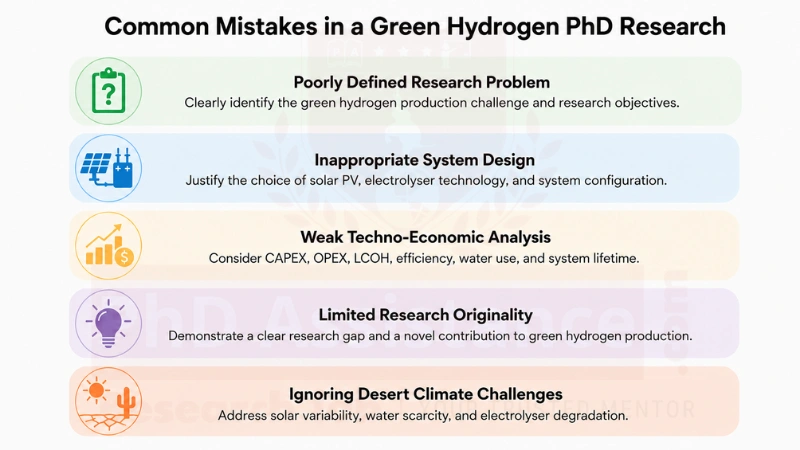
1. Weak or Poorly Defined Green Hydrogen Research Questions
A common problem in green hydrogen PhD data analysis is that one might start the analysis with a certain technology or catalyst without stating the questions being addressed by the analysis. A PhD dissertation might have large datasets, obtained either experimentally or computationally, without clearly associating the variables, methodology and conclusions with a specific question.
An adequately formulated research problem must determine what data is required, the variables to look at, and the way the results will be analysed. For instance, in experimental research, variables may include operating conditions for the generation of hydrogen or efficiency, while in computational research, there may be an analysis of parameters of the model.
A focused approach is to:
Research Example: Khalifa University’s PhD study on hydrogen integration investigated the contribution of hydrogen within the industrial, transport, and electricity sectors and provided an expanded system framework of “green-to-green”. This is an example of a PhD research question that goes beyond merely quantifying hydrogen production to looking at hydrogen’s potential contributions to the overall energy transition of the UAE (Zaiter, 2024).
2. Poor Selection and Justification of Data Analysis Methods
Another significant challenge is the use of either statistical or computational methods without justification as to why they are appropriate for the specific data set.
The choice of the right methodology will depend on the nature of the study question and the data itself. For instance, regression analysis can investigate connections between operating variables and hydrogen production. Time series analysis is used to investigate changes in the efficiency of the system over time; optimisation helps to find better operating conditions, etc.
The method should therefore be selected to answer the research question rather than simply because it is commonly used.
The hydrogen studies of Khalifa University include modelling, optimisation, techno-economics, and environmental impact analysis besides experimental testing. (ku.ac.ae)
Researchers should:
Research Example: A 2025 study from the University of Sharjah produced a multi-layer electrode for seawater electrolysis and assessed several issues, such as chloride attack, surface fouling, stability of the electrode, and electrochemical performance. The paper attained 1.0 A cm⁻² at 1.65 V, which is an example of why green hydrogen research data analysis should focus on performance, stability, and degradation instead of production rates alone (Haq et al.,2025).
A good PhD dissertation should be able to justify the choice of methodology used instead of merely showing graphs, means, correlations, and performance measures.
3. Poor Green Hydrogen Data Management
Green hydrogen experiments and simulations can experience problems with measurements, calibration, variations in operational parameters, unavailability of data, and lack of sufficient replication in experiments.
Even the most sophisticated models can provide misleading results when the initial data is of poor quality.
Data from experiments and computations are only as good as the measurements made, the experimental conditions described and replicated, and the handling of abnormal data.
Researchers should:
4. Limited Originality or Green Hydrogen Research Contribution
Lack of analytical depth can arise where an existing hydrogen technology or data analysis technique is used for another data set but without offering any additional understanding. In postgraduate analysis, data analysis should go beyond providing descriptive results and offer evidence of the analytical contribution to knowledge.
Analytical originality can be demonstrated through:
RICH Centre at Khalifa University involves hydrogen production, storage, modelling, optimisation, techno-economics, and lifecycle assessment, and the University of Sharjah focuses on producing green hydrogen using seawater and wastewater through advanced materials. (ku.ac.ae)
Originality in UAE Green Hydrogen PhD Research could entail a new material, catalyst, methodology for experiments, modelling approach, optimisation strategy, UAE-specific data set or any combination of these.
5. Ignoring Sustainability, Validation, and Practical Application
Green hydrogen technology might emphasise laboratory effectiveness while ignoring factors such as energy efficiency, costs, environmental impact, scale-up, and actual application.
The technology might be capable of producing green hydrogen efficiently, but consume too much energy, use costly materials, or operate under harsh conditions.
Techno-Economic Assessment of Green Hydrogen in the UAE studied a photovoltaic-based system for hydrogen production in the UAE. The techno-economic assessment included technical performance as well as the cost of hydrogen production and the use of renewable energy, showing the significance of both technical and economic performance (Urs et al., 2023).
Researchers should:
Effective analysis should assess whether observed improvements are statistically meaningful and whether their size is large enough to have practical significance. Reporting uncertainty, such as confidence intervals, can also help readers judge the reliability of the findings.
What These UAE Examples Show
Research at Khalifa University, UAEU, University of Sharjah, and Heriot-Watt University Dubai suggests that strong green hydrogen doctoral research will generally need to demonstrate:
Heriot-Watt University Dubai’s doctoral research areas cover energy, renewable technology, hydrogen-based energy, and problems in the UAE and Gulf region. The university’s PhD research requirements cover methodology and expected contribution. (hw.ac.uk)
Addressing these challenges can strengthen the methodological rigour, originality and relevance of a green hydrogen PhD dissertation.
Quick Self-Check
Conclusion
Improper research questions, wrong methods of analysis, poor data management, inadequate validation, and lack of originality may undermine a green hydrogen PhD dissertation.
An effective dissertation should demonstrate a clear research gap, appropriate methodology, reliable data, rigorous analysis of green hydrogen research in UAE, robust validation, reproducibility, and practical relevance.
Looking to strengthen your green hydrogen PhD research? Connect with the experts at PhD Assistance Research Lab for support in research methodology, Green Hydrogen PhD Data Analysis in the UAE, statistical analysis, and dissertation development.
References
- Zaiter, I. (2024). Optimising the UAE’s Energy Sector through Hydrogen Integration for Cost-Effectiveness and Net-Zero Carbon Emissions. Khalifa University, Doctoral Thesis. https://khazna.ku.ac.ae/en/studentTheses/optimizing-the-uaes-energy-sector-through-hydrogen-integration-fo/
- Haq, T. ul, Tahir, A., Smari, M., Al-Haik, M. Y. A., & Haik, Y. (2025). Microenvironment-Engineered Multilayered Electrode Design for Sustainable Seawater Oxidation. Small, 21, 2501376.https://doi.org/10.1002/smll.202501376
- Alghoul, I. J. M. (2026). Ab-initio investigation of 2D materials for VOC-based cancer biomarker detection and hydrogen storage application [Doctoral dissertation, United Arab Emirates University]. UAEU Scholarworks. UAEU Scholarworks
- Urs, R. R., Chadly, A., Al Sumaiti, A., & Mayyas, A. (2023). Techno-economic analysis of green hydrogen as an energy-storage medium for commercial buildings. Clean Energy, 7(1), 84–98. https://doi.org/10.1093/ce/zkac083
- Khalifa University. (n.d.). Research and Innovation Center on CO₂ and Hydrogen (RICH). Khalifa University – RICH Centre
- University of Sharjah. (n.d.). Materials for energy applications. University of Sharjah – Materials for Energy Applications
- University of Sharjah. (n.d.). Renewable Energy Research Laboratory. University of Sharjah – Renewable Energy Research Laboratory
- Heriot-Watt University. (n.d.). PhD Energy, Geoscience, Infrastructure and Society. Heriot-Watt University Dubai – PhD Energy, Geoscience, Infrastructure and Society
References
1. Why does green hydrogen PhD data analysis fail?
It may fail due to unclear research questions, poor-quality data, unsuitable methods, weak validation, and limited interpretation.
2. How to fix green hydrogen data analysis errors?
Define clear objectives, select suitable methods, check data quality, validate results, assess uncertainty, and interpret findings against existing research.
3. What are common green hydrogen data analysis challenges?
Common challenges include limited datasets, missing data, inappropriate statistical methods, overreliance on hydrogen yield, and poor consideration of efficiency, operating conditions, and reproducibility.
4. How is green hydrogen data analysed in PhD research?
Researchers analyse relationships between hydrogen yield, current density, voltage, temperature, pressure, energy consumption, and efficiency using appropriate statistical, modelling, optimisation, and validation techniques.
5. What data analysis methods are used for green hydrogen research?
Common methods include descriptive statistics, correlation, regression, ANOVA, time-series analysis, optimisation, uncertainty and sensitivity analysis, techno-economic analysis, life-cycle assessment, and machine learning.