
5 Common Mistakes in a UK PhD Dissertation on AI in Healthcare
Common Mistakes in AI healthcare

Recent Post
Introduction
An AI healthcare PhD dissertation is not just about building an AI model that works. It is important for researchers to clearly show a healthcare problem, AI methodology, data analysis, validation, and a contribution to healthcare research. Researchers often struggle to identify an appropriate healthcare problem.
Several UK universities have established doctoral research programmes that combine AI, healthcare and clinical research. These include Imperial College London, UCL, Oxford, Leeds, and Bristol. In fact, Leeds University hosts the Centre for Doctoral Training in AI for Medical Diagnosis and Care, which brings AI and clinical research together (University of Leeds, n.d.).
AI in Healthcare PhD Dissertation covers research methodology, AI model development, healthcare data analysis, model validation, and dissertation development, ensuring AI techniques align with healthcare objectives and data requirements.
What will you learn?
- Common mistakes that can weaken AI-healthcare PhD dissertations.
- Research and methodological expectations in UK AI-healthcare research.
- How to improve AI methodology, data analysis, and validation.
- How to demonstrate originality and healthcare relevance.
What Are the Common Mistakes in an AI in Healthcare PhD Dissertation?
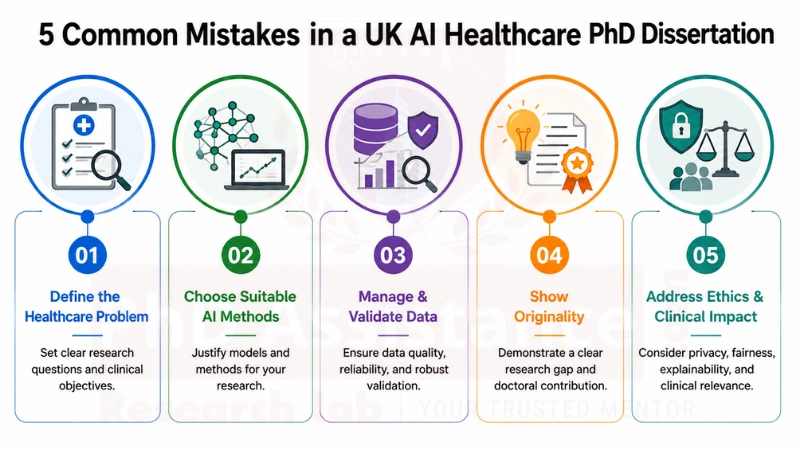
1. Weak or Poorly Defined Healthcare Research Questions
A common problem in AI healthcare PhD research is starting with an AI technique rather than a clearly defined healthcare problem. This is particularly relevant to UK doctoral research environments, where programmes increasingly integrate clinical relevance, responsible AI and translational research. The dissertation will show better technical performance but lack clarity on its significance in clinical research.
This is well illustrated by the University of Leeds, which has the Centre for Doctoral Training in AI for Medical Diagnosis and Care. It brings together AI researchers and clinical researchers while concentrating on using AI in real-world medical problems (University of Leeds, n.d.).
Researchers should:
- Define a focused healthcare problem.
- Identify a specific research gap.
- Develop clear research questions or hypotheses.
- Explain why AI is suitable for the problem.
- Connect objectives with meaningful healthcare outcomes.
Research Example: A 2026 multicenter NHS study evaluated an AI mammography system using 115,973 mammograms from five NHS screening services, alongside a prospective feasibility deployment at 12 sites. The study illustrates how AI research can be designed around a clinically meaningful problem rather than around algorithm development alone (Kelly et al., 2026; Warren et al., 2026).
2. Inappropriate AI Methodology
Another common problem is selecting an AI model without adequately explaining why it is appropriate for the research question and dataset.
The CDT at Oxford for Healthcare Data Science integrates machine learning, statistics, data management, medicine, and population health. This reflects the requirement for both technical and scientific rigour in AI research for healthcare (University of Oxford, n.d.).
Researchers should:
- Select methods suited to the research problem and data.
- Justify model selection.
- Use appropriate statistical methods.
- Establish meaningful baseline comparisons.
- Document model development and evaluation.
However, an effective thesis or dissertation needs to justify the suitability of the chosen AI method more than merely presenting a good accuracy rating.
3. Poor Healthcare Data Management and Validation
Healthcare databases may have data gaps, biases, data quality issues, and limited representativeness. Even an advanced artificial intelligence algorithm may generate inaccurate predictions due to poor data handling and validation processes.
The Oxford data science for healthcare research deals with big health data and biomedical data, which shows the significance of proper data collection and analysis (University of Oxford, n.d.).
Researchers should:
- Clearly describe datasets and inclusion criteria.
- Address missing data and data-quality issues.
- Prevent data leakage.
- Use appropriate training, testing, and validation procedures.
- Consider bias and generalisability.
4. Limited Originality or Healthcare Contribution
Originality in a thesis at the doctoral level can be difficult to establish in cases where an already established AI algorithm is merely applied to a different set of data without explanation of what new knowledge was generated.
Researchers should:
- Identify what is already known.
- Explain the unresolved research gap.
- Clearly state the original contribution.
- Compare findings with existing approaches.
- Explain the scientific and healthcare significance.
Oxford’s research on Artificial Intelligence for Digital Health includes medical time-series, foundation models, disease phenotyping, treatment effect modelling, and explainable AI. The research at UCL on medical imaging also relates to AI development in terms of diagnosis, patient management, evaluation, and clinical application (University College London, n.d.).
This means that originality in healthcare PhD research may include a novel methodology, novel application, evaluation approach, clinical knowledge, or implementation approach.
5. Ignoring Ethics, Explainability, and Clinical Translation
Healthcare AI often uses sensitive patient data and may influence clinical decision-making. Solely concentrating on model precision might result in ignoring other important aspects such as privacy, fairness, transparency, safety, and deployment.
Interpretable AI, privacy-preserving machine learning, trust, and safety are among areas of Imperial’s AI research. On the other hand, ethical concerns, responsibility in research, impacts, and engagement of patients are part of the AI-medical doctorate program at Leeds (University of Leeds, n.d.).
Researchers should:
- Address ethical use of healthcare data.
- Consider privacy, bias, and fairness.
- Discuss explainability where appropriate.
- Report limitations and risks transparently.
- Consider patient and clinician perspectives
A 2026 UK cluster randomised implementation trial of an AI-enabled stethoscope illustrates why technical performance alone is insufficient: researchers also need to evaluate how clinicians use the technology and how it performs within real-world workflows. This is an important lesson when it comes to AI healthcare dissertation writing, where good model performance does not necessarily mean successful implementation (Kelshiker et al., 2026)
What These UK Examples Show
The research environment at Leeds, Oxford, Imperial, and UCL indicates that good AI in healthcare doctoral research should be:
- Healthcare relevance: Address a meaningful clinical problem.
- Technical rigour: Justify AI and statistical methods.
- Data quality: Use reliable and appropriately validated healthcare data.
- Originality: Demonstrate how you have been able to contribute at the doctoral level.
- Responsible AI: Address ethics, privacy, fairness, and explainability throughout the research process.
- Clinical relevance: Check if the outcomes have any clinical relevance.
By staying away from these common PhD dissertation writing mistakes UK, one can write a dissertation that demonstrates innovation, scientific accuracy, and relevance to the healthcare field.
Quick Self-Check
- Is my healthcare research question clearly defined?
- Is my AI methodology appropriate and well justified?
- Are my healthcare data and validation procedures reliable?
- Have I demonstrated originality and a clear research gap?
- Have I addressed ethics, privacy, bias, and explainability?
Conclusion
An unclear research question, inappropriate use of AI methods, improper data management, an insufficient validation process, absence of originality, and poor consideration of ethical and explainability issues may be detrimental to the success of AI in Healthcare.
A strong AI healthcare dissertation should demonstrate proper healthcare objectives, appropriate AI methodology, valid data, originality, responsible AI, reproducibility, and clinical significance.
Need an expert review of your AI healthcare PhD dissertation? PhD Assistance Research Lab can help assess your research question, AI methodology, healthcare data analysis, validation strategy, originality and responsible AI considerations before submission.
Frequently Asked Question
Common mistakes include unclear research questions, inappropriate AI methods, poor data management, weak validation, and limited originality. Neglecting ethics, explainability, reproducibility, and clinical relevance can also weaken the dissertation.
Define a clear healthcare problem, justify your AI methodology, and use reliable, well-validated healthcare data. Also address research ethics, responsible AI, reproducibility, and clinical implementation.
Avoid weak research gaps, unsupported conclusions, inadequate statistical analysis, poor documentation, and insufficient validation. Make sure your research clearly demonstrates originality and a meaningful contribution to healthcare.
Strengthen the research question, methodology, data analysis, validation, and explanation of the research contribution. Consider clinical relevance, responsible AI, transparency, and potential real-world implementation.
Common problems include poor-quality healthcare data, dataset bias, limited generalisability, inappropriate model selection, and weak clinical validation.
Researchers may also face challenges with privacy, explainability, ethics, and translating AI models into clinical practice.
References
- Kelly, C.J., Wilson, M., Warren, L.M. et al. Diagnostic accuracy, fairness and clinical implementation of AI for breast cancer screening: results of multicenter retrospective and prospective technical feasibility studies. Nat Cancer 7, 494–506 (2026). https://doi.org/10.1038/s43018-026-01127-0
- Kelshiker M, Bächtiger P, Petri C et al. Triple cardiovascular disease detection with an artificial intelligence-enabled stethoscope (TRICORDER) in the UK: a cluster-randomised controlled implementation trial. The Lancet, 2026; 407, 704-715 https://www.thelancet.com/journals/lancet/article/PIIS0140-6736(25)02156-7/fulltext
- Imperial College London. (n.d.). Research. https://www.imperial.ac.uk/artificial-intelligence/research/
- University College London. (n.d.). Medical imaging. https://www.ucl.ac.uk/medical-sciences/divisions/medicine/research/medical-imaging
- University of Leeds. (n.d.). Programme: UKRI Centre for Doctoral Training in Artificial Intelligence for Medical Diagnosis and Care. https://ai-medical.leeds.ac.uk/programme/
- University of Oxford. (n.d.). Healthcare Data Science (EPSRC CDT). https://www.ox.ac.uk/admissions/graduate/courses/cdt-healthcare-data-science