
Critical Review of a Machine Learning Model for Early Sepsis Prediction in Hospital Inpatients
Introduction
Sepsis is a life-threatening condition caused by a dysregulated response to infection. At times, the traditional scoring systems used in the clinical setting are unable to predict sepsis onset, thus providing scope for the application of machine learning.
Thiboud et al. (2025) created and validated the SEPSI Score, a machine-learning algorithm used for predicting the occurrence of sepsis in hospitalised patients. This article is very relevant in that it breaks away from the trend of using predictive models in the ICU setting and investigates the possibility of identifying sepsis cases using routine clinical information.
This critical appraisal focuses on the study’s research contribution, methodology, validation, ethics, clinical implications, and limitations by comparing the study’s findings with Machine learning model sepsis prediction.
Summary of the article
Thiboud et al. (2025) created and validated a machine learning algorithm for predicting sepsis onset hospital inpatients in various departments. This algorithm relies on the use of routinely collected EHR data, which includes vital signs, laboratory parameters, demographics, and history.
It was established that the SEPSI Score performed well in comparison with other available scoring models, such as SOFA, SIRS, MEWS, and qSOFA. The SEPSI Score achieved an AUROC of 0.74 up to 3 hours before sepsis onset. Among patients whose sepsis developed during hospitalisation, 21 of 44 cases were detected at least 48 hours before the medically confirmed onset.
These results indicate that machine learning might potentially enhance traditional clinical assessment through recognising patterns related to sepsis at an early stage. Nevertheless, the algorithm was designed based on information from a single institution; thus, there is a need for future validation of its usefulness.
Significance and contribution of the field
A significant strength of Thiboud et al. (2025) is the inclusion of patients from all the hospital departments rather than only the ICU. This is an important improvement on the limitations of previous studies that predict sepsis using machine learning algorithms that mainly relied on ICU patient population data.
In addition, the SEPSI Score is compared with conventional clinical scoring systems in this study, which offers further proof of the usefulness of the score in the early detection of sepsis. Such early detection could be beneficial since it will give healthcare providers more time to evaluate their patients and offer necessary interventions.
These results coincide with the general body of knowledge. According to a systematic review and meta-analysis by Fleuren et al. (2020) on machine learning models for predicting sepsis, there are positive results about the effectiveness of the model in existing research; however, the differences in the research methods, populations, sepsis definitions, and validation procedures are also evident.
Moreover, Wong et al. (2021) showed the significance of external validation, as their assessment of a popularly used proprietary AI sepsis prediction model showed considerably inferior performance compared to previous reports, stressing the challenges associated with transferring a machine learning model from one clinical setting to another.
In this sense, the contribution of Thiboud et al. (2025) is important; however, the promising results of the proposed model cannot be viewed as an indicator of its effectiveness yet.
Methodology and research design
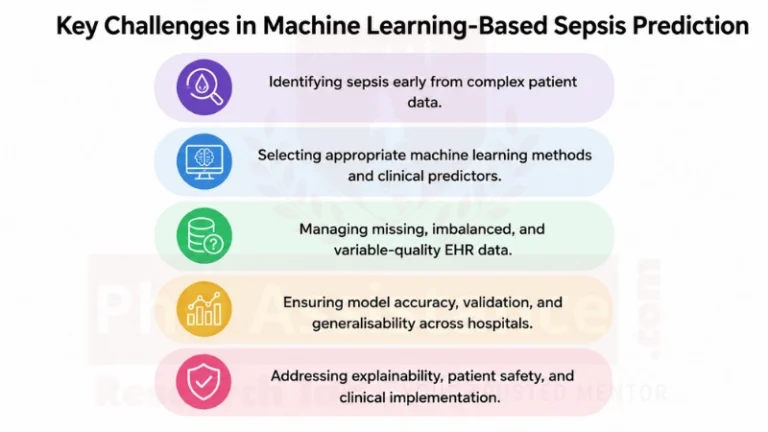
The machine learning approach and the use of the electronic health record dataset form a critical strength of the methodology in the study. Training and validation datasets are used, and comparison is done using existing sepsis scores. Sensitivity, specificity, positive predictive value, AUROC, and AUPR, among others, are used in the analysis, especially because the number of sepsis cases is relatively small in the dataset.
This is particularly important for machine learning sepsis onset validation, because patient characteristics, clinical procedures, EHR systems, data quality, and treatment practices may vary considerably between hospitals.
Another strength is the use of gradient-boosted machine learning with routinely collected clinical parameters.The algorithm tries to recognise features that can predict sepsis before its diagnosis based on the clinical criteria.
Nevertheless, the model was developed and tested at one hospital. Besides, this was a retrospective analysis. Thus, the authors recognise that it is not possible to provide evidence about the efficacy of the model in practice.
This is important since performance gained from one hospital may not necessarily be transferable to other hospitals with a different demographic, practice, database structure, and resources.
Theoretical and Interdisciplinary Analysis
The interdisciplinary nature of the study refers to the use of machine learning, clinical medicine, statistics, electronic health records, and healthcare decision support. The core idea of this work is that routine clinical data can be analysed to detect patients at risk of developing sepsis prior to visible signs of their deterioration.
Early detection is an important clinical issue as it will provide physicians with extra time to examine patients, conduct treatment and monitor them if necessary. This is an example of how artificial intelligence can assist conventional clinical examination.
However, from a critical perspective, further evaluation would be required in areas such as calibration, explainability, clinical utility, and decision curve analysis. While high predictiveness is necessary for an AI system, it is not sufficient to ensure improvement in clinical decision-making or patient outcomes.
The paper would benefit from more discussion regarding the interpretation of alert generation by a clinician, the selection of a prediction threshold, and the balancing of false positives against false negatives.
Clinical Implementation, Policy and Ethical Considerations
The key policy and research issues are those of implementation in the clinical setting, patient safety, data stewardship, healthcare resources, and ethical AI.
The study’s discussion of integrating the SEPSI Score with existing health-record systems and its reference to HL7 FHIR are relevant to interoperability and implementation. At the same time, the authors highlight the necessity for further research on the efficiency of the algorithm.
Regarding healthcare policy, the application of an AI sepsis prediction model development system goes beyond proving its predictive accuracy. Hospitals must think about data privacy, education of personnel, alarm fatigue, integration into workflow, clinical accountability, as well as potential adverse impacts of both false positive and false negative predictions.
Moreover, patients’ groups and healthcare facilities might vary by data quality and clinical profiles. Thus, further research will be necessary to evaluate this model in different hospitals among various patient populations.
Writing Style and Structure
The logical organisation of the article starts from the significance of sepsis to modelling, validation, results, comparisons, and the limitations of the research.
The inclusion of the ROC and precision-recall analysis in the study enhances its presentation because the researchers understand the problems related to the imbalance of data. The comparison with SOFA, SIRS, MEWS, and SOFA also helps understand the results better.
However, there are some statements about generalisability which should be considered with caution since this model was tested in one hospital only. The authors have rightly pointed out that prospective multi-centre studies are needed to confirm its effectiveness.
Conclusion
The research conducted by Thiboud et al. (2025) is an essential addition to the literature on the topic of machine learning-based early sepsis detection AI due to the generation of the SEPSI Score that predicts sepsis in hospitalised patients regardless of their departments.
Nevertheless, the retrospective, single-centre nature of the study prevents any strong claims regarding generalizability and clinical effectiveness. In the future, research should be directed toward external validation, prospective, multicenter studies, implementation, fairness, explainability, and outcomes for patients to determine whether the model can reliably help in practice.
Need support with your critical review? Get focused guidance on methodology assessment, statistical analysis, literature comparison, and manuscript improvement to strengthen the clarity and rigor of your research.
Frequently Asked Question
Machine learning analyses EHR data such as vital signs, laboratory results, and patient history to identify patterns associated with sepsis risk.
Yes. Machine learning models can identify risk patterns before clinical signs become obvious, potentially supporting earlier intervention.
There is no single best model. Performance depends on the dataset, clinical setting, prediction time, and validation approach.
Accuracy varies across models and healthcare settings. External and prospective validation are important for determining real-world performance.
Models are evaluated using separate datasets and measures such as AUROC, sensitivity, specificity, precision, and AUPR, followed by external or prospective validation.
Reference
- Adams, R., Henry, K. E., Sridharan, A., Zhan, A., Rawat, N., Johnson, L., Hager, D. N., Cosgrove, S. E., Markowski, A., Klein, E. Y., Chen, E. S., Saheed, M. O., Henley, M., Miranda, S., Houston, K., Linton, R. C., Ahluwalia, A. R., Wu, A. W., & Saria, S. (2022). Prospective, multi-site study of patient outcomes after implementation of the TREWS machine learning-based early warning system for sepsis. Nature Medicine, 28, 1455–1460. https://doi.org/10.1038/s41591-022-01894-0
- Fleuren, L. M., Klausch, T. L. T., Zwager, C. L., Schoonmade, L. J., Guo, T., Roggeveen, L. F., Swart, E. L., Girbes, A. R. J., Thoral, P., Ercole, A., Hoogendoorn, M., & Elbers, P. W. G. (2020). Machine learning for the prediction of sepsis: A systematic review and meta-analysis of diagnostic test accuracy. Intensive Care Medicine, 46(3), 383–400. https://doi.org/10.1007/s00134-019-05872-y
- Henry, K. E., Adams, R., Parent, C., Soleimani, H., Sridharan, A., Johnson, L., Hager, D. N., Cosgrove, S. E., Markowski, A., Klein, E. Y., Chen, E. S., Saheed, M. O., Henley, M., Miranda, S., Houston, K., Linton, R. C., Ahluwalia, A. R., Wu, A. W., & Saria, S. (2022). Factors driving provider adoption of the TREWS machine learning-based early warning system and its effects on sepsis treatment timing. Nature Medicine, 28, 1447–1454. https://doi.org/10.1038/s41591-022-01895-z
- Henry, K. E., Hager, D. N., Pronovost, P. J., & Saria, S. (2015). A targeted real-time early warning score (TREWScore) for septic shock. Science Translational Medicine, 7(299), 299ra122. https://doi.org/10.1126/scitranslmed.aab3719
- Moor, M., Bennett, N., Plečko, D., Horn, M., Rieck, B., Meinshausen, N., Bühlmann, P., & Borgwardt, K. (2023). Predicting sepsis using deep learning across international sites: A retrospective development and validation study. EClinicalMedicine, 62, 102124. https://doi.org/10.1016/j.eclinm.2023.102124
- Persson, I., Macura, A., Becedas, D., & Sjövall, F. (2024). Early prediction of sepsis in intensive care patients using the machine learning algorithm NAVOY® Sepsis: a prospective randomised clinical validation study. Journal of Critical Care, 80, 154400. https://doi.org/10.1016/j.jcrc.2023.154400
- Thiboud, P.-E., François, Q., Faure, C., Chaufferin, G., Arribe, B., & Ettahar, N. (2025). Development and validation of a machine learning model for early prediction of sepsis onset in hospital inpatients from all departments. Diagnostics, 15(3), 302. https://doi.org/10.3390/diagnostics15030302
- Wong, A., Otles, E., Donnelly, J. P., Krumm, A., McCullough, J., DeTroyer-Cooley, O., Pestrue, J., Phillips, M., Konye, J., Penoza, C., Ghous, M., & Singh, K. (2021). External validation of a widely implemented proprietary sepsis prediction model in hospitalised patients. JAMA Internal Medicine, 181(8), 1065–1070. https://doi.org/10.1001/jamainternmed.2021.2626