phdassistance

Call for Papers: Advanced Modalities in Drug Development: Radiopharmaceuticals, ADCs, Delivery Systems and Biodistribution of Next-Generation Gene and Cell Therapies

Introduction

The fast emergence of new advanced drug therapies, including radiopharmaceuticals, antibody-drug conjugates (ADCs), advanced gene and cell therapies, and delivery methods, has changed drug development.

These new technologies pose novel challenges in drug disposition, PK/PD properties, biodistribution, target engagement, efficacy, safety, and translational research that go beyond the usual problems associated with small molecules and biologics.

Drug Metabolism and Disposition (DMD) and the PhRMA Foundation will be working together to produce a themed collection that will be centred on exploring the new mechanisms of action, PK/PD, safety, and translational ADME science related to the Advanced Drug Development Modalities.

Contributions that will address the development and evaluation of such advanced therapies are welcome.

Why publish in this issue?

The Special Collection offers an excellent opportunity for investigators from the disciplines of drug metabolism, pharmacokinetics, pharmacology, bioanalysis, pharmaceutics, and therapeutic innovation to publish their work that relates to new drug modalities.

Key advantages:

  • Opportunity to publish studies on advanced drug development methods.
  • Visibility for studies on drug metabolism and disposition, pharmacokinetics/pharmacodynamics, and translational pharmacology.
  • Opportunities to conduct studies in new disciplines such as Radiopharmaceutical Drug Development, gene therapy, and cell therapy.
  • Consider innovative strategies in the areas of biodistribution, target engagement, exposure, efficacy, and safety.
  • Submissions can play a role in connecting cutting-edge molecular design to solid ADME research.
  • Selected submissions will be considered as part of a collection dedicated to next-generation drug development.
  • Trainee Challenge Award: Five winning submissions may receive a $5,000 award from the PhRMA Foundation to the eligible first author trainee.
  • Scope

    The Special Collection is interested in receiving research articles and minireviews that help us understand ADME, biodistribution, pharmacokinetics/pharmacodynamics, and translational pharmacology of new therapy approaches.

    Topics include:

  • Development of Radiopharmaceutical Drugs – Innovative development of radiopharmaceuticals, chelation stability, pharmacokinetics of radioisotopes, and tissue dosimetry.
  • Antibody Drug Conjugates (ADCs) – Advanced linker-payload systems, biotransformation mechanisms, bystander effect, and distribution in the body tissues.
  • Drug Development for Gene Therapy – Biodistribution, shedding, tissue tropism, and clearance of gene-editing tools, mRNA, AAV, and oligos.
  • Development of Cell Therapy – Trafficking, expansion kinetics, tissue retention, and target engagement of treatments like CAR-T and TCR-T.
  • Translational Modelling and Bioanalytics – High-end imaging, LC-MS/MS, qPCR/ddPCR, quantitative imaging, PK/PD modelling, and exposure-response.
  • Advanced Drug Delivery Systems – In vivo transport, cellular uptake, endosomal escape, and disposition kinetics of lipid nanoparticles, polymeric nanoparticles, and exosomes.
  • Contact PhD Assistance Research Lab today to publish your research papers in Scopus and PubMed-indexed journals!

    Know More About This Issue

    To develop sophisticated therapy platforms, innovative methodologies must be developed to determine how such intricate compounds function within the body.

    Unlike traditional drugs composed of simple molecules, the next generation of therapies could have several constituents or biological systems that would need special methodology to study their pharmacokinetics, biodistribution, and safety.

    This Special Collection is designed to collate research that goes beyond the mere description of dispositional data to an appreciation of the mechanisms that are involved in controlling drug disposition at the cellular and molecular levels.

    In addition, the collection emphasises the need for sophisticated bioanalytical workflows and a quantitative framework for assessing the nature of multi-component drugs and setting safety, exposure, and biodistribution parameters.
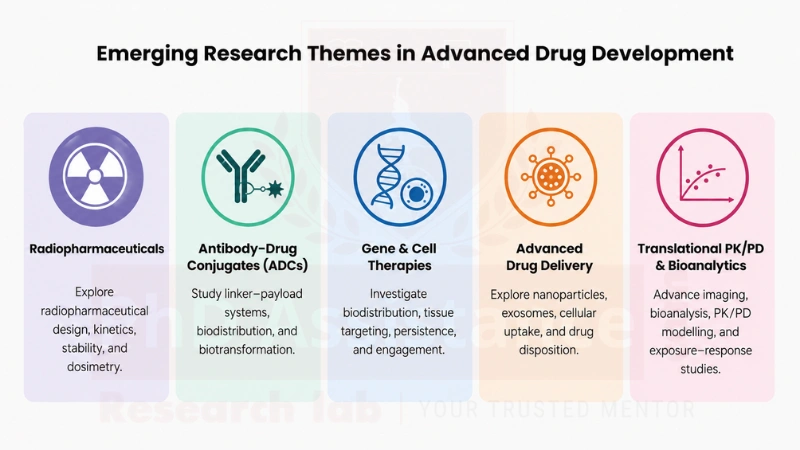
    Gene Therapy Drug Development

    Key factors           

  • Advanced ADME and drug disposition research.
  • Radiopharmaceutical kinetics and dosimetry.
  • ADC biodistribution and biotransformation.
  • Innovative delivery systems and cellular trafficking.
  • Gene and nucleic acid medicine biodistribution.
  • Cell Therapy Development, persistence, and target engagement.
  • Translational PK/PD and exposure–response modelling.
  • Advanced bioanalytical and imaging technologies.
  • How We Support Your Submission

    PhD Assistance Research Lab offers full paper-writing support to assist researchers in writing technical, clear, and well-prepared articles for international journals and special collections.

    Our services include:

  • Scientific manuscript development and technical editing.
  • Research design, methodology, and analytical support.
  • ADME, PK/PD, biodistribution, and translational research presentation.
  • Journal guideline compliance and manuscript structuring.
  • Statistical analysis and results interpretation.
  • Reference and citation management.
  • Figure, table, graphical, and visual research preparation.
  • Academic language enhancement and originality checks.
  • Pre-submission manuscript review.
  • Our experts assist researchers in presenting their findings accurately by ensuring that the manuscript is compliant with the guidelines of the Advanced Modalities in Drug Development Special Collection.

    Journal Guidelines:

  • The Special Collection is open to research papers and minireviews.
  • Topics should focus on the ADME, biodistribution, PK/PD, and translational pharmacology of novel therapeutic strategies.
  • Studies using radiopharmaceuticals, ADCs, novel drug delivery approaches, Gene Therapy Drug Development, and cell therapy are highly encouraged.
  • Studies on translational research, novel animal models, mechanistic disposition, bioanalysis, and safety are especially encouraged.
  • The manuscript should comply with all the submission guidelines of the journal.
  • The authors are advised to refer to the author guidelines of the journal before submitting the manuscript.
  • Manuscripts are to be submitted via the submission site of the journal.
  • Submission deadline: 01 February 2027
  • If you are a researcher interested in publishing research papers in the journal titled “Advanced Modalities in Drug Development: Radiopharmaceuticals, ADCs, Delivery Systems and Biodistribution of Next-Generation Gene and Cell Therapies,” then you can get help from the PhD Assistance Research Lab to publish your manuscript.

    Free Guide: How to Write the Journal Manuscript

    Book a free consultation to get guidance from the PhD Assistance Research Lab for writing a credible research manuscript and submitting it to a high-quality journal.

    Reference

    American Society for Clinical Pharmacology and Therapeutics. (2026). Call for papers: Advanced Modalities in Drug Development: Radiopharmaceuticals, ADCs, Delivery Systems and Biodistribution of Next-Generation Gene and Cell Therapies.

    https://www.sciencedirect.com/special-issue/336087/advanced-modalities-in-drug-development-radiopharmaceuticals-adcs-delivery-systems-and-biodistribution-of-next-generation-gene-and-cell-therapies

    Call For paper
    Generative AI on Educational Divide
    Call For paper
    Manuscript Call on TinyML advancements in Intelligent Systems
    Call For paper
    Abstract Submission Call on Big Data at IEEE international conference 2024
    Call For paper
    IEEE Annual Congress on Artificial Intelligence of Things (AIoT)
    We offer our Greatness in Various Parts of Research, and we help you with any phase of your Process. Make a Smart Decision and get your Paper Published.