
Critical Review of Structural change in agricultural inputs and greenhouse gas emissions: Pathways for sustainable environmental management in China
Introduction
The agricultural sector is a key driver of environmental degradation and GHG emissions in China, although the country faces the challenge of sustaining food production given its large population. The usage of fertilisers, pesticides, agricultural machinery, and plastic film has enhanced agricultural efficiency; however, these Agricultural Inputs have placed pressure on the environment as well. Thus, it becomes essential to understand the link between agricultural inputs and Agricultural GHG Emissions in China.
In the study “Structural Change in Agricultural Inputs and Greenhouse Gas Emissions: Pathways for Sustainable Environmental Management in China,” Koondhar et al. (2026) investigate the impact of structural changes in energy input to agricultural machinery, pesticide input, fertiliser input, and input of agricultural plastics on GHG emissions. Annual data on China from 1990 to 2023 and the DYNARDL simulation approach are used in the study to explore short- and long-run relationships between agricultural inputs and Emissions in Agriculture.
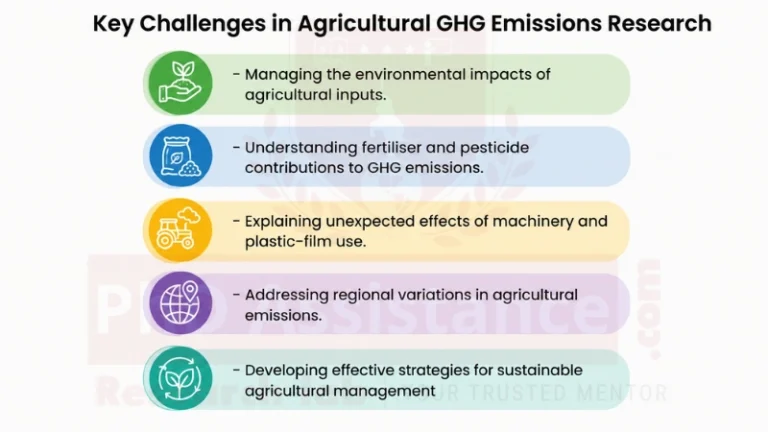
It is essential to emphasise the significance of this study for Sustainable Agriculture as it goes further than merely studying agricultural emissions as an output and examines how various inputs can have diverse environmental impacts. Nevertheless, the study findings should be scrutinised critically due to the limited length of the time-series sample, use of aggregated national data, and inability to interpret some unanticipated results such as the use of agricultural machinery and plastic film decreasing emissions.
Summary of the article
This study aims at establishing the impact of structural variations in key agricultural inputs on the agricultural greenhouse gas (GHG) emissions in China. The explanatory variables considered include agricultural machinery power (AMP), pesticide consumption (PC), fertiliser consumption (FER) and plastic-film application in agriculture (PFCAg). Data from 1990 to 2023 are used for analysis through DYNARDL simulations.
Some of the key results from this research are highlighted below. Higher levels of machine power and plastic film utilisation are linked to lower levels of GHG emissions from agriculture in the short and long run. There is a positive connection between pesticide use and agricultural emissions in the long run, while fertiliser use continues to be an important determinant of emissions. This means that agricultural environmental management needs to be input-specific.
Renewable sources of energy can be used in farming equipment. Also, biodegradable mulch, improved ways of producing fertilisers and pesticides, and changes in their application can help reduce CO2 emissions from farming. These recommendations were offered as ways to move towards low-carbon farming.
Critique
Significance and contribution of the field
One of the significant advantages of Koondhar et al. (2026) is the emphasis on the structure of agricultural inputs as opposed to only the calculation of total agricultural emissions. Koondhar et al. analyse such categories as machinery, pesticides, fertilisers, and plastic film in an attempt to present a wider view of the interrelation between Agricultural Inputs in China and Agricultural Emissions in China.
These findings concerning fertiliser emissions are highly supported by existing literature. For instance, Chai et al. (2019) noted that emissions of GHG due to synthetic nitrogen fertiliser manufacture and application were high when it came to wheat and maize crops in China. It is clear from their findings that emissions due to fertiliser use do not come from the use alone but also from fertiliser manufacture. In addition, Wang et al. (2017) noted considerable variations in greenhouse gas intensity in various types of fertilisers.
The research is consistent with the findings by Liang et al. (2021), where they created an inventory at the province level on GHG emissions in agriculture in China for the period 1978 to 2016, which incorporates emissions due to the use of machinery, the production of nitrogen fertilisers, pesticides, rice farming, and residue burning.
Additionally, Zhang et al. (2024) have found that agricultural management techniques can affect both yield and GHG emissions simultaneously. In their meta-analysis of 1,433 data points from 172 papers, it was shown that slow-release fertiliser application, water-saving irrigation, and no-tillage were associated with decreased GHG emissions without lowering the yield. Hence, Sustainable Agriculture could be related not only to changes in the quantity of inputs but also to their management.
Methodology and research design
Methodologically, one significant advantage of this paper lies in its usage of DYNARDL. This method enables the authors to examine the short-run and long-run relationship between the variables, and to simulate shocks both positive and negative to the agricultural sector inputs. This makes for a much better dynamic explanation as opposed to just using a static regression model.
Furthermore, the utilisation of annual data from 1990 to 2023 can also be considered an appropriate choice when conducting this study because it helps analyse structural changes in agriculture in China. In addition, the study can conduct an analysis of the correlation between variations in the usage of agricultural inputs and GHG emissions.
This is significant considering that agricultural emissions in China are geographically differentiated. In their study of agricultural material-related greenhouse gas emissions in 31 provinces in China from 2003 to 2018, Sun & Xu (2022) showed spatial and temporal variations in the emission levels. This was also highlighted by Liang et al. (2021).
Theoretical and Interdisciplinary Analysis
The study is interdisciplinary as it includes agricultural economics, environmental management, climate change, and econometric modelling. The main idea is that changes in the structure of agricultural inputs may affect the sustainability of the environment in China’s agricultural sector.
The results of the paper are very relevant to the theory of sustainable intensification, as agricultural production should be intensified while decreasing the impact on the environment. This study refutes the assumption that every increment in agricultural inputs will cause an increment in emissions.
Nevertheless, the analysis of the theoretical framework can be enhanced by the addition of different aspects like the environmental Kuznets curve, sustainable intensification, rebound effect, and life cycle assessment. The use of agricultural inputs generates some indirect consequences that cannot be measured using aggregated econometric equations.
For instance, according to Zhang et al. (2022), who applied a dynamic computable equilibrium framework, there is an expected increase in greenhouse gas emissions from agriculture in China. The use of material input within agriculture as a factor that influences the growth in emissions is considered by the authors using this approach, in contrast to the single-equation DYNARDL approach used by Koondhar et al.
This comparison leads to the conclusion that environmental management of agriculture cannot be based only on one type of modelling. Econometric time series models may reveal the statistical relations, but CGE, life cycle, and spatial models may assist in explaining these relations.
Ethical Considerations
Some of the environmental management concerns raised by the article include the use of fertilisers and pesticides, renewable energy, and plastic films. This is relevant to China’s approach to the food security and environmental sustainability balance.
Strengths of the study include its approach to reducing agricultural input use in a manner that takes into account the need for input-specific measures such as clean production of fertilisers and pesticides, renewable energy to run machines and biodegradable mulching technology. This is much more realistic for a country that prioritises agricultural output and food security.
Zhang et al. (2024) show the importance of taking into account both emissions and productivity in agricultural management. Zhang et al. prove that some agricultural practices like the use of slow-release fertilisers, irrigation water saving, and no-tillage do not affect rice production while lowering GHG emissions.
Writing Style and Structure
The structure of the paper is logical, and there is a gradual flow of information from the environmental problem to the contribution of agricultural inputs, methodology, empirical evidence, and policy proposals. Moreover, DYNARDL simulations help to better explain both the short- and long-run consequences for people who are interested in policy changes.
The strength of this paper lies in its policy relevance. Instead of simply describing their results in an econometric way, the authors link their findings to China’s goal of becoming carbon neutral and make concrete policy suggestions using renewables, fertiliser management, pesticide production, and biodegradable plastic alternatives.
Conclusion
Koondhar et al. (2026) make a significant contribution to the research on agricultural GHG emissions in China by analysing how modifications in agricultural technology usage, including machinery, pesticides, fertilisers, and plastic films, are related to emissions. The application of DYNARDL is quite helpful in obtaining information about short-run and long-run dynamics in this regard.
The most significant result of the study is that of fertilizer being a long-term emitter, which corresponds to previous evidence by Chai et al. (2019), Wang et al. (2017), among others. Nevertheless, the surprising results in relation to machinery and plastic film usage need to be considered with care, as the overall time-series relationship does not take into account regional variances and other factors.
In summary, the article is valuable for building the foundation for studying Agricultural Inputs, but further research should incorporate time series analysis with provincial-level panel data and Life Cycle Assessment of crops to offer empirical support to Sustainable Agriculture in China and Environmental Management strategies.
Need support with your critical review? PhD Assistance Research Lab provides expert guidance to doctoral scholars and early-career researchers on Agricultural GHG Emissions, Sustainable Agriculture, Agricultural Inputs, and Environmental Management in China, including literature evaluation, methodology, and research gaps.
Reference
- Chai, R., Ye, X., Ma, C., Wang, Q., Tu, R., Zhang, L., & Gao, H. (2019). Greenhouse gas emissions from synthetic nitrogen manufacture and fertilisation for main upland crops in China. Carbon Balance and Management, 14, 20. https://doi.org/10.1186/s13021-019-0133-9.
- Koondhar, M. A., Wang, J., Ahmed, S., & Khan, Z. A. (2026). Structural change in agricultural inputs and greenhouse gas emissions: Pathways for sustainable environmental management in China. Journal of Environmental Management, 399, 128628. https://doi.org/10.1016/j.jenvman.2026.128628.
- Liang, D., Lu, X., Zhuang, M., Shi, G., Hu, C., Wang, S., & Hao, J. (2021). China’s greenhouse gas emissions for cropping systems from 1978–2016. Scientific Data, 8, 171. https://doi.org/10.1038/s41597-021-00960-5.
- Sun, B., & Xu, X. (2022). Spatial–temporal evolution of the relationship between agricultural material inputs and agricultural greenhouse gas emissions: Experience from China 2003–2018. Environmental Science and Pollution Research, 29, 46600–46611. https://doi.org/10.1007/s11356-022-19195-x.
- Wang, Z.-B., Chen, J., Mao, S.-C., Han, Y.-C., Chen, F., Zhang, L.-F., Li, Y.-B., & Li, C.-D. (2017). Comparison of greenhouse gas emissions of chemical fertiliser types in China’s crop production. Journal of Cleaner Production, 141, 1267–1274. https://doi.org/10.1016/j.jclepro.2016.09.120.
- Zhang, X., Wu, L., Ma, X., & Qin, Y. (2022). Dynamic computable general equilibrium simulation of agricultural greenhouse gas emissions in China. Journal of Cleaner Production, 345, 131122. https://doi.org/10.1016/j.jclepro.2022.131122.
- Zhang, L., Zhang, F., Zhang, K., Liao, P., et al. (2024). Effect of agricultural management practices on rice yield and greenhouse gas emissions in the rice–wheat rotation system in China. Science of the Total Environment, 916, 170307. https://doi.org/10.1016/j.scitotenv.2024.170307.