
How to Develop a PhD Manuscript in UK Biomedical Engineering: Applying Wearable Sensor Data and Clinical Rehabilitation Models
Sustainable Practices in Environmental Science
- Identify Relevant Literature on Wearable Sensor Data and Clinical Rehabilitation Models
- Conduct Critical Literature Review and Research Gap Analysis
- Develop Biomedical Engineering Frameworks and Clinical Rehabilitation Models
- Select Research Methodologies, Validation Techniques and Statistical Analysis
- Evaluate Results and Demonstrate Manuscript Contributions
- Strategies for Publishing a Strong Healthcare Manuscript
- Conclusion

Recent Post
Introduction
The progress of biomedical engineering studies in the UK comes from wearable sensing, artificial intelligence and clinical rehabilitation technologies. Nonetheless, many PhD scholars have problems transforming their research into manuscripts because of difficulties in synthesising multilevel evidence, verifying data from wearable sensors, and proving the clinical relevance of rehabilitation models.
According to a recent study by Daniore et al. (2024) published in npj Digital Medicine in 2024, there is a challenge in the conversion of the data obtained by wearables for medical purposes into clinically useful digital biomarkers, since it is constrained by poor design, validation and interpretation. To address the issue, the authors proposed a DACIA framework.
This article explains how to craft a Biomedical Engineering Manuscript in the UK by using both Wearable Sensor Research and Clinical Rehabilitation with structured PhD Manuscript Support in UK.
What you will learn?
Step 1: Identify Relevant Literature on Wearable Sensor Data and Clinical Rehabilitation Models
Preparing a manuscript requires performing an extensive review of the most recent works in the biomedical engineering field. It is necessary to perform a search for scientific works in peer-reviewed journals concerning wearable sensor technology, digital health solutions, rehabilitation engineering, analysis of human locomotion and decision-support systems in a clinical environment, such as IEEE Xplore, PubMed, Scopus, Web of Science and ScienceDirect.
Literature sources need to be classified into topics such as IMUs, EMG, gait analysis, musculoskeletal assessment, AI-based rehabilitation and wearable sensor validation. Prioritising systematic reviews, multicenter clinical trials and most recent sources would make sure that a Biomedical Engineering Manuscript UK contains the latest scientific discoveries.
What Research shows:
Wei, S., & Wu, Z. (2023) have shown that IMU wearable sensors combined with machine learning techniques greatly enhanced gait assessment in neurorehabilitation practice. This research emphasized the increasing use of wearable devices in the field of objective assessment and remote monitoring of patients’ mobility.
Tips
Step 2: Conduct Critical Literature Review and Research Gap Analysis
The biomedical engineering manuscript needs to be critically analysed and not summarised. Comparing methodologies, validation, subjects used, statistical analysis, and technological issues would help to come up with research gaps that need to be addressed.
Gaps in Wearable Sensor Data Research include lack of clinical validation, small number of participants used, multi-sensor integration, and use of explainable AI for rehabilitation. This will make the proposed research novel and scientifically valuable.
What Research shows:
According to Micó-Amigo et al. (2023), even though there is great possibility of using wearables in musculoskeletal rehabilitation, some studies have not been validated clinically on a big scale and using standard protocols for testing.
Tips
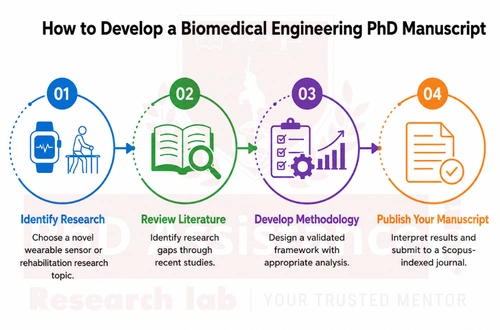
Step 3: Develop Biomedical Engineering Frameworks and Clinical Rehabilitation Models
Following gap analysis, researchers must come up with a methodological framework that would relate wearable technology to rehabilitation results. Many biomedical engineering research papers use IMU, EMG, ECG, PPG, and force sensors in their research through signal processing, feature extraction, sensor fusion, and machine learning algorithms.
It is important to determine relevant outcome measures like gait speed, joint kinematics, muscle activity, balance, and functional recovery. It would make the methodological framework more well-defined.
Further, interpretation of findings and their clinical significance is provided in the Discussion. Scopus Journal Publication can be achieved by adhering to specific author guidelines in various journals.
What Research shows:
Silva-Batista et al. (2023) devised a framework using IMUs, which involved combining wearable gait parameters with machine learning models for evaluating the rehabilitation process after orthopaedic surgeries. This technique helped them to conduct functional evaluations outside the lab environment successfully.
Tips
Step 4: Select Research Methodologies, Validation Techniques and Statistical Analysis
Methodology selection is a key element in the process of crafting an article in biomedical engineering for publication. Researchers should be able to state why such-and-such designs, subjects, sensors, data acquisition techniques, and analyses were chosen considering the research objectives. It would be good for them to follow the STROBE, CONSORT, and TRIPOD guidelines as well.
Conducting reliable validation is necessary in wearable sensor research. Accuracy, reliability, sensitivity, specificity, and validity of the sensors against gold standard clinical measurements should be determined. Statistics, such as Bland-Altman plots, ICC, regression, ROC, and machine learning evaluation methods, are popular tools used for model assessment.
What Research shows:
In a study conducted by Micó-Amigo et al. (2023), the validation of wearable IMU-based gait assessment against clinical motion capture systems was performed on patients with Parkinson’s disease. The high level of agreement between wearable devices and clinical measurements confirms the reliability of the sensors in assessing patients’ movements.
Tips
Step 5: Evaluate Results and Demonstrate Manuscript Contributions
The findings should be interpreted in relation to other research conducted in biomedical engineering rather than just the statistical results. It should be clear whether the results have solved the research gaps and supported other researchers in the area of wearable sensors and rehabilitation engineering.
Manuscripts must also address clinical importance, limitations, areas for future research, and translation of wearable technology innovations into clinical practice. The ability to clearly state theoretical, methodological, and clinical significance will greatly improve the quality of the manuscript. Researchers looking for support with PhD Journal Manuscript Writing UK must ensure that conclusions are evidence-based, well-structured, and in line with the purpose of the study.
What Research shows:
Lanotte et al. (2024) showed in their latest findings that incorporating wearable motion sensors and artificial intelligence into rehabilitation after stroke therapy resulted in more accurate predictions of rehabilitation success. The results indicate that there is potential in using wearable devices in conjunction with predictive analytics to create individualised rehabilitation plans.
Tips
- Interpret findings against existing biomedical engineering literature.
- Discuss methodological limitations with supporting evidence.
- Highlight theoretical and clinical research contributions.
- Present conclusions supported by statistically significant results.
Strategies for Writing a Strong Biomedical Engineering Manuscript
Conclusion
The field of biomedical engineering is being revolutionised through the use of wearable sensors along with Clinical Rehabilitation Models because it provides objective assessment of the patients. But to publish a good paper in the journal, it is not enough for researchers to simply present their experimental results. They must synthesise the literature, build a methodology, validate their sensor system, and show its significance.
Following a systematic manuscript preparation process will enhance the methodological rigour of the work and will also contribute to enhancing scientific communication skills among UK doctoral students for publishing in the leading journals of biomedical engineering.
Looking for expert PhD Manuscript guidance in UK? The PhD Assistance Research Lab helps researchers prepare publication-ready biomedical engineering manuscripts for high-impact journals.
References
- Daniore, P., Nittas, V., Haag, C., Bernard, J., Gonzenbach, R., & von Wyl, V. (2024). From wearable sensor data to digital biomarker development: Ten lessons learned and a framework proposal. npj Digital Medicine, 7, 161. https://www.nature.com/articles/s41746-024-01151-3
- Wei, S., & Wu, Z. (2023). The application of wearable sensors and machine learning algorithms in rehabilitation training: A systematic review. Sensors, 23(18), 7667. https://doi.org/10.3390/s23187667
- Micó-Amigo, M. E., Bonci, T., Paraschiv-Ionescu, A., Ullrich, M., Kirk, C., Soltani, A., et al. (2023). Assessing real-world gait with digital technology: Validation, insights and recommendations from the Mobilise-D consortium. Journal of NeuroEngineering and Rehabilitation, 20, 78. https://doi.org/10.1186/S12984-023-01198-5
- Silva-Batista, C., Harker, G., Vitorio, R., Studer, M., Whetten, B., Lapidus, J., et al. (2023). Mobility Rehab visual feedback system for gait rehabilitation in older adults. Journal of NeuroEngineering and Rehabilitation, 20, 144. https://doi.org/10.1186/s12984-023-01260-2
- Lanotte, F., Okita, S., O’Brien, M. K., & Jayaraman, A. (2024). Enhanced gait tracking measures for individuals with stroke using leg-worn inertial sensors. Journal of NeuroEngineering and Rehabilitation, 21. https://doi.org/10.1186/s12984-024-01521-8
References
- What can I do with a PhD in biomedical engineering?
A PhD in Biomedical Engineering prepares you for careers in academia, medical device industries, healthcare innovation, and clinical research. It also opens opportunities in AI-driven healthcare, rehabilitation engineering, and biomedical R&
- What are the 4 types of biomedical engineering?
The four major areas include biomaterials, biomechanics, medical imaging, and biomedical instrumentation. Modern biomedical engineering also encompasses tissue engineering, rehabilitation engineering, and digital health technologies.
- What is the new research in biomedical engineering?
Current research focuses on wearable sensors, AI-assisted diagnostics, digital biomarkers, smart prosthetics, regenerative medicine, and personalised healthcare. These innovations are transforming disease monitoring and clinical rehabilitation.
- What are the real-life applications of biomedical engineering?
Biomedical engineering supports the development of medical devices, wearable health monitors, rehabilitation robots, diagnostic imaging systems, and implantable technologies. These applications improve disease diagnosis, treatment, and patient recovery.
- How do I publish a biomedical engineering manuscript in a high-impact journal?