
Call for Papers: Advanced Human Models for Drug Discovery and Immunopharmacology: Organoids, Organ-on-Chip, and Beyond
Introduction
The Advanced Human Models in immunopharmacology is revolutionising the domain through which diseases are studied, and therapeutic responses are assessed. Conventional animal models as well as two-dimensional cell cultures often lack the ability to reproduce human physiology, thus necessitating the creation of more predictive experimental platforms. The recent developments in Advanced Human Models for Drug Discovery, Organ-on-a-chip Technology, iPSC-based Models and other Human Models have been instrumental in this regard.
These emerging platforms offer many possibilities in Drug Discovery studies, including better validation of targets, drug toxicity evaluation, investigation of interactions between drugs and the immune system, studies on hosts and pathogens, and personalised medicine. This Special Issue welcomes papers describing novel uses of human models for immunopharmacology and therapy development.
Why publish in this issue?
This special issue offers an amazing platform for scientists and researchers working on advanced human models and translational drug development. The publications in such a special issue gain worldwide recognition in the fields of pharmacology, regenerative medicine, and biomedical engineering.
Key advantages:
Scope
We invite authors to submit original research articles, review articles, short communications, and translational studies concerning advanced human experimental models and their use in drug development.
Contact PhD Assistance Research Lab today to publish your research papers in Scopus and PubMed-indexed journals!
Know More About This Issue
As human diseases become more complex, there is a need to develop models for experimentation that accurately mimic human physiology more closely than traditional animal models. Advanced Human Models, which include organoids, organ-on-chip, and other models using iPSCs, are good examples.
With the help of these technologies, it is possible to investigate cell interaction, immune reaction, drug effectiveness, and its toxicity in an accurate manner. That is why these technologies have become more important for translational medicine, pharmaceutical sciences, and drug discovery.
The main objective of this Special Issue is to provide a platform for research of an interdisciplinary nature on topics related to the development and use of organoids for drug therapy, organ-on-a-chip technology, and human cell models in general to increase the predictive ability of preclinical studies.
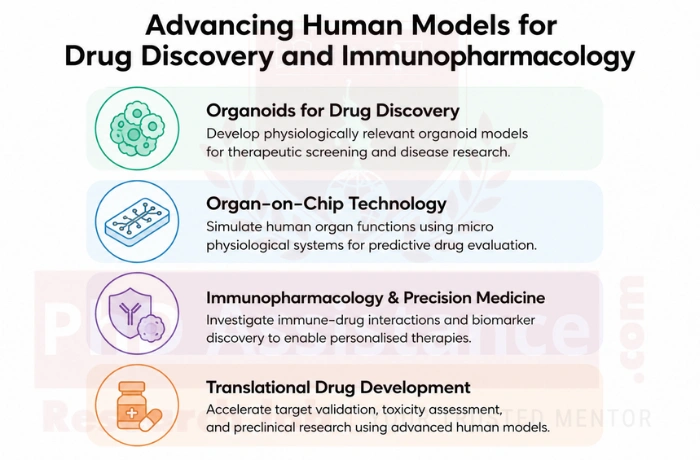
Key factors
How We Support Your Submission
Our team of publication specialists offers extensive assistance in developing high-standard manuscripts that can be considered acceptable by renowned international journals and special issues. We help authors during the entire publication process in improving the scientific and technical aspects of their work.
Our services include:
- Scientific manuscript development and technical editing
- Literature review enhancement and content refinement
- Journal guideline compliance and manuscript formatting
- Reference management and citation editing
- Academic language editing and plagiarism screening
- Research methodology and experimental design support
- Statistical analysis and data interpretation
- Figure preparation, graphical abstracts, and table formatting
- End-to-end submission support through Editorial Manager
We will assist you in meeting the criteria set by the Special Issue on Human Models for Drug Discovery and Immunopharmacology: Organoids, Organ-on-Chip, and Beyond.
Journal Guidelines:
If you are a researcher who wants to publish research work in Human Models for Drug Discovery and Immunopharmacology, PhD Assistance Research Lab can offer guidance and assist you in successfully publishing the manuscript.
Free Guide: How to Write the Journal Manuscript
Book a free consultation to get guidance from the PhD assistance research lab for writing a credible research manuscript and submitting it in a high-quality journal.
Reference
China Economic Review. (2026). *Income and wealth distribution, labor market, and subjective well-being in China – In honor of Professor John Knight* (Special issue call for papers). Elsevier.