
How to Design Effective Primary Data Collection in UAE Economics: Using Questionnaires, Sampling, and Economic Analysis Models
Sustainable Practices in Environmental Science
- Step 1: Design Reliable Questionnaires for Economic Research
- Step 2: Select Appropriate Sampling Methods in Economics
- Step 3: Implement Effective Primary Data Collection Methods
- Step 4: Apply Economic Analysis Models for Data Interpretation
- Step 5: Ensure Data Quality and Demonstrate Research Contribution
- Strategies for Effective Primary Data Collection
- Conclusion

Recent Post
Introduction
The UAE, guided by the UAE Vision 2030, have positioned itself as a regional benchmark in economic diversification, digital transformation and sustainable development, creating many exciting research areas for PhD researchers. These range from FinTech (financial technology), labour economics, entrepreneurship, sustainable finance, and public policy. Unfortunately, a major factor in carrying out robust economic research is data – particularly, the acquisition of good-quality primary data.
To address issues of internal and external validity, Primary data collection can help doctoral students to directly collect evidence from policy-makers, firms and customers. However, numerous PhD Researchers run into problems regarding the formulation of reliable questionnaires, the choice of an appropriate sample size and the application of the economic models in analysis. Flaws in Primary data collection can compromise both validity and reliability.
This article guides PhD researchers to learn how to approach Primary Data Collection in the UAE for economics and what should be considered for the collection and valid analysis of data. Further, it discusses how PhD Primary Data Collection Help in UAE can assist PhD students to collect valid primary data for their PhD research.
What you will learn?
Step 1: Design Reliable Questionnaires for Economic Research
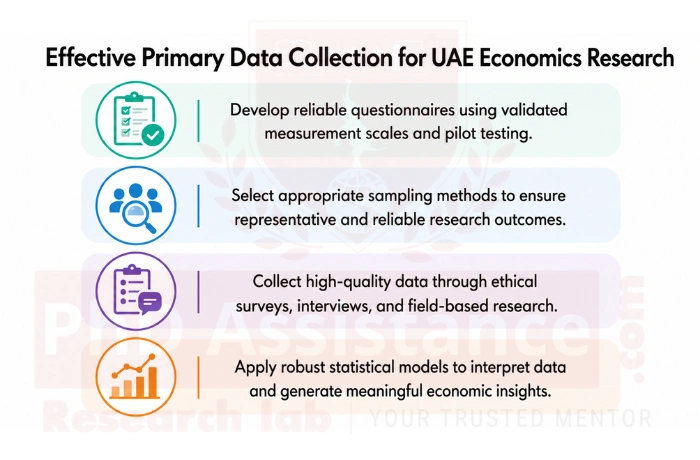
It is best to use existing, validated measurement instruments, if applicable, and break questionnaires into three areas: demographics, behavioural items and items about a specific construct. Closed-ended questions, such as Likert scales, tend to offer more consistency for quantitative research of economic studies.
Whenever possible, researchers should make use of previously validated measurement scales, arranging questions within the survey or questionnaire by section into demographics, behavior, and measures of the constructs of interest. Closed-ended Likert scales provide a more consistent response for use in an econometric analysis.
Prior to collecting data on a large scale, pilot testing has been done to look for possible ambiguous wording or bias responses, as well as possible errors in measurement. Internal consistency then needs to be confirmed via Cronbach’s Alpha and Composite Reliability.
Example:
As mentioned by Hair et al. (2022), a validated survey instrument allows for enhancing construct reliability of the measure, reduce error and increasing accuracy in studies related to social and business Sciences. Based on the findings that quality survey instruments increase the accuracy of empirical results in studies.
Step 2: Select Appropriate Sampling Methods in Economics
The sampling methodology chosen to obtain these respondents is an important one, and should also be considered alongside developing the actual questionnaire. If too narrow or selective, results cannot be generalised beyond the selected study population and may not be statistically sound.
It may be possible to utilise the probability sampling method (simple random, stratified and cluster) when aiming to draw inferences on a specific population level. Probability methods are suitable if a research group consists of specialist economists. The FinTech sector of entrepreneurship, decision-making or investing specialists. Sample size estimation. It is advisable to select an appropriate sample size through statistical power calculation or by the utilisation of specific guideline methods.
Example
Memon et al. (2023) provided insight as to how structural equation modelling (SEM) and partial least squares structural equation modelling (PLS-SEM) analyses benefit significantly if appropriate sampling strategies are selected. They conclude that representative samples result in reliable parameter estimates and a valid model structure.
Step 3: Implement Effective Primary Data Collection Methods
After creating the questionnaire design for economic research, a primary data collection method must be considered appropriate according to the research. Online surveys, structured interviews, field surveys, and focus groups may be included under this methodology. Various data collection methods can be combined when employing a mixed-method methodology.
Growing reliance on online questionnaires in the UAE economic study reflects ease of gathering responses from business managers, entrepreneurs, finance managers and consumers on one side and their lower data collection costs on the other.
Researchers should acquire consent of participants, safeguard the privacy of their answers and adhere to the university’s ethics in human subject research policies. The proper management of response rates and of missing data also determines a quality data set.
Example: Aguinis et al (2021) found that digital administration of survey questionnaires may lead to higher levels of response efficiency if rigorous sampling techniques, survey reminders and good questionnaires are applied, resulting in greater research validity.
Step 4: Apply Economic Analysis Models for Data Interpretation
However, the mere gathering of data does not lead to significant findings from your research. Economists need to use appropriate Economic Analysis Models that best suit the kind of answers they are looking for.
Several analytical methods are often used: multiple regression, panel data, Structural Equation Modelling (SEM), PLS-SEM, mediator analysis, moderator analysis and logistic regression. By these modelling techniques, the researcher assesses policy changes, causal relations, and behavioural intentions.
Researchers must test assumptions on normality, multicollinearity, heteroscedasticity, and model fit before reporting results.
Example: PLS-SEM, and therefore economic researchers use to analyse our data, have robust descriptive statistical capabilities of our complex economic models containing several latent constructs, as evidenced by Sarstedt et al. (2022), which highlight how to develop economic models, using statistical modelling to enhance economic theories.
Step 5: Ensure Data Quality and Demonstrate Research Contribution
Finally, researchers should assess and verify data quality as well as demonstrate originality through construct validity analyses, CFA, evaluation of convergent and discriminant validity and robustness tests, if any may seem appropriate.
Common method bias, non-response bias and measurement invariance will be identified to strengthen the research quality. Additionally, research clearly stating its contribution to economic theory, policy or business development in the UAE is preferable. Structured Primary Data Collection Methods help the quality of the dissertations to increase and leads to a higher possibility of their publication in top international journals.
Example: As stated by Guenther et al. (2023), robust validation and full model assessment would significantly increase confidence in empirical studies where modelling is carried out under the framework of a latent variable approach, especially for studies from business research and economics.
Strategies for Effective Primary Data Collection
Conclusion
Effective collection of primary data lies at the heart of strong, meaningful PhD research on economics, because through carefully considered questionnaires, rigorously applied sampling designs, responsible data collection processes and suitably advanced economic analysis methods, economists may gather the empirical evidence, which can make a meaningful contribution.
Given the UAE’s increasing focus on growing the knowledge economy and implementing evidence-based policymaking, there are ample research opportunities for PhD students to delve into a variety of topical economic problems regarding extensive primary research. Adopting an orderly process strengthens research quality, increases the chances of gaining publications and contributes to the economy in a real manner.
Getting assistance from a reliable PhD Primary Data Collection Help in UAE with PhD Assistance Research Lab can help researchers in the formulation of strict methods, acquisition of accurate data and production of high-standard results.
References
- Aguinis, H., Villamor, I., & Ramani, R. S. (2021). MTurk research: Review and recommendations. Journal of Management, 47(4), 823–837.
- Hair, J. F., Hult, G. T. M., Ringle, C. M., & Sarstedt, M. (2022). A primer on partial least squares structural equation modelling (PLS-SEM) (3rd ed.). Sage.
- Guenther, P., Guenther, M., Ringle, C. M., Zaefarian, G., & Cartwright, S. (2023). Improving PLS-SEM use for business marketing research. Industrial Marketing Management, 111, 127–142. https://doi.org/10.1016/j.indmarman.2023.03.010
- Memon, Mumtaz & Ramayah, T. & Cheah, Jun-Hwa & Ting, Hiram & Chuah, Francis & Cham, Tat-Huei. (2021). PLS-SEM STATISTICAL PROGRAMS: A REVIEW. Journal of Applied Structural Equation Modeling. 5. i-xiv. 10.47263/JASEM.5(1)06.
- Sarstedt, Marko & Ringle, Christian & Cheah, Jun-Hwa & Ting, Hiram & Radomir, Lacramioara & Moisescu, Ovidiu. (2020). Structural model robustness checks in PLS-SEM. Tourism Economics. 26. 531–554. 10.1177/1354816618823921.