
How to Conduct PhD Big Data Analytics in USA Engineering: Using Multimodal AI and Deep Learning Models
Sustainable Practices in Environmental Science
- Step 1: Identify Core Literature in Big Data Analytics and Multimodal AI
- Step 2: Critical Literature Review and Research Gap Identification
- Step 3: Apply Theoretical and Computational Frameworks
- Step 4: Evaluate Methodologies and Deep Learning Models
- Step 5: Develop Research Questions and Contributions
- Strategies for Strong PhD Engineering Big Data analytics
- Conclusion

Recent Post
Introduction
The growth of Big Data Analytics is significantly impacting USA engineering research, optimising intricate engineering systems for areas such as smart manufacturing, infrastructure engineering, and autonomous systems. Previous engineering analytics are generally single-source and structured, which makes them incapable of effectively modelling complex behaviours and interactions within the natural environment.
Recent research has shown that deep learning-based multimodal systems are highly competent in engineering areas. Wang et al. (2024) published work in IEEE Transactions on Industrial Informatics which shows that the fusion of vibration data and thermal images could be helpful to improve the detection accuracy of an industrial monitoring system.
Likewise, in Mechanical Systems and Signal Processing, Liu et al. (2023) reported the performance of deep neural networks that overcome traditional statistical techniques in predictive maintenance by considering nonlinear temporal relations of sensor readings. This research proves that PhD Big Data Analytics in USA is moving toward multimodal and deep learning frameworks to improve engineering decision-making.
What you will learn?
Step 1: Identify Core Literature in Big Data Analytics and Multimodal AI
High-impact, peer-reviewed papers are crucial when researching Engineering Big Data Analytics. The literature needs to be searched from IEEE, ACM, Springer, and Elsevier databases. The focus needs to be on multimodal fusion techniques, distributed computing, and deep learning models for applications in engineering such as smart grids, robotics, and structural structural health monitoring.
Zhang et al. (2024) found that transformer-based multimodal models considering both sensor and image inputs enhanced anomaly detection accuracy by over 15% for industrial IoT systems using the IEEE Internet of Things Journal. The research emphasised that cross-modal attention mechanisms can capture sophisticated dependencies between multimodal engineering data.
Example:
Bitam et al. (2025) in Expert Systems with Applications demonstrated how integrating structured sensor data with unstructured maintenance logs through deep learning methods improved predictive maintenance in manufacturing systems. Both studies highlight the requirement for mapping structured literature in Big Data Analytics Research engineering disciplines.
Step 2: Critical Literature Review and Research Gap Identification
A comprehensive literature review on Big Data Analytics should analyse not just model performance but also constraints like interpretation, scalability, and on-time deployment limitations. Though most Deep Learning Models for Research provide high accuracy, they have not been interpretable in making decisions, which is highly required for safety-critical engineering applications.
To further illustrate this issue, Li et al. (2024) in the journal Engineering Applications of Artificial Intelligence demonstrated that while CNN-LSTM hybrid models can successfully carry out fault detection tasks, the opacity of black-box models limits their application in high-safety-critical domains such as those present in aerospace engineering.
Shortcomings in prior research can be highlighted by changes in the market, technology, policy or problems within the research topic, and errors in studies carried out before. This identification will justify the current study and support key research questions.
Example
Bala et al (2024) published in Reliability Engineering & System Safety stating that many predictive maintenance models cannot be deployed to edge devices. Thus, there is a distinct research opportunity on developing the real-time light weight and interpretable multimodal AI for Engineering Big Data Analytics Research.
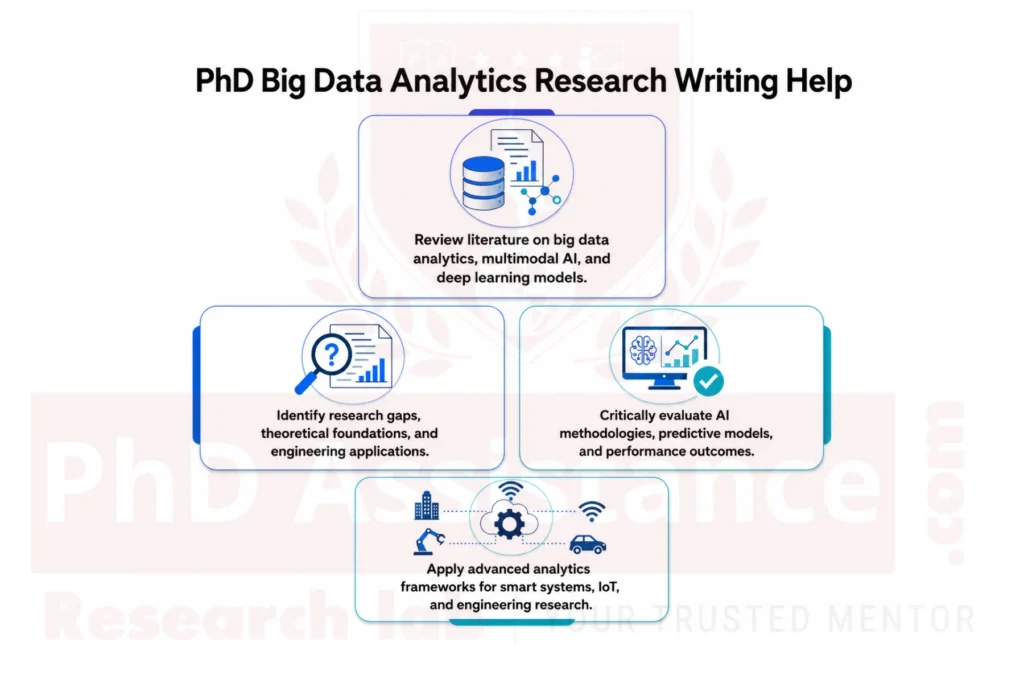
Step 3: Apply Theoretical and Computational Frameworks
Engineering Big Data Research’s theoretical frameworks include information fusion theory, cyber-physical systems and deep learning optimisation models. Such frameworks assist heterogeneous engineering data fusion and enhance decision-making of system-level functions. Multimodal transformer architectures and graph neural networks are adopted for modelling complicated dependencies within engineering systems more frequently.
The transformer architecture proposed by Vaswani et al. (2017) has already been extended to engineering applications of multi-modal data fusion. Recently, Chen et al. (2024) in IEEE Transactions on Neural Networks and Learning Systems used transformer-based fusion models in structural health monitoring, which achieved a high accuracy on damage detection through cross-attention between vibration and acoustic signals.
Example: Furthermore, Zhang and Zhao (2023) show that graph neural networks can be used to model spatial relationships within smart infrastructure systems. These research efforts are exemplary of how deep learning models underpin modern Multimodal AI in Engineering Research.
Step 4: Evaluate Methodologies and Deep Learning Models
Identifying strengths and weaknesses of machine learning and deep learning techniques is a crucial task for Big Data Analytics Research in USA engineering. The widely used methods are CNNs for image-based tasks, LSTMs for sequential tasks, and transformers for multimodal fusion tasks.
He et al. (2024) conducted a study and proved the superiority of Vision Transformers over CNN-based methods in manufacturing systems surface defect detection by their more powerful global feature extraction ability; however, they also raised more computing power requirements as a drawback in IEEE Transactions on Industrial Informatics.
Likewise, Mateus et al. (2023) show in Neurocomputing that hybrid CNN-GRU models increase predictive maintenance accuracy for rotating machines but do not scale effectively for large industrial environments. The works suggest that while deep learning is a viable approach, optimisation is needed for time-critical and real-time execution in Engineering Big Data Analytics.
Step 5: Develop Research Questions and Contributions
Regarding research questions for a PhD in Big Data Analytics in the USA, the emphasis should be on making systems understandable, scalable and able to handle multi-modality effectively for engineering applications. Integrating deep learning with explainable AI to make decision-making more interpretable in safety-critical engineering systems is one effective research path.
As shown in Singh et al.’s (2024) study on expert systems with applications, they developed an explainable multimodal framework for predictive maintenance and achieved impressive accuracy. With the help of SHAP values to interpret the models.
Example: Zhou et al. (2023) from IEEE Access further emphasised the importance of energy-efficient multimodal architectures for edge-based industrial IoT devices. The findings clearly imply that further research needs to target developing energy-efficient, lightweight, interpretable and scalable models to meet the demands of Engineering Big Data Analytics.
Strategies for Strong PhD Engineering Big Data analytics
Conclusion
The PhD research in Big Data Analytics in USA engineering is growing fast and has been evolving with the application of Multimodal AI and Deep Learning Models. It is universally recognised that fusion with multimodal data helps to improve the prediction accuracy of the engineering system, and deep learning helps in recognising complex patterns. However, there are limitations and difficulties in interpretation, scalability, and real-time processing.
According to recent peer-reviewed studies IEEE, Elsevier, Springer) there appears to be a consensus in the industry on efficient, explainable hybrid AI applications. Therefore, the following PhD research should target building dependable, hybrid and multimodal systems which offer the best trade-off between performance and accuracy with high interpretability. This will enable efficient use in Big Data analytics Research in Engineering.
Get professional customised big data analytics support for your multimodal AI and deep learning models from experts at PhD Assistance Research Lab.
References
- Wang, Y., Yu, W., Yu, C. et al.A survey on multimodal learning for industrial diagnostics: a data dimensionality perspective. Artif Intell Rev 59, 126 (2026). https://doi.org/10.1007/s10462-026-11527-4
- Chen, Z., Chen, D., Zhang, X., Yuan, Z., & Cheng, X. (2022). Learning graph structures with transformer for multivariate time-series anomaly detection in IoT. IEEE Internet of Things Journal, 9(12), 9179–9189. https://doi.org/10.1109/JIOT.2021.3100509 .
- Zhang, Y., Lin, L., Huang, Y., Wang, X., Hsieh, S. Y., Gadekallu, T. R., & Jalilpiran, M. (2024).A cooperative vehicle-road system for anomaly detection on vehicle tracks with augmented intelligence of things. IEEE Internet of Things Journal, 11(22), 35975–35988. https://doi.org/10.1109/JIOT.2024.3398023
- Chen, Z., et al. (2022). Learning graph structures with transformer for multivariate time-series anomaly detection in IoT. IEEE Internet of Things Journal. https://doi.org/10.1109/JIOT.2021.3100509
- Mateus, B. C., Mendes, M., Farinha, J. T., & Martins, A. (2025). Hybrid Deep Learning for Predictive Maintenance: LSTM, GRU, CNN, and Dense Models Applied to Transformer Failure Forecasting. Energies, 18(21), 5634. https://doi.org/10.3390/en18215634
- Bala, A., Rashid, R.Z.J.A., Ismail, I. et al.Artificial intelligence and edge computing for machine maintenance-review. Artif Intell Rev 57, 119 (2024). https://doi.org/10.1007/s10462-024-10748-9
- Bitam, T., Yahiaoui, A., Boubiche, D. E., Martínez-Peláez, R., Toral-Cruz, H., & Velarde-Alvarado, P. (2025). Artificial Intelligence of Things for Next-Generation Predictive Maintenance. Sensors, 25(24), 7636. https://doi.org/10.3390/s25247636
- Zhou, X. Chen, E. Li, L. Zeng, K. Luo and J. Zhang, “Edge Intelligence: Paving the Last Mile of Artificial Intelligence With Edge Computing,” in Proceedings of the IEEE, vol. 107, no. 8, pp. 1738-1762, Aug. 2019, doi: 10.1109/JPROC.2019.2918951.