
Critical Review of Thirty-five years of sensemaking in the business & management research: a bibliometric analysis, review and discussion
Introduction
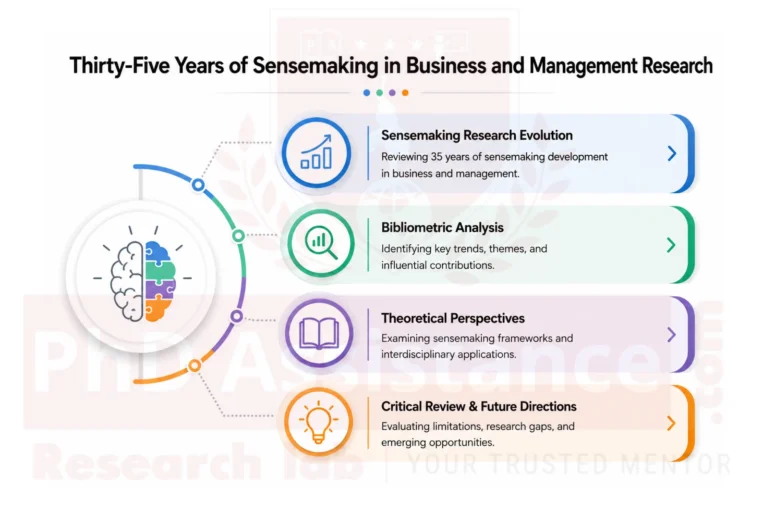
Sensemaking in Business is super influential for grasping how folks and firms make sense of chaotic, unpredictable worlds. After Karl Weick brought it into organisational studies, the theory took off. Now, researchers use it to look at organisational change, crisis management, leadership, strategy, innovation, and decision-making – there’s no stopping the trend. Eckstein et al.’s (2025) piece, “Thirty-Five Years of Sensemaking in Business & Management Research: A Bibliometric Review and Discussion,” examines how sensemaking research has progressed in biz over three and a half decades. They offer a deep look at the main shifts and growth in this field.
Unlike traditional literature reviews, this study uses Bibliometric assessment to look at 2,838 articles from 1988 to 2023. The goal is to spot how Sensemaking in Business and Management Research has grown, see what’s popular now, and hint at where research might head next. With uncertainty, digital change, and resilience becoming super important, the article offers great insights into Organisational Sensemaking and why it matters in today’s Business Research.
Summary of the article
The article looks at the growth and future of sensemaking research through a big bibliometric review of 2,838 papers from the Web of Science database. It focuses on three main questions: how sensemaking research developed, what’s hot now, and where it might head next. The study uses performance analysis and science-mapping techniques like co-citation analysis, keyword co-occurrence analysis, and clustering to spot key authors, journals, themes, and theory advances.
The findings show sensemaking research has grown since its start in 1988. Publications have risen a lot too. Four big groups stand out: communication and organisational learning, sustainability and corporate social responsibility, innovation and strategy, and crisis management.
The authors also point out how marketing and international business are becoming super important in sensemaking research. They wrap up by saying that sensemaking is still really useful for understanding how orgs handle uncertainty. Plus, they suggest some cool new paths for studying this, like tying it to marketing, international biz, strategic management, and different views.
Critique
Significance and contribution of the field
One of the major strengths of this study is its comprehensive examination of Sensemaking in Business Research across multiple disciplines. Unlike previous reviews that focused on limited samples, the authors analyse a substantially larger dataset comprising 2,838 publications, providing a broader understanding of the field’s evolution. This represents a significant advancement over Cristofaro’s (2022) review of 402 studies and Turner et al.’s review of 60 studies.
The study shows that Organizational Sensemaking goes beyond just crisis management to include things like marketing, sustainability, innovation, and international business. This finding backs up Christianson and Barton’s (2021) idea that sensemaking research should study beyond its limitations.
The article does a great job of showing how Karl Weick’s work affects management today. It backs up Weick et al.’s (2005) idea that sensemaking works in various organisational settings. By looking at new topics like sustainability and marketing agility, the study grows our understanding and shows that Sensemaking still matters in current orgs.
Though it does have some strengths, the study mostly just maps the literature rather than diving into theoretical inconsistencies or debates. It identifies trends pretty well but fails to illustrate how sensemaking operates in different real-world settings. So, it ends up lacking practical insights.
This study’s main strength is its thorough Bibliometric Analysis of 2,838 publications, offering a wider view than earlier reviews like Cristofaro (2022). It backs up Maitlis and Christianson’s (2014) idea that communication, sensegiving, and sensebreaking are crucial for Organisational Sensemaking. Plus, it confirms Gioia et al.’s (2013) point about the ongoing prevalence of qualitative research in Management Research.
Methodology and research design
The study’s strengths lie in its methodological approach. The authors use a systematic Bibliometric Assessment with performance analysis and science-mapping techniques. They examine a big set of publications through co-citation analysis, keyword co-occurrence mapping, and clustering algorithms. This gives a solid, unbiased look at how sensemaking research developed.
We used 2,838 articles from the Web of Science to make our study more reliable and analyse trends better. Unlike narrative reviews, our bibliometric approach cuts down on bias and gives us hard data on publishing patterns, key players, and new research topics.
Still, some methodological approaches exist. The research depends solely on the Web of Science and skips Scopus, Google Scholar, and other databases. So, important studies might have been left out. Also, focusing only on English publications restricts the worldwide reach of sensemaking research. These problems match what Zupic and Čater (2015) pointed out – that choices in databases and citation biases can mess with bibliometric studies. So, even though the method is solid, results need to be understood with these limits in mind.
This study builds on Christianson and Barton’s (2021) work by pointing out new research areas like marketing and international business. Unlike Weick (1995), who mainly took an interpretivist view, the authors think realist approaches could help too in developing Sensemaking Theory. Still, their main focus is on spotting research trends rather than analyzing different theories deeply.
Theoretical and Interdisciplinary Analysis
The article lays down a solid theoretical base, following Theory back to Karl Weick and others like Brenda Dervin, Gary Klein, Daniel Russell, and David Snowden. It dives into Weick’s framework, including the SIR COPE model, showing key cognitive and social processes.
The study shows how sensemaking research connects different fields like marketing, international business, and strategic management. This fits with Maitlis and Christianson (2014), who say sensemaking can explain many organisational things across various areas. So, the finding supports their view that it’s an umbrella concept for diverse phenomena.
The discussion stays descriptive, though. While the article notes the philosophical tension between constructionism and realism, it doesn’t explore it deeply enough. Engaging more with current thoughts on creating and understanding org knowledge could’ve boosted its theoretical impact, though.
Though these are significant points, the theoretical section is still rather broad and generic. The study could’ve dug deeper into AI’s impact and explored some ethical theories like utilitarianism or deontological ethics. It also needs more interdisciplinary looksee. Comparing sensemaking with theories such as dynamic capabilities or organizational learning would slot it better into the wider management field. This could make the essay way more helpful for understanding management in AI settings.
Ethical Considerations
This study shows good ethical practice by taking a clear and open approach in its review of existing papers. The authors explain their search strategy, along with the inclusion and exclusion rules and the methods they used for analysis. They do this to boost the study’s credibility and make it easily reproducible, letting others check or expand on their work too.
The article also shines by giving proper credit to key scholars and important work in Sensemaking in Management Research. By rightly citing earlier studies and showing how Sensemaking evolved, the authors keep their academic integrity and help spread knowledge ethically in the field.
The study barely talks about the possible ethical issues with its approach to bibliometrics. Its dependence on the Web of Science database and exclusion of non-English papers could be problematic. Plus, there’s the issue of citation bias affecting Organisational Sensemaking research. Discussing these limitations more thoroughly would have made the study ethically clearer and more rigorous overall.
Writing Style and Structure
The article is well-organised, making it easy to follow. It moves from theory to methods and then to results and future directions. This helps readers understand the material. The author also uses visuals like co-citation networks and keyword clusters, which make the complex data easier to grasp.
The writing is academic but easy to follow, explaining Theory and Organisational Sensemaking clearly. The tables and visuals enhance the study’s readability and value for Business Management Research too.
The article mainly describes publication trends and research themes rather than critically assessing them. It points out new areas and theoretical views but barely touches on conflicts or debates. Still, a closer look at those disagreements would’ve made the study more impactful for Management Review.
Conclusion
This study presents value to Sensemaking in Business Research. Analysing 2,838 publications, the authors shed light on the growth, key topics, and future paths in theory and Organisational Sensemaking. They show how sensemaking is getting bigger in marketing, international business, sustainability, and strategic management too.
It reviews earlier work by Weick (1995, 2005), Maitlis and Christianson (2014), Cristofaro (2022), and Christianson and Barton (2021) while pointing out new paths for more research. Even with drawbacks like picking the right database, digging deep enough into theory, and testing ideas in real-world settings, it’s still a big help for scholars in Business Research. It adds a lot to the Management Research Review‘s collection too. The study essentially stresses the importance of using sensemaking to figure out how organisations handle uncertainty, complexity, and change.
“Are you facing challenges in writing a high-quality critical review for your research? The PhD Assistance Research Lab offers specialised guidance tailored to doctoral scholars and early-career researchers.”
Reference
- Christianson, M. K., & Barton, M. A. (2021). Sensemaking in the time of COVID-19. Journal of Management Studies, 58(2), 572–576.
- Cristofaro, M. (2022). The role of sensemaking in management studies: A systematic review and research agenda. European Management Journal, 40(1), 65–76.
- Eckstein, G., Shrestha, A., & Russo, F. (2025). Thirty-five years of sensemaking in the business & management research: A bibliometric analysis, review and discussion. Management Review Quarterly, 75, 3191–3217.
- Gioia, D. A., Corley, K. G., & Hamilton, A. L. (2013). Seeking qualitative rigor in inductive research: Notes on the Gioia methodology. Organizational Research Methods, 16(1), 15–31.
- Maitlis, S., & Christianson, M. (2014). Sensemaking in organizations: Taking stock and moving forward. Academy of Management Annals, 8(1), 57–125.
- Weick, K. E. (1995). Sensemaking in Organizations. Thousand Oaks, CA: Sage Publications.
- Weick, K. E., Sutcliffe, K. M., & Obstfeld, D. (2005). Organizing and the process of sensemaking. Organization Science, 16(4), 409–421.
- Welch, C., Piekkari, R., Plakoyiannaki, E., & Paavilainen-Mäntymäki, E. (2011). Theorising from case studies: Towards a pluralist future for international business research. Journal of International Business Studies, 42(5), 740–762.