
How to Develop a PhD Research Proposal in UAE Management: Applying Smart Cities, AI Strategy and Innovation Models
- Home
- Academy
- PhD Research Proposal
- How to Develop a PhD Research Proposal in UAE Management: Applying Smart Cities, AI Strategy and Innovation Models
Sustainable Practices in Environmental Science
- Step 1: Find Emerging Trends in Urban Sustainability and Smart City Model
- Step 2: Build a Strong Literature Review in Smart City Research
- Step 3: Design a Research Methodology for Smart City Management Studies
- Step 4: Connect Urban Sustainability with Smart City Governance
- Step 5: Analyse Data and Present Research Findings
- Step 6: Prepare a Publication-Ready Dissertation
- Conclusion

Recent Post
Introduction
UAE is one of the most prominent destinations for studying innovation-led management practices owing to the digital revolution that the country is witnessing, coupled with smart city developments and artificial intelligence strategies. There are plenty of opportunities available for students seeking to study innovation-led management practices thanks to government initiatives like the UAE Artificial Intelligence Strategy 2031 and the smart cities of Dubai & Abu Dhabi.
There is an increasing trend for many Management PhD students from the UAE to conduct research about topics that include smart cities, artificial intelligence strategy, innovation models, sustainable development, and organisational competitiveness. But writing an excellent PhD research proposal can be difficult as researchers need to determine their topic’s research gap, provide a basis in theory, prove their methodology, and prove the importance of their proposed study.
In this article, we’ll discuss how to write a PhD research proposal in the UAE management discipline that focuses on Smart Cities, Artificial Intelligence (AI) Strategy, and Innovation Models. PhD Research Proposal Writing Service in UAE will aid researchers in drafting their proposal in an organised manner.
What you will learn?
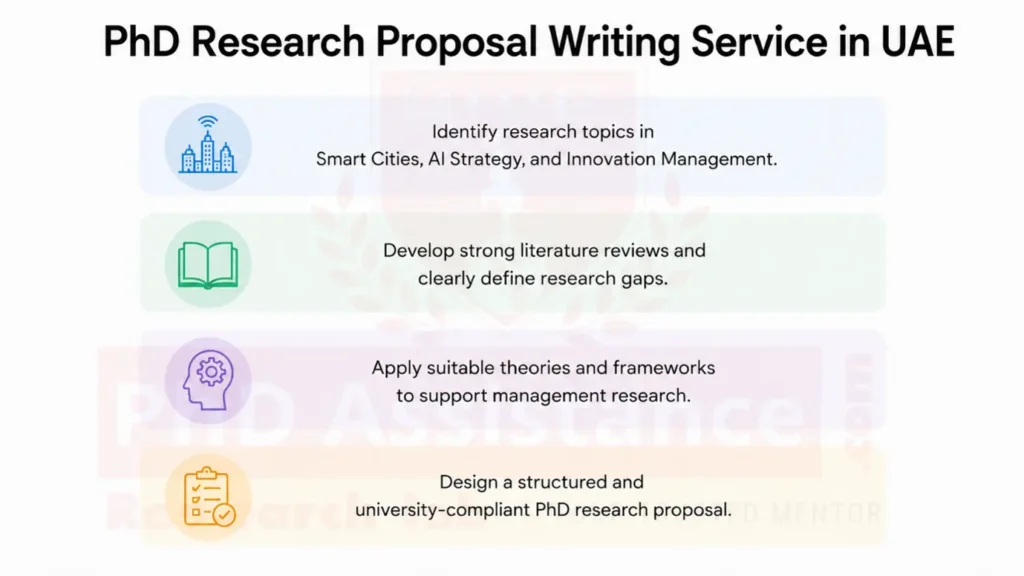
Step 1: Identify Emerging Research Topics in Smart Cities and AI Strategy
Topic selection for a thesis is the first step towards creating a great thesis proposal. Some emerging topics related to UAE management studies are: artificial intelligence-driven decision-making, digital transformation, smart governance, innovation management, technology adoption, and sustainable development of smart cities. These topics resonate well with the development agenda of the country and thus hold much promise for research.
Many doctoral students find it difficult to refine their general interests into specific researchable topics. The topic selected for your research should not only solve an identifiable management problem but also add value to either organisations, policymakers, or stakeholders in smart cities. Students seeking PhD Research Proposal Help in UAE are encouraged to get expert advice on translating their research interests into viable research topics.
It is also important that researchers determine whether there is enough literature available, along with theoretical and source material, for their topic choice. Early literature searches may prove useful in identifying gaps and assessing the feasibility of the selected topic.
Example: The research done by Bibri and Krogstie (2017) was about investigating how smart cities are built around concepts of information technologies, sustainability, and governance frameworks that can be used to manage the city. The research offers some promising areas for further investigation in smart governance, AI-powered decision-making, and digital innovation practices. A UAE Management PhD can hence explore the effects of AI-powered smart city projects on organisational innovation.
Step 2: Build a Strong Literature Review and Research Gap
The literature review presents the extent of the knowledge that the researcher is aware of and identifies the issues that require further investigation. Regarding management literature, the emphasis in this context should be on reviewing previous studies relating to the smart city concept and AI strategy.
Most students writing their PhD dissertations highlight previous studies but do not clearly identify research gaps. This results in poor proposals, since they will not bring out the weaknesses in the literature in terms of the disagreements within it, the limitations of the literature, and how the research may address such gaps in knowledge. Such gaps may be caused by changes in technology and environment..
The literature review also needs to make the conceptual links among important variables and offer a rationale for the research framework being proposed. This adds credibility to the scholarly groundwork for the research proposal and helps generate research questions and hypotheses.
Example
In a thorough analysis of the literature on digital transformation, Vial (2019) found that there were many gaps in relation to organisational and strategic change processes. These gaps offered UAE management scholars chances to examine the effect of AI strategy on innovation in smart city organisations.
Step 3: Apply Smart City, AI Strategy, and Innovation Models
The theoretical framework forms the bedrock upon which academic research is based. Proposals by management on the topic of smart cities and AI must, therefore, be based on theory explaining organisational behaviour, technology diffusion, and innovation performance.
Some of the most common theories include: Technology Acceptance Model (TAM); Diffusion of Innovations Theory; Resource-Based View (RBV); Dynamic Capability Theory; and Smart City Governance Models. Selection of an appropriate theory will assist in explaining the impact of technology in organisations. Researchers looking for Management PhD Proposal Writing Help need to choose the theories for their research and explain the linkages between variables.
Theoretical integration becomes especially relevant when researching AI and innovations due to several factors operating within the organisational setting at the same time. Theorists must provide a rationale for the chosen theories in relation to their research aims.
Example:
Innovation theory as developed by Rogers (2003) involved innovation diffusion in both organisations and society. The Innovation Theory can be used by an academic in the UAE to study innovation diffusion within government organisations through the use of AI technologies.
Step 4: Design a Research Methodology
A sound methodology supports the proposed research to provide answers to research questions. The researchers must justify the choice made about research philosophy, methodology, sample, data collection methods, and analysis.
Research on management issues, Smart City technologies, and artificial intelligence is usually conducted using quantitative surveys, qualitative interviews, or both together (a mixed-methods approach). The scholars involved in the Doctoral Research Proposal Writing UAE need to ensure that their methodology corresponds with their research purposes and goals.
Data collection and its analysis should also be presented. Some popular statistical procedures used in management studies include regression analysis, Structural Equation Modelling (SEM), and thematic analysis.
As noted by Hair et al. (2022), SEM is very powerful in studying the interrelationships between technology adoption, organisational capabilities, and innovations. In this manner, a UAE-based researcher interested in AI diffusion and innovation performance can utilize SEM.
Example: Anthopoulos, L. (2017) used qualitative case studies in investigating the topics of smart city governance and implementation, stressing the significance of stakeholder engagement and technological integration in cities.
Research methodology
Step 5: Develop Research Questions and Expected Contributions
Research questions form the basis of the research proposal as a whole. The questions need to be focused, measurable, and should answer the research gap. Moreover, there must be an exploration of what contribution the research can make to theory, practice, and policy. Proposals are considered by universities in light of their innovativeness and impact.
The well-formulated contribution part showcases the importance of the research in advancing management knowledge and aiding decision-making within the fast-growing digital economy of the UAE.
Example: Dwivedi et al. (2021) found important areas of future research relating to AI application in organisations. Their findings revealed that there was a need for more research regarding AI governance and innovation.
Strategies for developing a management proposal
Conclusion
Other emerging areas that can be considered important include Smart City, AI Strategy, and Innovation Model. These are among other areas that can serve as important bases for pursuing one’s doctorate and researching organisational transformation, adoption of technologies, innovation efficacy, and sustainability.
A good PhD research proposal demands proper choice of topic, thorough analysis of literature, correct theoretical basis, and suitable methodology. Choosing the correct process will give the required proposal structure aligned with university guidelines.
Get professional PhD Proposal Development Services UAE for your Smart City management Research from experts at PhD Assistance Research Lab.
References
- Bibri, S. E., & Krogstie, J. (2017). Smart Sustainable Cities of the Future: An Extensive Interdisciplinary Literature Review. Sustainable Cities and Society, 31, 183–212.
- Rogers, E. M. (2003). Diffusion of Innovations (5th ed.). Free Press.
- Hair, J. F., Hult, G. T. M., Ringle, C. M., & Sarstedt, M. (2022). A Primer on Partial Least Squares Structural Equation Modeling (PLS-SEM).
- Dwivedi, Y. K., et al. (2021). Artificial Intelligence (AI): Multidisciplinary Perspectives on Emerging Challenges, Opportunities, and Agenda for Research. International Journal of Information Management, 57.