
How to Format a PhD Manuscript in UAE Management: Following AI Research Publishing and Citation Standards
- Home
- Academy
- PhD Manuscript
- How to Format a PhD Manuscript in UAE Management: Following AI Research Publishing and Citation Standards
Sustainable Practices in Environmental Science
- Steps for Formatting a PhD Manuscript in UAE Management
- Structuring the Anatomy of the Document
- Formatting the Title Page and Abstract
- Applying Style and Citation Standards
- Formatting Figures, Tables, and Equations
- Preparing the Manuscript for an Indexed Journal Submission
- Formatting Challenges in AI-Based Management Manuscripts
- Conclusion

Recent Post
Introduction
Writing a PhD manuscript in UAE Management Academic research is expected to incorporate concepts related to Artificial Intelligence (AI), prediction models, digital transformation models, and other contemporary theories of management within publication-based academic writing. Contemporary management studies in the UAE examine artificial intelligence-powered organisational decision-making mechanisms, sustainability analysis, intelligence, and automation-friendly business operations.
The growing use of AI-Based Management Research in the UAE has revolutionised how PhD students develop their papers for publication in Scopus databases. Scholars are now required to be transparent about methodologies, accurate in citations, computationally reproducible, and to disclose any use of AI in the process of developing the manuscript.
Professional manuscript formatting in management studies has now expanded beyond traditional academic writing. Academics need to organise their manuscript according to journal guidelines, incorporating Explainable AI, analytical models, machine learning models, and organisational performance analysis into their scholarly articles. This article discusses how a doctoral dissertation on UAE Management can be appropriately formatted as per the AI research publishing standards, citation standards, and academic journal formats with the help of professional PhD Manuscript Formatting Help in UAE.
What you will learn?
Steps for Formatting a PhD Manuscript in UAE Management
1. Structuring the Anatomy of the Document
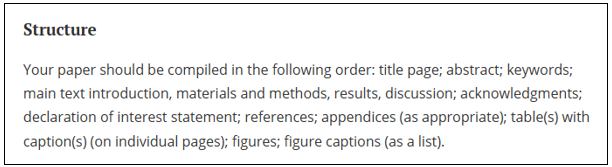
The structure of the manuscript pertains to the overall organisational structure of the PhD thesis based on the publication standards and the guidelines of the UAE University. An academic management paper must have coherent flow, coherence in concept, and coherence in analysis within all parts of the structure. This paper should follow the following format: title page, abstract, key terms, introduction, literature review, methodology, AI analytical model, results/ findings, discussion, conclusion, references, and appendices.
It is necessary to establish a relationship between objectives, methodology, AI analysis models, results and the implications for management by the authors. Consistent heading levels, proper paragraph structure, and logical development should exist throughout all the chapters of the manuscript. UAE management-related manuscripts on Artificial Intelligence require a clear demonstration of computational models, prediction analysis, and decision variables in their technically structured form. A customised PhD Journal Manuscript Formatting Help in UAE assists researchers in keeping their manuscripts well-organised and formatted in compliance with journal requirements.
Example: Below are the standards for structuring a manuscript in the Journal of Management Information Systems.
2. Formatting the Title Page and Abstract
The title page and abstract serve as the initial impression of the manuscript and greatly affect the publishing process, indexing, and reviewing perspectives. The title page must consist of the research title, the author’s name, institution, department details, degree, and submission information in line with university and journal standards.
The manuscript title must technically reflect the research variables, artificial intelligence, analysis method, organisational setting, and UAE management application. Manuscripts on artificial intelligence and management research must highlight the presence of predictive models, machine learning systems, organisational intelligence, or automation systems.
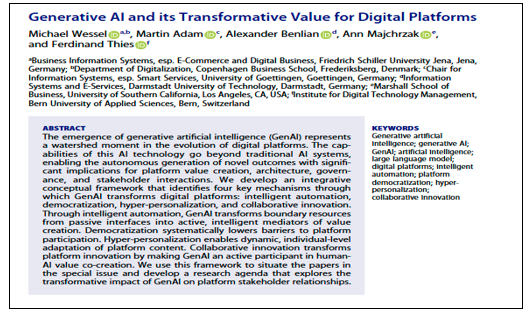
An abstract should give a summary of the purpose, methodology employed in the study, how AI analysis techniques have been used, findings, and the relevance of the research to business. The authors are advised to use relevant keywords such as Artificial Intelligence, Explainable AI, Digital Transformation, UAE Management, Predictive Analytics, and Organisational Performance that can be used to index the paper.
Example: The image reflects the standard for the title page in a manuscript from the study of Michael et al in the Journal of Management Information Systems.
3. Applying Style and Citation Standards
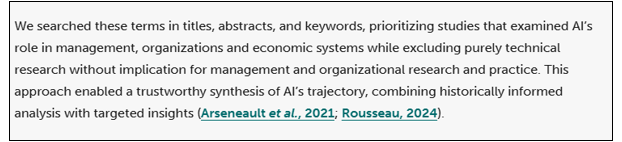
Referencing and citations are very important for ensuring academic integrity of a paper, maintaining accuracy in published papers, and preventing plagiarism in papers on management studies. There are many standard referencing styles that an author can choose to follow such as APA (7th edition), Harvard Referencing, or IEEE Citation Method.
In-text referencing needs to be consistent in reference format, DOI citation, dataset citation, and AI tool citation. Where AI is applied in management studies, the authors must cite the machine learning tools, computational tools, and datasets used in carrying out the research. To ensure accuracy and publishing requirements, many authors have started using professional PhD Manuscript Formatting and Citation Services.
In order to maintain accuracy and fulfil the publication standards, many students have begun to use PhD Manuscript Formatting and Citation Services.
Many software applications can be used to assist in citations and to minimise any errors. The use of AI technology in no way must compromise interpretation, theoretical or academic analysis. Scholars need to remain transparent when it comes to any AI-based analysis.
Example:
The image below shows the in-text citation in the APA formatting from the study by Cristofaro et al.
4. Formatting Figures, Tables, and Equations
The use of figures, tables, equations, and analysis charts may make the presentation of information in AI-based management studies much more understandable. The figures must effectively display results of predictive analysis, performance trends, AI models, automation structure, and relevant statistical relationships for the management decision-making context.
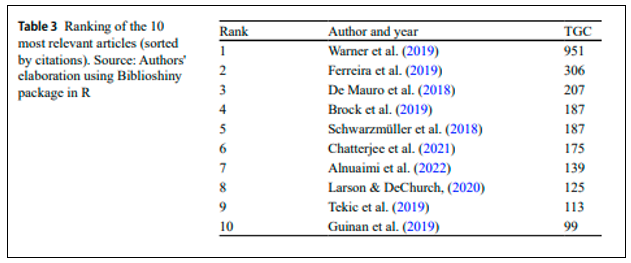
Figures should be appropriately numbered, captioned, have axis labelling, statistical measures, and definitions for variables to aid in comprehension during the review process. Tables should contain descriptive statistics, regression results, reliability tests, hypothesis tests, and management metrics through standardised formats of publishing. Academics often require structured Manuscript Formatting and Referencing Support to ensure that analytical visuals and statistical tables conform to journal standards.
Equations play an integral part in AI-based management papers when describing regression equations, prediction equations, optimisation processes, machine learning methods, and analytics validation systems. Scholars must preserve sequential equation numbering, proper definition of variables, and consistent mathematical notations when describing the business meaning of equations and analytics models.
Example:
Table formatting given in the image below from the study.
5. Preparing the Manuscript for an Indexed Journal Submission
Manuscript formatting, referencing, analysis, and ethical considerations must match the requirements of indexed journals at the last stage of manuscript development. Academic researchers are encouraged to make sure that all these aspects fulfil the necessary requirements of the journal.
It is important to conduct an academic review of the paper, its technical editing, statistical verification, formatting, plagiarism checking, and linguistic editing to enhance the chances of publishing the research paper successfully. The clarity of AI methodologies, predictive models, and analytical methods must also be ensured by researchers.
Professional manuscript polishing greatly enhances the chances of publication success, academic validity, analytical presentation effectiveness, and overall professionalism of the document within UAE management contexts.
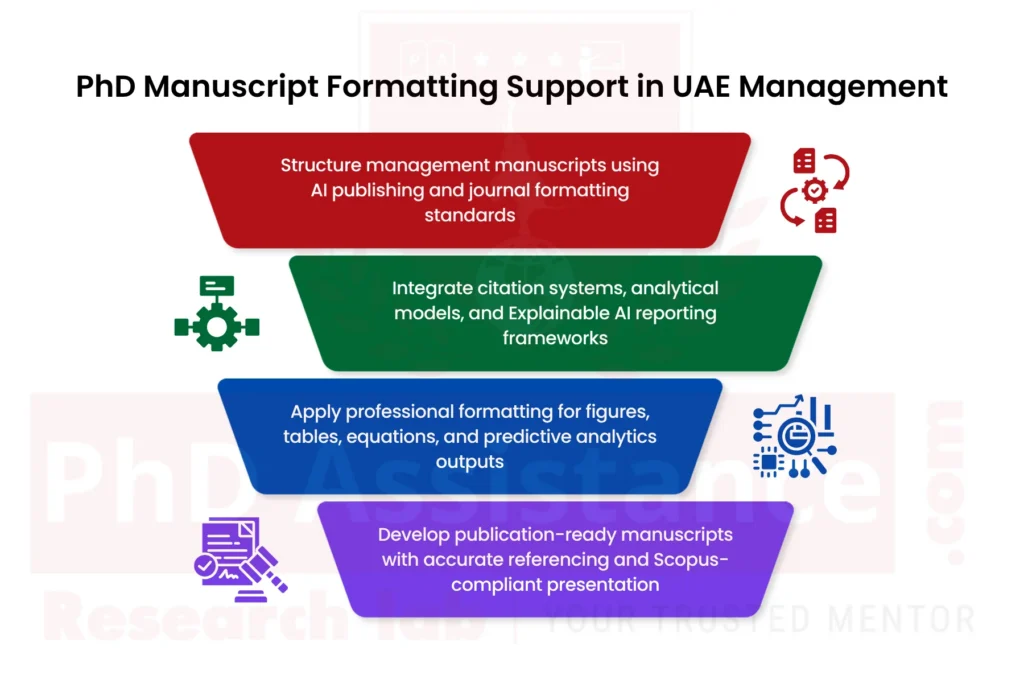
Formatting Challenges in AI-Based Management Manuscripts
The formatting difficulties that researchers often encounter include inconsistent referencing formats, inadequate AI methodology description, improper presentation of tables and diagrams, problems with equation formatting, AI output interpretation problems, violation of journal format requirements, plagiarism concerns, and inadequacy of analytical discussion formats. These difficulties make the papers less ready for publication and impact the quality of reviewers’ evaluations in management journals.
Conclusion
The process of formatting a manuscript in the UAE management studies requires the incorporation of sophisticated writing techniques, transparency in the use of AI in research, accurate citations, and formatting. Modern management research heavily relies on AI, predictive analytics, digital transformation, and Explainable AI.
The incorporation of structured anatomy of manuscript, professional title page and abstract formats, accurate citation mechanisms, and analysis tables and equations greatly enhances the quality, readability, and publishability of research.
Increase your research visibility and publication success with Academic Journal Manuscript Formatting Services for management research using AI technologies with PhD assistance.
References
- Wessel, M., Adam, M., Benlian, A., Majchrzak, A., & Thies, F. (2024). Generative AI and its transformative value for digital platforms. Journal of Management Information Systems.
- Cristofaro M, Giardino PL (2025), “Surfing the AI waves: the historical evolution of artificial intelligence in management and organisational studies and practices”. Journal of Management History, Vol. ahead-of-print No. ahead-of-print. https://doi.org/10.1108/JMH-01-2025-0002
- Bevilacqua, S., Masárová, J., Perotti, F.A. et al. Enhancing top managers’ leadership with artificial intelligence: insights from a systematic literature review. Rev Manag Sci 19, 2899–2935 (2025). https://doi.org/10.1007/s11846-025-00836-7