
Critical Review of Advancing international business research through artificial intelligence and machine learning applications
Introduction
In international business studies, a critical review involves the assessment of theories, methodologies, and interdisciplinarity in the study of management. Many researchers encounter difficulties when examining the dynamics of the contemporary business environment due to the inability of statistical tools to process extensive data sets.
The article “Advancing International Business Research through Artificial Intelligence and Machine Learning Applications” discusses the use of AI, ML, and computational intelligence within the realm of international business (IB). The paper analyses the potential that AI has within the IB environment for enhancing predictive analysis, theory construction, and methodology. This AI and machine learning applications critical review critically analyses the above article.
It integrates AI models and theories of international business to study legitimacy, foreignness, governance, institutional complexity, and multinational enterprises. This paper will contribute to the development of AI and ML in International Business Research through supervised learning, unsupervised learning, generative AI, and multimodal analytics in the context of business research.
Summary of the article
This paper examines how AI and ML techniques can help perform international business studies through the analysis of structured and unstructured big data. Some of the areas that have been covered in this paper include supervised learning, unsupervised learning, generative AI, neural networks, CNNs, RNNs, and GNNs.
The authors further note how artificial intelligence techniques increase predictability and provide more options than standard econometric models. This study provides examples of AI Applications in International Trade Research from previous studies, such as Ramani & Aguinis (2023) and Yiu et al. (2022), who used text analysis in IB literature and studied public sentiments on social media related to cross-border acquisitions, respectively.
The AI is both a technology and a new methodology that could potentially transform International Business Research. Additionally, this paper addresses some ethical concerns associated with artificial intelligence technology.”
Critique
Significance and contribution of the field
It creates a strong link between international business studies, artificial intelligence, and digital transformation research using its interdisciplinary approach. This study makes a remarkable contribution by illustrating how AI-enabled approaches transform theoretical and empirical studies in global business settings.
The paper is consistent with arguments by Lindner, Puck, and Verbeke (2022) that AI technology advances internationalisation studies through dynamic analysis techniques. Also, according to Ramani and Aguinis (2023), text analysis advances management studies because it reveals organisational stories.
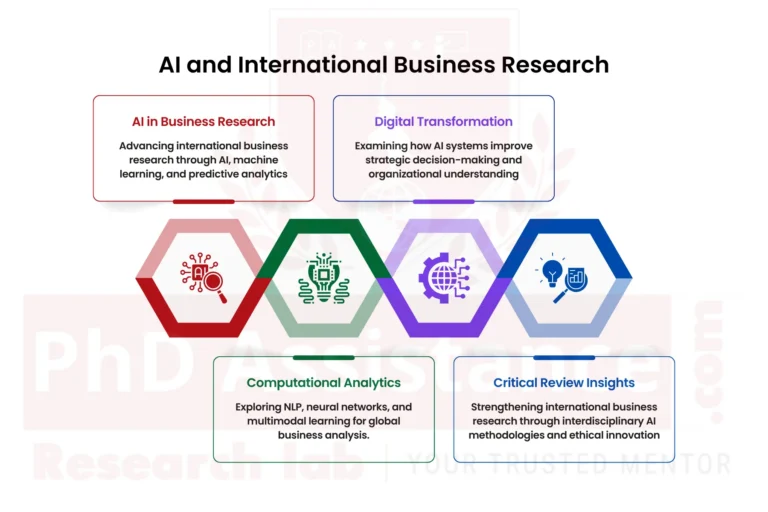
Some of the key contributions of the article include incorporating Natural Language Processing (NLP) and multimodal learning in business-related studies, predictive analysis, and facilitating collaboration between management studies and data science. The article is highly valuable for scholars studying international business, organisation studies, digital transformation, and Artificial Intelligence in Global Business Studies.
Methodology and research design
It adopts an approach that involves a review of concepts and methodologies used to elucidate machine learning systems within international business literature. The article groups artificial intelligence systems into four categories: supervised learning systems, unsupervised learning systems, generative artificial intelligence systems, and multimodal learning systems.
The analysis provides a clear idea of how neural networks, Bayesian models, CNN, and RNN work within predictive business research and organisational analytics. The methodological explanation successfully bridges theoretical artificial intelligence techniques with their real-life international business applications. The literature review mentions several empirical applications of the concepts, including Zhang et al. (2024)’s use of gradient boosting models to forecast multinational acquisitions, as well as the application of BERT analysis for cultural foreignness analysis in international business by Gu et al. (2025).
It is further emphasised in the article that the analysis of textual data, visual data, and relational data can all be done at the same time. It makes the analysis more flexible and effective in the context of international business studies. However, the current article is rather theoretical than empirical; no actual empirical implementation has been described, and no comparison with traditional techniques has been provided.
Theoretical and Interdisciplinary Analysis
An interdisciplinary approach is evident in the article through the combination of international business theory, intelligent computation, organisation studies, and digital transformation theories. In their discussion of complex artificial intelligence systems, the authors achieve both clarity on the topic and theoretical validity from a business and management perspective.
It contributes to the debate on legitimacy, governance, institutional complexity, foreignness, and multinational strategy by looking at them from the perspective of computation. It states that with the aid of artificial intelligence (AI), scholars can examine the traditional theories in the field of IB. This is because of their ability to see patterns across organisations, institutions, and geography.
This study is relevant to digital transformation studies through its focus on the significance of AI to organisational understanding, prediction, and computerised decision-making. The limitation in this case is the lack of in-depth exploration of the challenges of using AI in interpretation with human-based qualitative approaches.
Ethical Considerations
Perhaps the best ethical contribution that this paper provides is through the issues of algorithmic bias, reproducibility, interpretability, and the management of AI-Driven International Business Research systems. The authors acknowledge that the machine learning system can give biased results if there are some imbalances within the dataset used to train the machine. Such an issue becomes important because AI-driven systems are increasingly being utilised in business.
These issues are related to the work conducted by Dwivedi et al. (2023), who underlined the significance of ethical AI governance in organisational and management studies. Additionally, the current article touches upon the problem of XAI and mentions such methods as SHAP and LIME models to enhance the interpretability of machine learning systems.
Writing Style and Structure
The paper exhibits a clear and professional writing style. The material is logically arranged into different concepts, such as categories of Machine Learning in Business Analytics, theoretical consequences, ethics, and potential avenues for further research.
The article provides an effective combination of technological and managerial descriptions to make complex AI technology understandable for business researchers. Summarised tables on machine learning implementations help enhance comprehension.
Nevertheless, some parts include complex technological language that might confuse readers who are not versed in computational intelligence systems.
Conclusion
The article adds considerable value by its contribution to the body of international business research and AI-driven methodology. It illustrates the extent to which machine learning techniques enhance predictive analysis and theoretical understanding in multinationals.
This research successfully incorporates supervised learning, unsupervised learning, generative AI, natural language processing (NLP) algorithms, and multimodal analysis techniques into international business methodologies. This research further facilitates AI and Machine Learning Applications in International Business by analysing the effects of computational systems on organisational and institutional research.
Despite the limitations regarding implementation and accessibility associated with the article, it does present key lessons on the future of research on business utilising AI. This is evident from the way the study shows how artificial intelligence is not merely a technology but also a methodological tool for future business research.
“Are you finding difficulties in writing an excellent critical review for your research paper? The PhD Assistance Research Lab provides professional support designed specifically for PhD students.”
Reference
- Gaur, A., Peng, E. L., Pattnaik, C., & Li, Y. (2026). Advancing international business research through artificial intelligence and machine learning applications. Journal of World Business, 61(3), 101725.
- Akter, S., Dwivedi, Y. K., Sajib, S., Biswas, K., Bandara, R. J., & Michael, K. (2022). Algorithmic bias in machine learning-based marketing models. Journal of Business Research, 144, 201–216.
- Andrews, D., Fainshmidt, S., & Gaur, A. S. (2026). Progress or perish: International business and the adoption of artificial intelligence. Journal of World Business, 61(1), 101689.
- Papagiannidis, Emmanouil & Mikalef, Patrick & Conboy, Kieran. (2025). Responsible artificial intelligence governance: A review and research framework. The Journal of Strategic Information Systems. 34. 10.1016/j.jsis.2024.101885.
- Lindner, Thomas & Puck, Jonas & Puhr, Harald. (2025). Artificial intelligence in international business: IB theory under augmented decision-making. Journal of World Business. 60. 101676. 10.1016/j.jwb.2025.101676.
- Ramani, Ravi. (2023). Using Field and Quasi Experiments and Text-based Analysis to Advance International Business Theory. Journal of World Business. 58. 101463. 10.1016/j.jwb.2023.101463.