
Call for Papers: Biomaterial Interactions at Cell–Tissue–Material Interfaces: From Fundamental Mechanisms to Biomedical Applications
Introduction
The biomedical field is facing rapid advancement in technology, with an increasing need for clinical evidence. Researchers develop better medical biomaterials through their study of how cells interact with different materials and tissues. The properties of materials display their different biological interactions through the interfaces between materials, which control protein adsorption, cell adhesion, immune modulation, and tissue integration.
The Special Issue of “Biomaterial Cell–Material Interactions” allows researchers to present their original research work, which explores basic mechanisms that govern biomaterial interfaces and their applications in biomedical engineering and regenerative medicine research. The issue demonstrates its interdisciplinary nature through its focus on interfacial phenomena instead of bulk properties, which are studied in the results of Surfaces and Interfaces.
It connects surface science, biomaterials, and cell biology through its experimental research, theoretical work and computational studies. The researchers must submit their work by 21 July 2027, which needs to be published in an internationally recognised journal that researchers can read from around the world.
Why publish in this issue?
Researchers can showcase their advanced studies, which establish links between basic interface science and its practical use in biomedical research through the Special Issue. The issue about the cell tissue material interface shows that biological effects from material surface interactions create treatment outcomes that testing methods cannot prove through bulk material property assessment.
Publishing in this issue offers several key advantages:
Scope
The Special Issue invites research papers and review papers on.
Contact PhD Assistance research lab today to publish your research papers in Scopus and PubMed-indexed journals!
Know More About This Issue
Researchers created dynamic environments through biomaterial interfaces, which enabled them to maintain continuous biological contact with artificial surfaces. The material interface between cells and tissue determines the success or failure of biomedical devices and implants, together with tissue-engineered constructs.
Scientists created predictive biological models through their research, which investigated biomaterial cell interactions and cells by merging actual experimental findings with results from their computer simulations. The Special Issue invites research submissions that investigate scientific progress while solving current challenges.
It is the case that any research evidence useful to direct application to other comparable settings, and where one can expect with a high degree of certainty that test techniques will result in consistent findings, will be outstandingly beneficial.
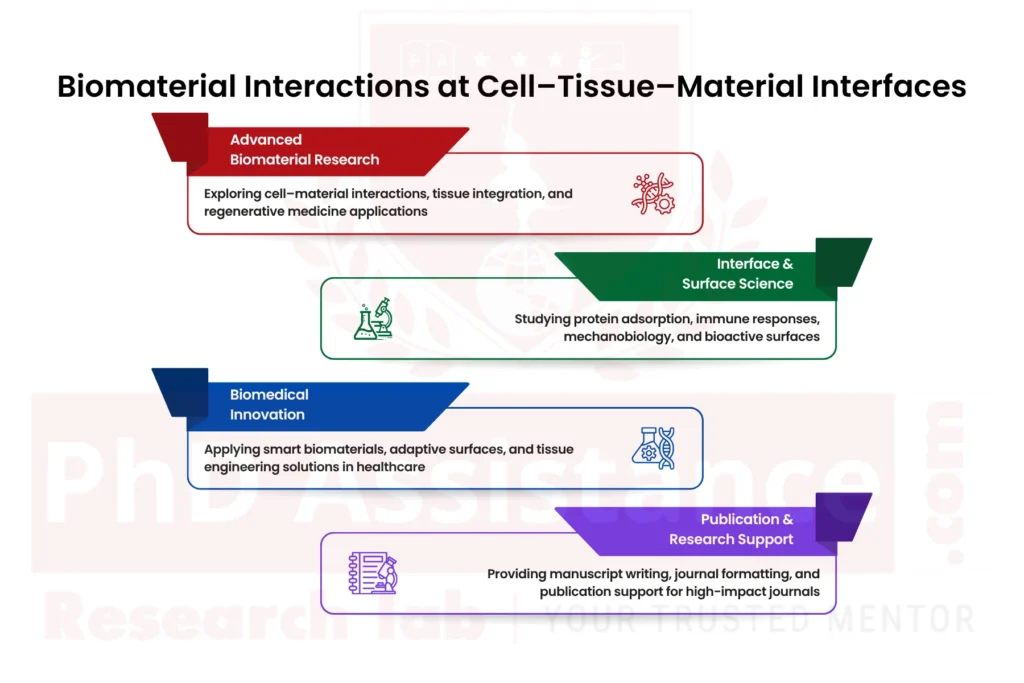
Key factors
How We Support Your Submission
The research publication process at high-impact journals requires scientists to conduct original research while demonstrating effective communication skills, their ability to organise work and their compliance with publication standards.
The PhD Assistance Research Lab helps researchers who require Special Issue manuscript development and submission support through comprehensive research assistance. We use precise academic research methods to demonstrate your research work. The authors receive our support to meet journal requirements while presenting their research results accurately.
The additional support we offer to researchers includes plagiarism detection services, data presentation support, and assistance with handling reviewer comments. Our team provides support to meet the high academic standards required for your “Biomaterial Interactions at Cell–Tissue–Material Interfaces” Research Paper, which will improve your chances of academic publication success.
Journal Guidelines:
The PhD assistance research lab offers structured manuscript writing and publication support to researchers. To submit a high-quality research manuscript to the special issue “cell–material interface mechanisms,” contact our experts today.
Free Guide: How to Write the Journal Manuscript
Book a free consultation to get guidance from the PhD assistance research lab for writing a credible research manuscript and submitting it in the high-quality journal.
Reference
Ratner, B. D. (2015). Biomaterials science: A perspective. Journal of Materials Science: Materials in Medicine, 26(7), 1–4. https://doi.org/10.1007/s10856-015-5497-2