
Critical review of Researcher Social and Emotional Wellbeing: A Qualitative Exploration of Workplace Supports and Self-Care Strategies While Engaging in Sensitive-Topic Research
Introduction
PhD students face difficulties with critical literature review development because they need to assess essential statements while discovering their advantages and disadvantages, and following university regulations. The research process for PhD studies, together with journal articles and proposals, becomes difficult due to these issues.
The article by Fiolet et al. (2026) explores Researcher social and emotional wellbeing by examining how Australian researchers experience workplace support and coping strategies during their sensitive-topic research work. The study identifies three primary problems, which include vicarious trauma research issues, insufficient support for researchers and the need for researchers to develop effective self-care strategies in academic environments that demand their performance.
Our experts at PhD Assistance Research Lab offer expert support in writing a comprehensive critical review for your research that effectively analyses the methodology, findings, research gap, and significance of the study.
Summary of the article
The article uses a qualitative research design, which includes in-depth semi-structured interviews with 42 Australian researchers from 13 universities and research organisations. The study participants researched various emotionally sensitive fields, which included suicide research, addiction studies, family violence work, sexual assault cases, child abuse investigations, chronic disease research and death studies.
Using reflexive thematic analysis, the authors identified two overarching themes:
- Researchers are being failed -The investigation proves that researchers face organisational neglect, which results from weak leadership, insufficient support mechanisms and the existence of an unfavourable work environment, and the university system’s failure to handle its obligations.
- An isolated fight for survival – Researchers deal with distress through exercise, nature experiences and personal reflection, and various self-care techniques, which they use to maintain boundaries and space from others.
Critique
Significance and contribution of the field
It makes a significant contribution to research on researchers’ social and emotional well-being because this area has not been thoroughly studied, although it exists as a vital component of research ethics that protects participants. The emotional impact on researchers is often overlooked by institutions that prioritise participant safety.
Scholars who experience Vicarious trauma in research through their work demonstrate this as a permanent research impact that affects their professional output. The discussion now moves from personal resilience to institutional responsibility.
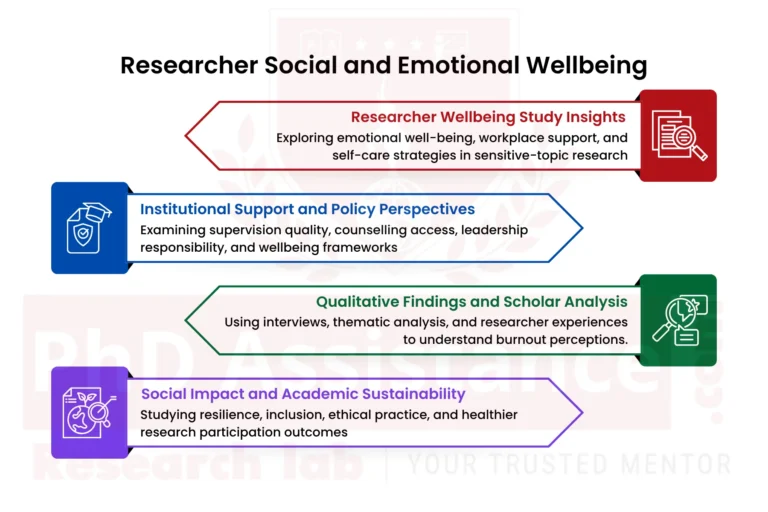
The article also contributes practically by identifying the need for:
The above findings deliver their informative knowledge to doctoral students, early career research scientists and professionals who work in research fields with high emotional demands.
Methodology and research design
The study needs qualitative semi-structured interviews to investigate emotional, perceptual, and coping and workplace cultural elements. The problems need extensive research because their resolution requires more than basic numerical evaluation.
The sample includes 42 participants from multiple institutions that produce diverse research findings. The researchers selected reflexive thematic analysis as their main methodology because it enables them to examine both research findings and underlying patterns in detail.
This study maintains its strength and effectiveness in exploring qualitative research wellbeing challenges.
If you are not sure how to analyse a literature like this, let the experts at PhD Assistance Research Lab conduct the critical review for your research.
Argumentation and Use of Evidence
The article uses thematic analysis together with direct participant quotes to create a persuasive argument. The citations provide proof for institutional failure claims, which explain emotional burnout and assistive resource access problems.
The authors show two different research methods that workplace systems fail to provide Workplace support for researchers.
The argument of Researcher burnout and coping strategies alone is especially compelling. The article supports its claims through actual experiences of people instead of using theoretical frameworks.
The results needed to demonstrate direct links to international university systems because this would enhance their worldwide use.
Ethical considerations and omissions
The study demonstrates good ethical practice. The establishment of a distress protocol enabled participants to give their informed consent while receiving support services. The lead interviewer organised research supervision together with reflective practice sessions to demonstrate proper research conduct.
The study demonstrates its main importance through its investigation of emotional risk.
However, some omissions remain:
Future studies could explore these areas to expand understanding of Self-care strategies for researchers across their entire career path and all their different identities.
Writing Style and Structure
The article establishes its structure through a sequence of background information, which leads to methods and findings, and then proceeds to discussion and policy implications. The text includes thematic headings, which make it easier to read and help readers understand difficult emotional situations.
The writing style maintains academic standards while remaining understandable to readers. The quotations from participants bring human character to the research while preventing its development into excessive theoretical abstraction.
The document requires shorter sections because some parts need better readability, yet the complete structure maintains its academic suitability for an ethics journal.
Conclusion
Fiolet et al. (2026) present their research study about researchers who investigate sensitive topics to show the current-day mental health needs of researchers. The article shows that universities do not establish suitable systems to help researchers who require emotional support. This forces researchers to manage their emotional challenges without any help.
The research demonstrates its primary value because workplaces must provide researchers with complete institutional support instead of basic services. The paper presents useful self-care methods that researchers can use daily, but it shows how self-care methods fail when organisational systems do not function effectively.
The study provides a significant academic contribution to the field of vicarious trauma research through its investigation of how researchers who experience burnout handle their work and their health status. The study requires additional international research comparisons that need to be tested through more diverse sampling methods.
“Are you facing challenges in writing a high-quality critical review for your research? The PhD Assistance Research Lab offers specialised guidance tailored to doctoral scholars and early-career researchers.”
Reference
Fiolet, R., Cullen, P., Brown, C. et al. Researcher Social and Emotional Wellbeing: A Qualitative Exploration of Workplace Supports and Self-Care Strategies While Engaging in Sensitive-Topic Research. J Acad Ethics 24, 23 (2026). https://doi.org/10.1007/s10805-025-09700-5