
Call for Papers: Advanced resilience assessment & enhancement for complex engineering systems exposed to multi-hazards
Introduction
The rapid rise of climate change effects and industrial development, together with changing technological dangers have raised the vulnerability of complex engineering systems (CESs) to multiple hazard situations. The natural disasters, together with human-made events, create situations that produce simultaneous, cascading and compounded interruptions. The assessment of system resilience for complex engineering systems has emerged as a vital research area in those situations.
The existing reliability methods face limitations because they cannot handle modern risk environments, which involve dynamic systems and interconnected elements. Infrastructure networks need advanced multi-hazard risk assessment frameworks that can track how different scales interact, manage uncertainty and identify system weaknesses. The interdependencies between sub-systems create stronger cascading effects, which establish cascading analysis as a vital part of resilience science research.
The Special Issue of Reliability Engineering & System Safety on Resilience assessment of complex engineering systems requests submissions of top-tier research that develops both the theoretical and practical aspects of resilience analytics through its quantitative modelling and AI-based techniques, and its advanced methods for improving critical system resilience.
Scope
The Special Issue presents modern methods that scientists use to assess resilience in advanced engineering systems that experience multiple hazards. The required contributions must include three fields of study, which are reliability engineering, dynamic risk theory and data-driven modelling techniques.
The submitted work should focus on two specific areas, which are cross-scale modelling methods and high-fidelity modelling techniques that improve infrastructure resilience assessment in areas facing multiple hazardous events. The research community should focus on studying multi hazard risk assessment techniques that apply to industrial systems, energy networks, transportation systems and essential infrastructure systems.
Dynamic performance tracking studies that use AI-based prediction tools and real-time monitoring systems, and optimisation algorithms to improve resilience strategies have high research value. The field of research benefits from contributions that analyse cascading failures in interdependent networks and Natech events, which are triggered by natural disasters.
Know More About This Issue
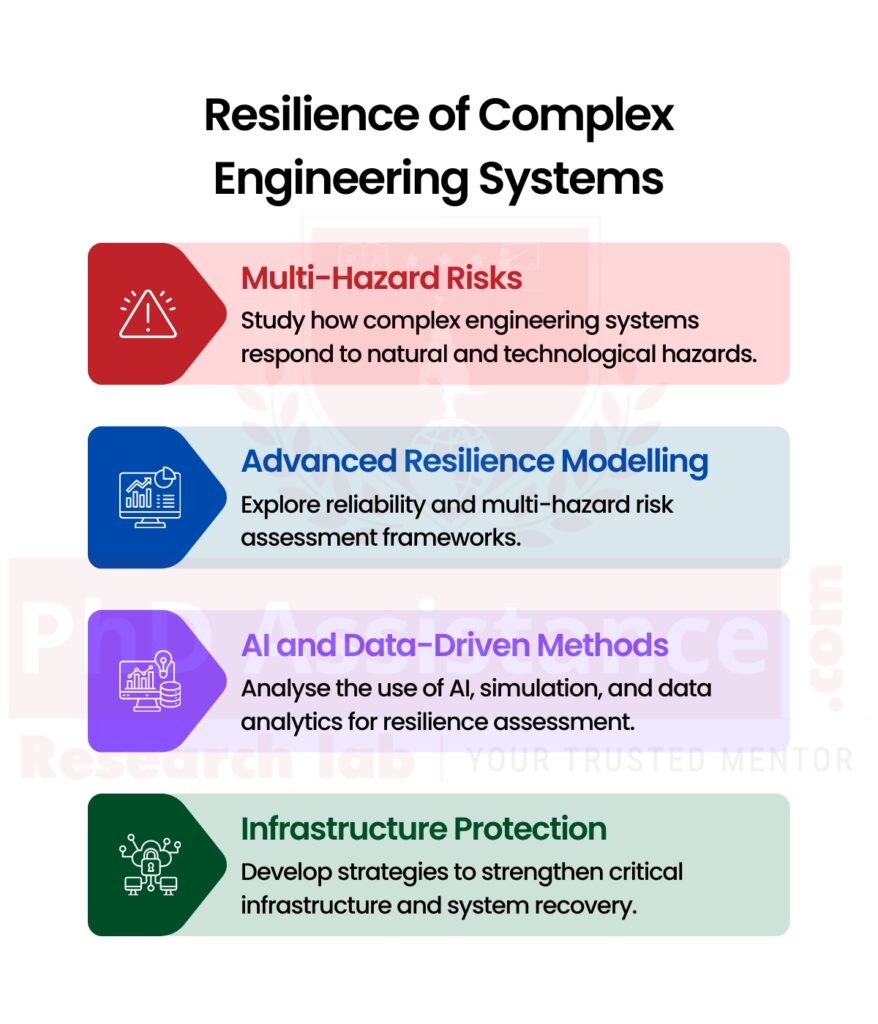
Volatility impacts modern engineering systems because climate change events, industrial growth, and technological advancements create new challenges for the systems. The systems require assessment of both their reliability and their ability to adapt and recover. Advanced Resilience assessment of engineering systems enables stakeholders to quantify system robustness, recovery speed, and functional continuity under multi-hazard stressors.
The newest AI analysis technologies, which combine AI analytics with multi-scale simulation and network modelling, have created new ways to model infrastructure resilience. The development of deep learning and reinforcement learning methods now enables organisations to perform predictive multi-hazard risk assessments even when they lack sufficient data. The new technologies allow security experts to create better plans for critical infrastructure protection and manage their resources.
Researchers can create advanced resilience strategies through their work, which combines dynamic system monitoring with probabilistic modelling and optimisation algorithms.
Key Themes
Researchers can submit their manuscripts to study the following topics and additional areas of research:
- The assessment of resilience in complex engineering systems requires advanced assessment methodologies.
- The integrated frameworks enable assessment of multiple hazards through their risk assessment capabilities.
- The study examines how infrastructure systems experience failures that affect multiple levels of their operations.
- The infrastructure resilience modelling uses two distinct methods that operate through artificial intelligence and data-based systems.
- The resilience enhancement strategies use optimisation methods to improve systems under changing hazardous conditions.
- The simulation methods that use multiple fidelity levels together with network modelling techniques.
- The study quantifies reliability and resilience during environments that experience consecutive disruptive events.
- The study implements protection methods to secure critical infrastructure from Natech incidents and multiple hazardous situations.
How We Support Your Submission
Publishing in a high-impact Special Issue such as this requires rigorous research design, advanced modelling accuracy, and strict adherence to journal standards. Our research support services assist authors in preparing publication-ready manuscripts that meet the requirements of Reliability Engineering and System Safety.
We provide academic editing services together with technical editing services to improve the clarity and accuracy of Resilience assessment research from complex engineering systems. Our team offers methodological assistance to help researchers integrate AI-based prediction models with probabilistic risk assessment frameworks and cascading failure analysis techniques.
The organisation provides backing for structural alignment to fulfill requirements of journal formatting rules and citation standards, and graphical abstract creation and data presentation requirements. The team helps authors respond to reviewer feedback while developing stronger arguments for multi-hazard risk assessment and infrastructure resilience modeling and enhancement strategies, which will improve their chances of acceptance.
Journal Guidelines:
• Researchers must submit unpublished work, which includes original research or complete review articles that have not been published or submitted to other venues. The work should show new ideas that researchers developed through their research to improve resilience engineering and multi-hazard risk assessment fields.
• The authors must give their approval for the complete manuscript before the submission process begins, while showing all funding sources, institutional ties and potential research-related conflicts that could impact study results.
• The Guide for Authors of Reliability Engineering & System Safety establishes complete requirements that submissions must follow as mandatory rules for formatting and referencing, structural organization and ethical standards. The mathematical models need to be described together with their simulation procedures and validation methods because this description will enable others to achieve technical transparency and reproducibility.
• Manuscripts must be submitted through the Editorial Manager® online system. All required supplementary materials, figures and supporting data should be uploaded according to journal requirements.
• Authors must choose their article type as Special Issue during the submission process by selecting the article type which is designated as “VSI: RESS_Multi-hazard Resilience.”
• The process of double-blind peer review will assess all manuscripts through two independent experts who will determine their originality and technical quality, analytical depth, and clarity and their relationship to the Special Issue theme.
Important Dates
Submission Deadline: 28 February 2027026
To ensure successful and timely submission to the special issue “Advanced resilience assessment & enhancement for complex engineering systems exposed to multi-hazards,” researchers are encouraged to seek expert publication support from conceptualisation to final submission.
Free Guide: How to Write the Journal Manuscript
Book a free consultation to get guidance from the PhD assistance research lab for writing a credible research manuscript and submitting it in the high-quality journal
Reference
Reliability Engineering & System Safety. (2026, February 27). Call for papers: Advanced resilience assessment & enhancement for complex engineering systems exposed to multi-hazards. Elsevier. https://www.sciencedirect.com/journal/reliability-engineering-and-system-safety/call-for-papers