
What a citation is for
A citation is a short signal in your text that points to a full reference, telling the reader exactly where an idea, finding, quotation or piece of data came from. Styles differ in how they do this: author-date systems such as APA put the author and year in the sentence, numbered systems such as Vancouver use a bracketed number, and note systems use footnotes (American Psychological Association, 2020; International Committee of Medical Journal Editors, 2024). The style is a convention your university or journal chooses. The purpose is the same in all of them: to give credit, to let the reader check, and to show how your work connects to what is already known.
Researchers cite for many reasons. Studies of citing behaviour show that authors cite to acknowledge ideas, to support claims, to point to methods and data, to contrast their results with earlier ones and to position their own contribution (Bornmann & Daniel, 2008).
| Reason to cite | What it gives the reader | Example in a thesis |
|---|---|---|
| Help the reader understand | Background they can follow up if a concept is unfamiliar | Citing the paper that defined the construct you measure |
| Give access to further sources | A route into the literature behind your argument | Citing a recent systematic review of the field |
| Support a short technical paper | Detail that cannot fit on the page | Citing the full protocol or an earlier methods paper |
| Acknowledge earlier work | Credit for the ideas you build on | Citing the model your framework extends |
| Link your findings to others | A way to judge agreement or conflict | Citing the studies your results confirm or contradict |
| Avoid plagiarism | A clear line between your ideas and others' | Citing every paraphrase, quotation, figure and dataset |
Citations, credibility and verification
Citations make an argument credible because they make it checkable. A reader who doubts a claim can find the source and judge it. This is different from saying that a citation proves a claim is true: a citation shows where a claim comes from, and the source itself may be wrong, outdated or misread. Your responsibility is therefore to read what you cite, to check that it says what you say it says, and to prefer current, peer-reviewed or official sources where they exist.
Citing well also helps you as a researcher. Tracking sources as you read lets you fact-check your own draft, shows examiners and reviewers the range of your reading, and makes revision faster because you can return to the evidence behind each sentence. Over a career, careful citation is part of a reputation for reliable scholarship.
Citation and plagiarism
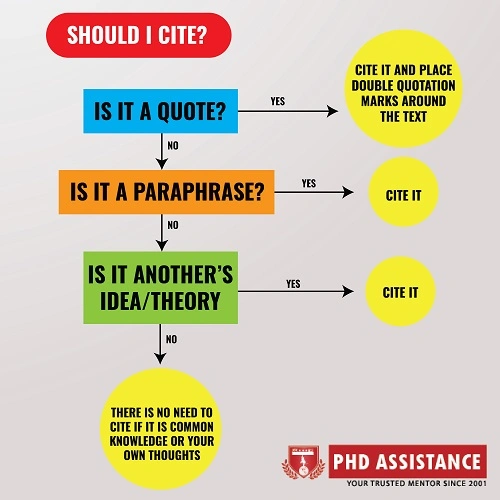
Plagiarism is presenting someone else's words, ideas, data or images as your own. It applies to paraphrases as well as quotations: putting a source into your own words does not remove the need to cite it. It also applies to your own earlier work. Reusing text from your published papers without attribution, sometimes called self-plagiarism, is governed by publisher and university rules on text recycling (Committee on Publication Ethics, 2024).
Consequences are set by institutional regulations, not by a single rule. In India, for example, the UGC regulations require institutions to check theses and set graded consequences: similarity up to 10 per cent attracts no penalty, while higher levels lead to revision, debarment or, above 60 per cent, cancellation of registration; quotations with attribution, references and generic terms are excluded from the count (University Grants Commission, 2018). Elsewhere, penalties range from resubmission to failure of the work or, in the most serious cases, withdrawal of a degree. Read your own university's policy early.
A similarity report is a tool, not a verdict. It flags matching text, which may be a properly quoted and cited passage, or may miss a close paraphrase. Detectors for AI-generated text are less reliable still: an evaluation of detection tools found them neither accurate nor reliable (Weber-Wulff et al., 2023). The protection is correct citation as you write, not a score at the end.
Worked example: from source to cited sentence (illustrative)
Suppose a source reports that a training programme improved nurses' confidence in handling emergencies. Three versions of a sentence in a thesis show the difference between acceptable and unacceptable use.
| Version | What the writer did | Acceptable? |
|---|---|---|
| Copies a sentence from the source with two words changed and no citation | Close copying without credit | No: plagiarism |
| Copies the same sentence and adds a citation, without quotation marks | Credit given, but the words are presented as the writer's own | No: still plagiarism of wording |
| Writes "Simulation-based training has been linked to greater confidence among nurses in emergencies (Author, Year)", having read the study | Own words, own sentence structure, cited | Yes |
| Quotes a distinctive phrase in quotation marks with author, year and page | Exact words, clearly marked and cited | Yes, if used sparingly |
The test is simple: a reader should be able to tell, for every sentence, which ideas and words are yours and which come from a named source.
What to cite, and what not to
Citation is not only for journal articles. Cite every source of words, ideas, data, figures, tables, images, questionnaires, software and code that you did not create yourself. If you adapt a figure or a scale, say so and cite the original; if you reuse a figure in a thesis that will be made public, you may also need the copyright holder's permission. Datasets and software increasingly have their own persistent identifiers, and most style manuals now give formats for citing them (American Psychological Association, 2020).
You do not need to cite common knowledge in your field: facts that are widely known, undisputed and easily found in many general sources, such as the year a major event happened. What counts as common knowledge depends on the audience, so when in doubt, cite. Equally, do not cite to decorate. A string of six citations after a general sentence tells the reader little; one or two well-chosen sources, each doing a clear job, are more persuasive. A useful habit is to ask of each citation which of the purposes in Table 1 it serves.
Citations in the age of AI tools
Generative AI tools add a new risk. When chatbots generate references, many can be fabricated or contain errors (Walters & Wilder, 2023), so never cite a source you have not seen. Publication ethics bodies agree that AI tools cannot be authors and that authors remain fully responsible for the content, including its references (Committee on Publication Ethics, 2023). Universities are responding with clear rules, assessment design and honest disclosure (Cotton et al., 2024). If you use an AI tool to search or summarise, trace every claim to the original source and cite that source, and disclose the tool's use as your university or journal requires.
Citation counts: useful but limited
Citations are also counted. Citation analysis has been used to evaluate journals since Garfield (1972), and citation counts now feed into rankings, hiring and funding. Their limits are well documented: fields cite at different rates, authors cite for many reasons other than quality, and counts reward visibility as well as merit (Moed, 2005; Bornmann & Daniel, 2008). Counts can also be manipulated, for example by buying citations through citation mills (Ibrahim et al., 2025). Judge a paper by its content, and cite what supports your argument rather than what is most cited.
Common mistakes and a checklist
- Citing a source you have not read, or citing it for a claim it does not make.
- Paraphrasing too closely, or forgetting to cite a paraphrase.
- Copying a reference from another paper's list without checking it.
- Mixing citation styles, or citing in the text without a matching reference.
- Relying on a similarity score to show that work is original.
- Inserting AI-generated references without verifying them at source.
- Reusing your own published text without attribution.
- Record full source details as you read, ideally in a reference manager.
- Note page numbers for every quotation and key paraphrase.
- Use the style your university or journal requires, consistently.
- Check that every citation has a reference and every reference is cited.
- Verify every reference at source before submission.
- Declare any AI tool use as your institution requires.
Key takeaways
- Citations give credit, make claims checkable and connect your work to the field (Bornmann & Daniel, 2008).
- Every paraphrase, quotation, figure and dataset from another source needs a citation.
- Plagiarism consequences are set by institutional regulations and can be severe (University Grants Commission, 2018).
- Verify every reference at source, especially any suggested by an AI tool (Walters & Wilder, 2023; Committee on Publication Ethics, 2023).
- Citation counts are informative but limited and can be manipulated (Moed, 2005; Ibrahim et al., 2025).