
How to use this list
This list is for master's and doctoral researchers in immunology and related fields who need a project topic.
Treat every row as a starting point. Before you commit, check what samples, animal models, cell lines, flow cytometry or sequencing capacity your laboratory can provide, and search for studies from the last three years. Related pages: biology dissertation titles, CRISPR gene editing topics and a critical review of lactylation in cancer.
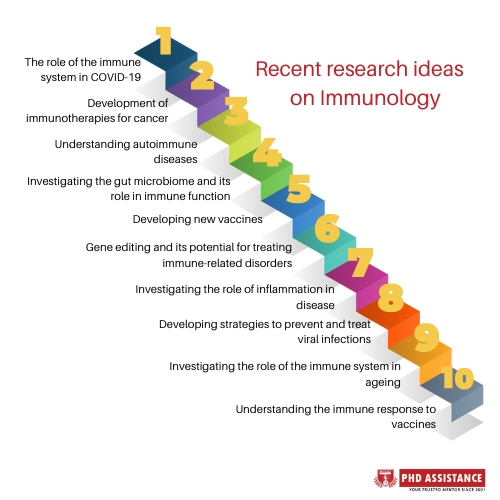
Theme 1: Tumour immunology and immunotherapy
Immune checkpoint inhibitors and engineered T-cell therapies have changed cancer treatment, but many patients do not respond, and the tumour microenvironment is one reason. Tumour metabolism is part of that environment: lactic acid produced by tumour cells can polarise tumour-associated macrophages towards a function that supports tumour growth (Colegio et al., 2014), and lactate-derived protein modification (lactylation) is now studied as a link between metabolism and immune evasion (Chen, J., et al., 2025). In pancreatic cancer, for example, histone lactylation has been reported to increase CXCL1 expression, neutrophil infiltration and immune escape (Zhang, P., et al., 2026).
| Topic | Possible research question | Likely design and data | Why it matters now |
|---|---|---|---|
| Lactate and macrophage function | Does blocking lactate export from tumour cells shift macrophages away from a tumour-supporting phenotype in co-culture? | Co-culture of tumour cells and macrophages; flow cytometry and gene expression; pharmacological or genetic inhibition | Links tumour metabolism to a cell type that shapes immunotherapy response |
| Neutrophils and immune escape | Does reducing CXCL1 signalling restore T-cell infiltration in a mouse model of pancreatic cancer? | Syngeneic mouse model; immunohistochemistry and flow cytometry; ARRIVE-compliant design | Pancreatic cancer responds poorly to current immunotherapy |
| Predicting checkpoint inhibitor response | Do circulating immune cell profiles before treatment predict response to checkpoint inhibitors in one cancer type? | Prospective or biobank cohort; flow cytometry or single-cell data; pre-registered prediction model | Response is hard to predict, and non-responders face toxicity without benefit |
| Reproducibility of a key finding | Does a published immunotherapy-enhancing effect replicate in an independent model and laboratory? | Pre-registered replication with power calculation and blinded assessment | Many preclinical cancer findings have failed to replicate |
The last row deserves serious consideration. When one company tried to confirm landmark preclinical cancer studies, most could not be reproduced (Begley & Ellis, 2012), and a well-designed replication can be a strong doctoral contribution.
Theme 2: The microbiome and immunity
The gut microbiome trains and regulates the immune system, and microbial communities differ between health and disease. Early work showed that the gut microbiome of obese mice had an increased capacity to harvest energy and that this trait could be transferred to germ-free mice (Turnbaugh et al., 2006). Yet a reanalysis of human datasets found that a simple taxonomic signature of obesity was not consistent across studies (Finucane et al., 2014). That tension, between striking experimental effects and inconsistent human associations, defines the best microbiome-immunity topics.
| Topic | Possible research question | Likely design and data | Why it matters now |
|---|---|---|---|
| Microbial metabolites and regulatory T cells | Do short-chain fatty acids produced by gut bacteria change the balance of regulatory and inflammatory T cells in a colitis model? | Mouse model with dietary or bacterial intervention; flow cytometry; metabolite measurement | Mechanisms are needed to move beyond association |
| Microbiome and vaccine response | Is baseline gut microbiome composition associated with antibody response to a routine vaccine in adults? | Prospective cohort; stool sequencing; antibody titres; adjustment for age and antibiotic use | Vaccine responses vary widely between individuals |
| Reproducibility of microbiome signatures | Do reported microbiome signatures of an autoimmune disease replicate across public datasets? | Secondary analysis of public sequencing data with harmonised processing | Inconsistent signatures have weakened earlier claims |
Theme 3: Immunosenescence and inflammaging
The immune system changes with age: responses to new infections and vaccines weaken, and low-grade chronic inflammation, often called inflammaging, is linked to cardiovascular disease, diabetes and neurodegeneration. Measuring biological age is now a research field of its own, from DNA methylation clocks (Horvath & Raj, 2018) to a broader effort to validate biomarkers of ageing for use in studies (Moqri et al., 2024). Immune measures are natural candidates for such work.
| Topic | Possible research question | Likely design and data | Why it matters now |
|---|---|---|---|
| Immune ageing and epigenetic age | Are T-cell subset proportions associated with epigenetic age acceleration in older adults, independent of chronological age? | Cross-sectional or cohort study; flow cytometry; DNA methylation data | Connects immune ageing to validated ageing biomarkers |
| Inflammaging and cardiometabolic risk | Do inflammatory markers add to standard risk scores in predicting cardiovascular events in older adults? | Secondary analysis of a cohort or biobank; survival models | Tests whether inflammation measures are clinically useful |
| Vaccine response in older adults | Which immune features before vaccination predict a weak antibody response to influenza vaccine in people over 65? | Prospective cohort; immunophenotyping; antibody titres | Could guide who needs enhanced vaccines |
Theme 4: Infection immunology and vaccines
Tuberculosis remains a major global health problem, and the choice of model system shapes what TB immunology can learn. Each model, from cell culture to animals, captures some features of human infection and misses others (Nangpal et al., 2025). Bioengineered models are one response: magnetic bioprinted granulomas have been used to study the immune response of cattle to Mycobacterium bovis (Krueger et al., 2025). Vaccine research also extends beyond the laboratory, for example to how limited vaccine supplies can be distributed efficiently and fairly (Enayati & Özaltın, 2020).
| Topic | Possible research question | Likely design and data | Why it matters now |
|---|---|---|---|
| 3D granuloma models | Does a 3D granuloma model reproduce the cytokine profile of human TB granulomas better than 2D macrophage culture? | In vitro comparison of 2D and 3D models; cytokine and gene expression assays; containment-level facilities | Better models could reduce reliance on animals |
| Durability of vaccine immunity | How quickly do antibody and memory T-cell responses wane after a respiratory virus vaccine, and do they differ by age? | Longitudinal cohort with repeated blood samples | Informs booster timing beyond the pandemic period |
| Equitable vaccine allocation | How do equity constraints change the optimal allocation of a limited influenza vaccine supply across regions? | Mathematical optimisation or simulation with public surveillance data | Combines immunology with operations research and policy |
Theme 5: Autoimmunity and gene editing
Autoimmune diseases arise when tolerance fails, and new therapies aim to reset the immune system rather than suppress it broadly. Gene editing underpins several of these approaches. CRISPR-Cas9 was first shown to be a programmable DNA-cutting enzyme in a study of bacterial adaptive immunity (Jinek et al., 2012), and it is now used to engineer immune cells and to model immune disorders in the laboratory.
| Topic | Possible research question | Likely design and data | Why it matters now |
|---|---|---|---|
| Gene-edited models of immune disorders | Does knocking out a candidate susceptibility gene in a human T-cell line alter activation and cytokine release? | CRISPR knockout in a cell line; activation assays; off-target checks | Moves genetic associations towards mechanism |
| Cell therapy for autoimmunity | What are the reported efficacy and safety outcomes of engineered T-cell therapies in autoimmune disease so far? | Systematic review of early clinical reports | Engineered T-cell therapies are being tested beyond cancer |
| Regulatory T-cell stability | Under what inflammatory conditions do regulatory T cells lose their suppressive function in vitro? | Primary human cell culture; flow cytometry; functional suppression assays | Regulatory T-cell therapies depend on stability |
How to test a topic before you commit
A useful screen is the FINER test: is the question feasible, interesting, novel, ethical and relevant (Hulley et al., 2013)? In immunology, feasibility usually turns on access to samples, animals and equipment. If your design uses animals, plan it against the ARRIVE 2.0 guidelines from the start, including sample size, randomisation and blinding (Percie du Sert et al., 2020). Decide what your experimental unit is: cells from one donor or one mouse are not independent replicates (Lazic et al., 2018).
Then write the question in one sentence that names the cell type or pathway, the model or population, the outcome and the comparison, and ask your supervisor whether a three- or four-year project can answer it with the resources available. If not, narrow the population, the outcome or the number of models.
Common mistakes
- Choosing a fashionable area such as immunotherapy without a specific cell type, pathway or outcome.
- Building a thesis on one unreplicated mouse finding.
- Treating cells or wells as independent samples, which inflates significance.
- Underestimating the time needed for ethics approval, biobank access or animal licences.
- Claiming causation from a cross-sectional microbiome or biomarker association.
Key takeaways
- Tumour metabolism, including lactate and lactylation, is an active route to understanding immune evasion (Colegio et al., 2014; Chen, J., et al., 2025).
- Microbiome topics are strongest when they test mechanisms or replication, because human signatures are often inconsistent (Finucane et al., 2014).
- Immunosenescence topics can draw on validated biomarkers of ageing (Moqri et al., 2024).
- Model choice shapes what infection immunology can learn (Nangpal et al., 2025).
- Plan replication, the experimental unit and ARRIVE reporting from the start (Begley & Ellis, 2012; Lazic et al., 2018; Percie du Sert et al., 2020).