

How to critically review academic papers in Biological & life sciences
January 7, 2025
Importance of peer reviewing in academic publishing
January 7, 2025Top 10 suggestions given by peer reviewer in the methodology section of the original manuscript
Introduction
The pursuit of scientific knowledge and the quest for excellence in research requires a critical evaluation of scholarly work. As researchers, we understand the significance of peer review in refining and strengthening our manuscripts. In this context, we present the top 10 invaluable suggestions our esteemed peer reviewer provided to enhance the methodology section of our original manuscript. These suggestions have been meticulously considered and thoughtfully incorporated, shaping our research into a more robust and comprehensive study, with gratitude for the valuable input received, which now embodies a deeper level of clarity, precision, and rigour in pursuing scientific excellence.
How do you suggest reviewers for a manuscript?
Selecting suitable reviewers for manuscript editing is a crucial step in publication. First, identify experts in the types of manuscript’s subject area who have published relevant work in reputable journals. Look for researchers with diverse perspectives to ensure a comprehensive review. Avoid potential conflicts of interest. Reach out to colleagues, mentors, and research databases to compile a list of potential reviewers. When suggesting reviewers, provide detailed justifications for each choice, highlighting their expertise and relevant contributions to the field. Aim for a balanced mix of senior and junior researchers. A thoughtful selection of reviewers will strengthen the manuscript and increase its chances of successful publication.
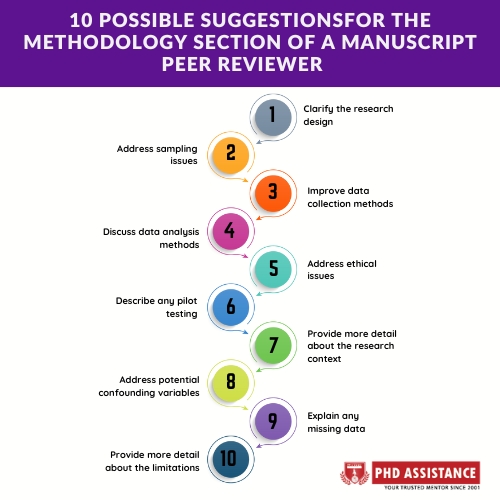
10 possible suggestions that a peer reviewer might give for the methodology section of a manuscript:
- Clarify the research design: The reviewer might suggest that the authors clarify the research design and explain how it fits the research questions and objectives.
- Address sampling issues: The reviewer might suggest that the authors provide more detail about the sampling method, the size and characteristics of the sample, and any potential biases or limitations.
- Improve data collection methods: The reviewer might suggest that the authors provide more detail about the data collection instruments, procedures, and protocols. They might also suggest ways to improve the reliability and validity of the data.
- Discuss data analysis methods: The reviewer might suggest that the authors provide more detail about the data analysis methods and the software or tools used to analyze the data. They might also suggest ways to improve the rigour and credibility of the analysis.
- Address ethical issues: The reviewer might suggest that the authors provide more detail about the ethical considerations of the research and how they were addressed. They might also suggest ways to conduct the research ethically and responsibly.
- Describe any pilot testing: The reviewer might suggest that the authors describe any pilot testing or pre-testing that was conducted to refine the research instruments or procedures.
- Provide more detail about the research context: The reviewer might suggest that the authors provide more detail about the research context, such as the setting, the population, and any relevant background information.
- Address potential confounding variables: The reviewer might suggest that the authors identify and address any potential confounding variables that could impact the study results.
- Explain any missing data: The reviewer might suggest that the authors explain any missing data and how it was handled in the analysis.
- Provide more detail about the limitations: The reviewer might suggest that the authors provide more detail about the limitations of the study, including any potential sources of bias or other factors that could impact the results or generalizability of the findings.
- Check out our sample PhD Manuscript examples to see how the PhD Manuscript is developed.
Improving the reliability of manuscript peer review:
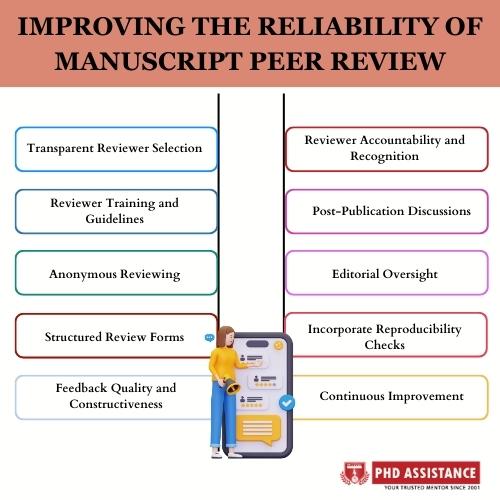
The peer review process is the backbone of scholarly publishing, ensuring the quality and credibility of research. However, concerns over the reliability of this process have been raised in recent years. To address these challenges and foster more robust and trustworthy reviews, we propose a comprehensive approach to improving the reliability of manuscript peer review. This manuscript in research outlines key strategies to enhance reviewer selection, feedback quality, and overall review consistency.
To improve reliability, rigorously select reviewers with expertise in the manuscript publishing subject matter. Implement an expert database and engage early-career researchers for fresh perspectives. A standard training program equips reviewers with best practices and ethical guidelines, promoting review consistency. A structured review template addresses key aspects of the manuscript example, and reviewers should provide clear rationales and actionable suggestions for improvement. A double-blind review process minimizes potential bias and enhances objectivity.
Furthermore, fostering an environment of open communication between authors and reviewers can enhance the peer review example process’s transparency. Encouraging post-publication discussions and offering opportunities for revision can strengthen the reliability and overall quality of published research.
- Check out our study guide to learn more about the Rules for Manuscript Submission and Publication
Conclusion
The peer reviewers have provided valuable insights and suggestions for improving the methodology section of the original manuscript. The top 10 recommendations aim to improve the research’s rigour and clarity, focusing on clear objectives, rationales, and theoretical frameworks. They also suggest addressing potential confounding variables, improving sampling techniques, and promoting transparency and reproducibility. The recommendations also enhance accessibility to readers by improving language, structure, and flow. Overall, the reviewers’ constructive feedback has significantly enriched the manuscript’s methodology in the article review example section, enabling researchers to refine and robust methodologies, contributing to advancing knowledge in their field.
About PhD Assistance
PhD Assistance offers end-to-end services for rewriting manuscripts, including statistics and programming, editing, proofreading, formatting, and submission. With years of experience, these experts aim to provide content with qualities like coherence, clarity, error-freeness, inconsistency, and repetition. There are three main copyediting processes: proofreading, copyediting, and precision editing. Their in-depth knowledge of the research subject, meticulous planning, organizing, presentation skills, and 100% client commitment have helped students complete their research projects ahead of deadlines.
References
- Kelly, Jacalyn, Tara Sadeghieh, and Khosrow Adeli. “Peer review in scientific publications: benefits, critiques, & a survival guide.” Ejifcc3 (2014): 227.
- Schmidt, Birgit, et al. “Ten considerations for open peer review.” F1000Research7 (2018). doi: 12688/f1000research.15334.1
- Cicchetti, Domenic V. “The reliability of peer review for manuscript and grant submissions: A cross-disciplinary investigation.” Behavioral and brain sciences1 (1991): 119-135. DOI
