

Big Data
- Concepts
- Computer Science And IT
- BlockChain
- Medical Informatics
- Multimedia Computing
- Digital Currencies – Bitcoin and cryptocurrencies
- Context-Aware Search System (CASS)
- Big Data
- Industrial Internet of things (IIoT)
- Assisted reality and virtual reality
- Deep learning - Artificial Intelligence and Machine Learning
- Cryptography
- Embedded System
- Databases and Data mining
- Computer Vision
- Wireless Body Area Network (WBAN)
- Computer Graphics and Visualization
- Operating Systems
- Data Privacy
- Programming Languages and Systems
- Scientific And Numerical computing
- Cyber-Security And AI
- Softwre Engineering
- Natural language Generation
- Producing Text From Computer Data
- AI Optimized Hardware
- Decision Management
- Deep Learning Platforms
- Pytorch
- Biometrics
- Robotic Process Automation
- Text Analytics And NLP
Big Data
Big Data is a term referring to large quantities of organized and unstructured data that are difficult to process using conventional computer and database techniques. Big Data is just to collect huge datasets with different formats. The volume of data or information is too high in most business cases, or it travels too quickly, or it exceeds the current capacity for storage (Kune, Konugurthi, Agarwal, Chillarige, & Buyya, 2016). Big Data has the potential to help businesses or firms improve their processes and make decisions faster and smarter.
Some examples of Big Data generation are stock exchanges such as The New York Stock Exchange (NYSE) generates about one terabyte of new trading data per day, Social Media statistics shows 500+terabytes of new data being ingested into the Facebook databases every day, and a single Jet engine can generate 10+terabytes of data in 30 minutes of flight time and so on.
Types of Big Data
The three types of Big Data are as shown below.
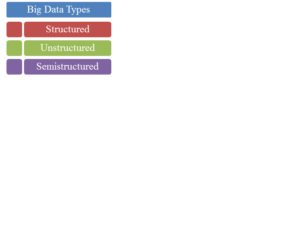 1. Structured: In structured data, the data is organised, processed, stored and retrieved in the fixed format. Example: employee details, KYC
2. Semi-Structured: In unstructured data, the data lacks in form and structure. Example: Email, Google search
3. Unstructured: In unstructured, the data is containing both the above formats and an unknown schema. Example: audio, video files
Characteristics of Big Data
The Big Data characteristics (Kapil, Agrawal, & Khan, 2016) are shown below:
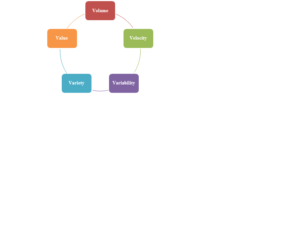 1. Volume – the name Big Data itself has to do with the enormous size, and therefore the term ‘volume’ is the size of the data that plays a crucial role in determining value from the data.
2. Velocity – the term ‘velocity’ refers to the speed in data generation. The velocity defines the actual data capacity by how quickly the produced and processed information meets the requirements.
3. Variability – the term ‘variability’ refers to the data inconsistency. And hence hampering the process of being able to effectively handle and manage the data.
4. Variety – the term ‘variety’ refers to different formats of data from various multiple sources. The data format is structured, unstructured and semi-structured.
5. Value – the term ‘value’ refers to useful data extraction.
The above characteristics represent the five V’s of Big Data. And as and when the data keeps evolving, the five more V’s have developed gradually over time (Sun, 2018).
1. Validity: data correctness
2. Variability: dynamic behaviour
3. Volatility: affinity to change in time
4. Vulnerability: vulnerable to breach or attacks
5. Visualization: visualizing significant usage of data
How Big Data Works
Big Data offers you new insights that open up new openings and business models. There are three key actions to get started (Muthulakshmi & Udhayapriya, 2016) :
1. Integrate – Big data incorporates information from a variety of sources and applications. The current methods of data integration, like ETL (extracting, transforming, and loading), are usually not up to the task. To analyse large data sets at terabytes, or even petabytes, level, it requires new techniques and technologies.
The data is processed and formatted in integration and then available in a form that can start with your business analysts.
2. Manage – Big Data requires storage in the cloud, on-premises, or both. Some people choose their storage solution based on the location of their data. The cloud is slowly gaining popularity as it supports the current requirements for computing and allows them to spin resources as needed.
3. Analyse – The investment in Big Data pays off when evaluating and acting on the data. Gain new insight by examining the diverse data sets visually. Explore the data further to make innovations.
Applications of Big Data
The remarkable change in the following industries where Big Data Applications are listed below (Hong et al., 2018):
IT: The IT industries are one of the largest users of Big Data to improve their functioning, enhance employee productivity, and risk management in business operations.
Healthcare: Big Data has already in full swing in creating a huge difference in the healthcare sector. With the help of predictive analytics, each patient is provided with personalized healthcare services.
Entertainment: Netflix and Amazon use Big Data to create shows and movie options to their users.
Banking: The banking sector bank on Big Data for fraud detection such as misuse of credit/debit cards, faulty change in the customer database, etc.
Education: Big Data is also helping to enhance education. Education is no more limited to the classroom; there are many online educational courses to learn and digital courses to budding learners.
Government: Big Data has proven its importance in the government sector. It plays a major role in politics to analyse patterns and influence election results.
Some interesting statistics results of Big Data (Davenport & Bean, 2019):
The Big Data analytics market is set to reach $103 billion by 2023.
By 2020, every person will generate 1.7 megabytes in just a second.
Internet users generate about 2.5 quintillion bytes of data each day.
97.2% of organizations are investing in Big Data and AI.
Netflix saves $1 billion per year on customer retention using Big Data.
By 2020, there will be around 40 trillion gigabytes of data (40 zettabytes).
Social media accounts for 33% of the total time spent online.
Twitter users send nearly half a million tweets every minute.
cation.
References:
Davenport, T. H., & Bean, R. (2019). Big Data and AI Executive Survey 2019: Executive Summary of Findings.Retrieved from https://newvantage.com/wpcontent/uploads/2018/12/Big-Data-Executive-Survey-2019-Findings-Updated-010219-1.pdf
Hong, L., Luo, M., Wang, R., Lu, P., Lu, W., & Lu, L. (2018). Big Data in Health Care: Applications and Challenges. Data and Information Management, 2(3), 175–197. https://doi.org/10.2478/dim-2018-0014
Kapil, G., Agrawal, A., & Khan, R. A. (2016). A study of big data characteristics. 2016 International Conference on Communication and Electronics Systems (ICCES), 1–4. https://doi.org/10.1109/CESYS.2016.7889917
Sun, Z. (2018). 10 Bigs : Big Data and Its Ten Big Characteristics. Managerial Perspectives on Intelligent Big Data Analytics, (January). https://doi.org/10.13140/RG.2.2.31449.62566
Muthulakshmi, P., & Udhayapriya, S. (2016). a Survey on Big Data Issues and Challenges. International Journal of Computer Sciences and Engineering, 7(2), 511–518. https://doi.org/10.26438/ijcse/v6i6.12381244