

A user-focused Artificial Intelligence (AI) Transdisciplinary Study Strategy-Supported Health Technology Management
May 6, 2020
Critical Analysis of Research Design and data Collection
June 10, 2020Selection of articles using data analytics for behavioral dissertation research
In brief
- Data analytics has been considered widely as a breakthrough in Research and Technological development in various fields.
- Despite the data analytics being launched by an increasing number of industries, there is still limited knowledge of how these fields interpret the power of such technologies into industry value.
- This blog shows that to realize the performance gains and to leverage data analytics, researchers must develop capabilities of data analytics. Most studies work under the concept that there is limited heterogeneity in the way industries develop their capabilities in data analytics and regardless of the framework, the related resources are of similar importance.
- The main idea that data analytics develops is by examining huge volumes of unstructured data from many resources, and that actionable insight can be created that industries can use to transform their business and gain an edge over their competition (Mikalef et al., 2019).
Introduction
Outcomes in health-related issues including psychological, educational, Behavioral, environmental, and social are intended to sustain positive change by digital interferences. These changes may be delivered using any digital device like a phone or computer, and make them gainful for the provider. Complex and large-scale datasets that contain usage data can be yielded by testing a digital intervention. This data provides invaluable detail about how the users interact with these interventions and notify their knowledge of engagement, if they are analyzed properly. This paper recommends an innovative framework for the process of analyzing usage associated with a digital intervention by the following methods: (1) drawing potential measures of usage together with identifying which are significant for the intervention, (2) generating specific research questions that act as a testable hypothesis, and (3) sustaining preparation of data and selecting data analysis methods (Miller et al., 2019).
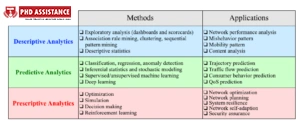
Fig 1 Data Analytics Methods
Data Analytics methods can be categorized into the following types as depicted in the figure.
- Descriptive Methods: Descriptive analytics method is used mainly to utilize existing data sets to unveil the properties of data.
- Predictive Analytics: Historical data is mainly utilized predictive analytics method to anticipate the development of data i.e., future developments in data.
- Prescriptive Analytics: The result of both descriptive and predictive analytics methods is used in this method to make the right decisions to get desired outcomes i.e., ways to achieve the desired goal (Dai et al., 2019).
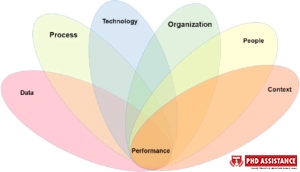
Fig 2 Research framework
The challenge of deriving business values from data analytics that has recognized by conceptual and empirical researches is not solely a technical one, but also an organizational one. Organizations face five main challenges in becoming data-driven that revolve around data, processes, technology, organization, and people. The capabilities of data analytics are responsible for the conversion of data that is collected by the organizations into business value by influencing it into an actionable approach. This is the main basis behind this point of view. This importance of factors that relate to the processes, technology, people, data, and organization are highlighted in this framework (Mikalef et al., 2019).
Development of the framework
The framework has three stages:
- Familiarization with datasets,
- Selecting significant measures of usage and generation of research questions, and
- Preparation for analysis.
Each stage is presented in a checklist format, which is prompted by generic questions for the Researcher to consider from the perspective of their own specific involvement. Depending upon whether the framework is applied after data collection or applied in advance, the use of the three stages will be iterative. The examination of the relationships between measures of usage and user data, behavior, theoretical variables, and health-related outcomes are mainly focused on this framework.
Stage 1: Familiarization with Data—Identification of Variables:
Large datasets that contain information in different formats are created by the evaluation of the digital intervention. Before the analysis of the usage of data has been conducted, it is mandatory to collect all relevant data across the datasets and figure out new variables. This Framework comprises a set of generic questions that will provide a comprehensive understanding of the process, structure, and also content of the intervention related to data capture and contents of the datasheets. This makes the process even simpler. This framework can be used in advance during the development to identify the important data that is crucial in software development or else alternative research works.
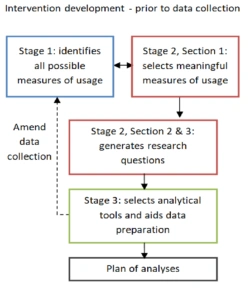
Fig 3 Intervention development-prior to data collection
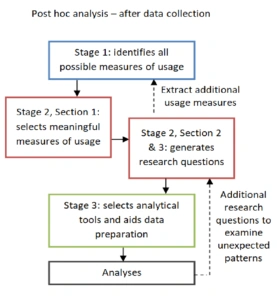
Fig 3 Post hoc analysis- after data collection
Stage 2: Selecting Usage Measures and Generating Research Questions for Engagement:
The aim of this stage is to sustain the generation of a specific set of research questions to handle the testing hypothesis. To reveal the increasing complexity of comprehensive usage analysis, this stage has been divided into three sections: the first section helps to define specific measures of usage i.e., descriptive statistics, while second and third sections facilitate the generation of research questions i.e., bivariate and multivariate analysis.
Stage 3: Preparation for Analysis:
The process of the selection of appropriate types of analysis is done in the third and final stage. This stage also facilitates the identification of analytical software, as well as the preparation of data that is significant in the translation of the research questions into an analysis plan. Researchers follow generic questions as a guide to consider broad issues, such as available resources like timeframe, the analysis plan for efficacy, and additional researcher support. They also consider more specific issues of selecting a suitable type of analysis and analytical software, and management of data like manipulation, amalgamation, and data cleaning (Miller et al., 2019).
Future research
Data analytics will evidently help projects in the process of value creation. Data analytics processes will help to maximize the efficiency of operation, reduce the cost of software development, ensure massively personalized production, and restructure the management of the supply chain. Emerging technologies like blockchain and fog computing play a major role in Data Analytics for the Internet of Things. New standards for interoperability among the data analytics platform must be devised by conducting future research and also to provide the capability for the end-to-end reliable application process (ur Rehman et al., 2019).
Conclusion
The latest techniques in Artificial Intelligence (AI) have gained attention to a greater extent in many applications because of their ability to mine information. The most powerful tool in AI is considered to be data mining for the collection of a large set of data. Data mining also helps to translate these data into useful information. Knowledge discovery and data mining are used in many fields of biological data analysis, telecommunication, and financial data, etc., Pre-processing steps like integration, conversion, sorting, reduction, and knowledge presentation are involved in data mining (El-Hasnony et al., 2020).
References
- Dai, H.-N., Wong, R. C.-W., Wang, H., Zheng, Z., & Vasilakos, A. V. Big data analytics for large-scale wireless networks: Challenges and opportunities. ACM Computing Surveys (CSUR), 52 5, (2019), pp. 1–36. https://dl.acm.org/doi/abs/10.1145/3337065
- El-Hasnony, I. M., Barakat, S. I., Elhoseny, M., & Mostafa, R. R. Improved Feature Selection Model for Big Data Analytics. IEEE Access, 8, (2020), pp. 66989–67004. https://ieeexplore.ieee.org/abstract/document/9058715/
- Mikalef, P., Boura, M., Lekakos, G., & Krogstie, J. Big data analytics and firm performance: Findings from a mixed-method approach. Journal of Business Research, 98, (2019), pp. 261–276. https://www.sciencedirect.com/science/article/pii/S014829631930061X
- Miller, S., Ainsworth, B., Yardley, L., Milton, A., Weal, M., Smith, P., & Morrison, L. A framework for Analyzing and Measuring Usage and Engagement Data (AMUsED) in digital interventions. Journal of Medical Internet Research, 21 2, (2019), pp. e10966. https://www.jmir.org/2019/2/e10966
- ur Rehman, M. H., Yaqoob, I., Salah, K., Imran, M., Jayaraman, P. P., & Perera, C. The role of big data analytics in industrial Internet of Things. Future Generation Computer Systems, 99, (2019), pp. 247–259. https://www.sciencedirect.com/science/article/pii/S0167739X18313645
